
SUMMARY
- 70% of enterprise AI use cases are adequately served by off-the-shelf AI solutions — most organisations should default to buy-first and build only when a clear gap exists (McKinsey, 2025)
- 85% of enterprise AI budgets in 2025–26 went to AI platform selection and integration rather than ground-up model training — the market has already voted on where complexity lives (McKinsey, 2025)
- Companies that piloted a buy-first approach before committing to custom AI development reported 3.2× higher ROI than those who built first (Forrester, 2026)
- A small-to-mid-sized in-house agentic AI team costs $500,000–$1.5 million annually — most organisations significantly underestimate this figure in their initial business cases
- Custom agents deliver better long-term ROI but require 12–24 months to reach payback — bought platforms deliver faster initial ROI but carry vendor lock-in and customisation ceilings
- The correct answer for most enterprises in 2026 is hybrid: buy commodity workflows (80%), build strategic differentiators (20%)
- The build vs buy question is not asked once — it is asked per workflow, per use case, and revisited as your AI programme matures
According to Gartner, over 40% of agentic AI projects will be cancelled by the end of 2027 — not paused, not pivoted, cancelled. The top reasons are escalating costs, unclear business value, and governance gaps. Companies that rushed to build custom AI before validating use cases wasted an average of 14 months and $780,000 in sunk costs (Gartner, 2025).
At the same time, 42% of companies scrapped the majority of their AI initiatives in 2025, up sharply from 17% the year prior (S&P Global, 2025). That is not a technology failure rate. That is a strategy failure rate.
Global AI spending hit $301 billion in 2026. The AI agent market alone is valued at $10.9 billion and projected to reach $50 billion by 2030. The money is moving. The question most leadership teams get wrong is not whether to invest in agentic AI — it is how to structure that investment without burning capital on the wrong approach.
The build vs buy decision for agentic AI is the most expensive question in enterprise technology in 2026. This guide gives you the real cost data, honest trade-offs, and a structured decision framework to answer it correctly for your specific situation.
What We Mean by Agentic AI
Before comparing build vs buy costs, it helps to be clear about what agentic AI actually is — because “AI agent” covers a wide range of systems with very different engineering requirements and cost profiles.
An AI agent is a system that perceives inputs, reasons about what to do, executes actions using tools, and loops through this cycle until a goal is reached — with minimal or no human involvement at each step.
The spectrum of agentic AI complexity:
| Agent Type | What It Does | Complexity | Build Cost Range |
|---|---|---|---|
| Simple task agent | Single-purpose: route a support ticket, extract data from a document, classify an email | Low | $15,000–$50,000 |
| Workflow automation agent | Multi-step: collect information, process it, update a system, notify a person | Medium | $50,000–$150,000 |
| Multi-system integration agent | Connects CRM, ERP, email, and databases; executes across all of them | High | $150,000–$400,000 |
| Multi-agent system | Multiple specialised agents coordinating to complete complex enterprise workflows | Very high | $250,000–$600,000+ |
The build vs buy calculus differs significantly across these tiers. A simple task agent is often better bought. A strategic multi-agent system coordinating proprietary workflows is often better built. The mistake is applying one answer to all of them.
The Real Costs of Building Agentic AI
Most build-vs-buy internal business cases significantly underestimate what building actually costs. Here is the honest breakdown.
Year 1 Build Costs
| Cost Category | Typical Range | Notes |
|---|---|---|
| AI engineering talent | $120,000–$300,000+ per senior engineer | Senior AI engineers in competitive markets earn $200,000–$300,000+ in the US/UK; $60,000–$120,000 in South Asia and Eastern Europe |
| Product and project management | $80,000–$150,000 | Required to translate business requirements into engineering scope; often underestimated |
| Infrastructure (compute, APIs, storage) | $24,000–$200,000/year | Inference costs, vector database, cloud compute; scales with usage volume |
| Data preparation | 10–20% of total build cost | Data preparation alone can consume 60–80% of a project’s time before a model is trained (S&P Global, 2025) |
| Orchestration and tooling | $15,000–$50,000 | LangChain, LangGraph, CrewAI, AutoGen, or custom orchestration layer |
| Evaluation and monitoring | $10,000–$30,000 | Required before production; often added as an afterthought, which is why it costs more when fixed later |
| Security and compliance architecture | $20,000–$80,000 | Higher for regulated industries (healthcare, finance, government) |
Total Year 1 cost for a production-grade custom agentic AI system:
- Simple agent: $80,000–$200,000
- Full multi-agent system: $400,000–$1,000,000+
Annual recurring costs (Year 2+):
- Team maintenance: $300,000–$800,000/year (salaries, benefits, training)
- Infrastructure: $24,000–$150,000/year (scales with usage)
- Iteration and improvement: 20–30% of initial build cost per year
A small-to-mid-sized in-house agentic AI team — two to five engineers, a product manager, and infrastructure — realistically costs $500,000–$1.5 million annually once all costs are factored in. Most internal business cases present only the engineering salaries and miss the infrastructure, data, compliance, and management overhead.
Practitioner Insight: The hidden cost that surprises most organisations is talent attrition. Senior AI engineers are among the highest-demand professionals in the labour market. When a key AI engineer leaves — and turnover rates in this category are high — the replacement costs (recruiting, onboarding, ramp time) plus the institutional knowledge lost can cost $200,000–$400,000 per departure, before the replacement is productive. Build strategies that depend on one or two key engineers are particularly exposed to this risk.
The Real Costs of Buying Agentic AI
Buying an off-the-shelf agentic AI platform is not as simple as it appears on the vendor’s pricing page. Enterprise platform costs follow a predictable pattern: the licence fee is the number in the slide; the real costs show up later.
Licence and Subscription Costs (2026)
| Tier | Annual Cost | What’s Included |
|---|---|---|
| SMB / starter | $5,000–$25,000/year | Limited agents, capped workflows, basic integrations |
| Growth / mid-market | $25,000–$100,000/year | Expanded agents and workflows, standard integrations, basic analytics |
| Enterprise | $100,000–$500,000+/year | Custom integrations, dedicated support, SLA guarantees, advanced governance |
Hidden Costs of Buying
| Cost Category | Typical Range | Notes |
|---|---|---|
| Implementation and integration | $20,000–$100,000 | Connecting the platform to your CRM, ERP, databases, and existing workflows |
| Customisation development | $15,000–$60,000 | Any workflow that deviates from the platform’s standard configuration |
| User training | $5,000–$20,000 | Time cost of getting your team productive on the platform |
| Migration risk | $50,000–$200,000 | If you need to switch platforms later — re-integrations, data migration, retraining |
| Usage overages | Variable | Many platforms charge per agent run, per API call, or per data processed — volume that exceeds plan limits triggers steep overage charges |
True Year 1 cost of an enterprise AI agent platform: $120,000–$600,000+ once implementation, integration, customisation, and training are included.
Practitioner Insight: Vendor lock-in is the risk most organisations underweight at purchase and overweight at migration time. The deeper you integrate a bought platform into your workflows, the more expensive it becomes to replace. Custom integrations, proprietary data schemas, and trained user habits all create switching costs that are invisible on the original comparison spreadsheet. Before signing an enterprise AI platform contract, model the migration cost explicitly — what would it cost in year three to switch to a competitor? If that number is not acceptable, it should factor into the current purchase decision.
The Real ROI of Each Approach
| Metric | Build (Custom) | Buy (Platform) |
|---|---|---|
| Time to first productive use | 3–9 months | 2–8 weeks |
| Time to payback | 12–24 months | 4–12 months |
| Long-term ROI (3-year) | Higher — own the IP; no per-use fees at scale | Lower — vendor margin on every interaction; price exposure at scale |
| Ceiling on customisation | None — you control the architecture | Platform-defined — customise within what the vendor allows |
| Capability to use proprietary data | Full — data stays in your infrastructure | Limited — depends on vendor’s data handling and privacy architecture |
| Ability to pivot | Slower — code changes take time | Faster — configuration changes are quicker than code changes |
| Competitive differentiation | High — unique to your organisation | Low — competitors can buy the same platform |
Companies that build custom AI agents see slower initial ROI — typically 12–24 months — but achieve better long-term returns because they own the infrastructure and can scale without increasing vendor costs. Companies that buy off-the-shelf AI agents see faster initial ROI but hit a customisation ceiling that limits their ability to differentiate over time.
The 3.2× higher ROI figure for buy-first approaches (Forrester, 2026) reflects the first 12 months, not the three-year picture. Both statements are true: buying is a better short-term financial decision; building is often a better long-term strategic decision for differentiated workflows.
Architecture Diagram: Build vs Buy Decision Framework
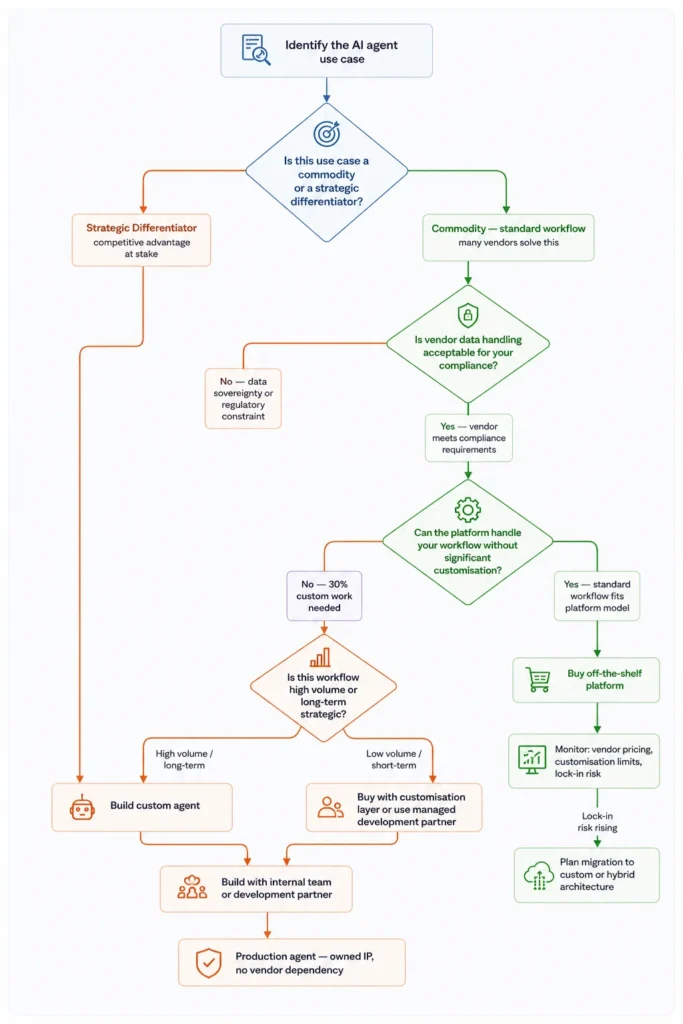
Figure 1: Build vs buy decision flowchart for agentic AI — routes each use case through commodity vs strategic, compliance, customisation fit, and volume checks to the correct architectural recommendation.
When to Build Custom Agentic AI
Build when the workflow is a strategic differentiator
If the AI agent is automating a process that is core to your competitive advantage — your unique underwriting methodology, your proprietary customer scoring model, your differentiated service delivery process — buying a platform means a competitor can buy the same capability. Owning the agent means owning the capability.
Build when you have proprietary data that creates advantage
If your AI advantage depends on training or fine-tuning on data that is genuinely proprietary — your historical customer interactions, your internal knowledge base, your operational data — that data needs to stay inside infrastructure you control. Most SaaS platforms cannot provide the data isolation guarantees that truly proprietary AI requires.
Build when your compliance requirements are non-negotiable
Regulated industries — healthcare, financial services, government, legal — often have data residency, audit trail, and explainability requirements that most commercial AI platforms cannot satisfy. When every AI interaction must be auditable, and the audit trail must be owned by the organisation rather than the vendor, building is the only architecture that reliably satisfies the requirement.
Build when long-term volume makes vendor economics unsustainable
AI agent platform pricing is typically usage-based — per agent run, per API call, per data processed. At low volume, this is fine. At high volume, the per-unit costs compound into numbers that exceed the cost of building and running the equivalent infrastructure. Calculate the crossover point before committing.
Build when your workflows are genuinely unique
The most honest signal that you should build rather than buy is when you spend more than 30% of your platform implementation time working around the platform’s limitations. If you are constantly finding that the platform’s standard workflow model does not map to how your business actually operates, that gap will only widen as your requirements grow.
When to Buy Off-the-Shelf Agentic AI
Buy when speed to value is the priority
A bought platform can be operational in two to eight weeks. A built custom agent takes three to nine months from requirements to production. If the business need is urgent — a competitive threat, a customer experience problem that is costing revenue now, a compliance deadline — buying is almost always faster.
Buy when the use case is commodity
Customer support ticket triage, appointment booking, standard FAQ handling, expense report processing — these are workflows that hundreds of companies have solved with the same platform. There is no competitive advantage in being the company that built a proprietary appointment booking agent. Buying the solved solution is the rational decision.
Buy when your team lacks AI engineering capability
Building a production-grade agentic AI system requires ML engineers, AI architects, DevOps expertise, and product management experience with AI systems. If you do not have this team, building is not the right strategy — the time and cost of building the team while also building the system is prohibitive for most organisations.
Buy when you need to validate before committing
70% of enterprise AI use cases are adequately served by off-the-shelf solutions (McKinsey, 2025). Before committing to a custom build, validate that your use case genuinely requires it. A bought platform that proves the concept — even imperfectly — is more valuable than a theoretical internal build that never reaches users.
Buy when vendor tooling is meaningfully ahead of what you could build
In some domains — advanced multimodal processing, enterprise security compliance at scale, complex multi-language NLP — commercial vendors have invested years and hundreds of millions building capabilities that no internal team could replicate cost-effectively. If the vendor’s tool is genuinely ahead of what you could build, buying is rational.
The Hybrid Pattern: What Most Enterprises Actually Do
The binary build vs buy question is a false choice. In 2026, the most successful enterprise agentic AI programmes run a hybrid architecture: buy commodity capabilities from platforms; build proprietary capabilities for differentiated workflows.
The 80/20 hybrid pattern:
- 80% of agent workflows → buy from platforms (customer support, scheduling, standard document processing, FAQ handling, expense management)
- 20% of agent workflows → build custom (proprietary risk models, competitive intelligence workflows, specialised technical processes, regulated decision-making)
This pattern achieves faster initial deployment (buying the 80%), lower risk on unvalidated use cases (platforms absorb the uncertainty), and competitive differentiation on what actually matters (custom agents for the 20% that is strategically important).
The validate-then-build pattern:
Start with a bought platform on every new use case. Run it for three to six months. If the use case proves valuable and the platform’s limitations become a ceiling — customisation gaps, data handling constraints, pricing at scale — that is the validated trigger to build. Gartner’s finding that 14 months and $780,000 were wasted on average by companies that built without prior validation (2025) is the cost of skipping this step.
Scoring Rubric: Build vs Buy Decision Tool
Score each dimension from 1 to 5. Total score determines recommendation.
| Dimension | Score 1–2 (Points to Buy) | Score 4–5 (Points to Build) | Your Score |
|---|---|---|---|
| Strategic differentiation | Commodity workflow, widely solved | Core competitive advantage | /5 |
| Proprietary data dependency | Standard data, vendor can handle | Sensitive proprietary data, needs full control | /5 |
| Compliance requirements | Standard — vendor meets requirements | Regulated — audit trail, data residency, explainability required | /5 |
| Customisation need | <20% customisation from standard | >40% customisation required | /5 |
| Volume / long-term economics | Low volume — platform pricing works | High volume — per-unit platform costs unsustainable | /5 |
| Engineering capability | No internal AI team | Strong AI engineering team in place | /5 |
| Speed to value | Urgent — need results in weeks | Timeline allows 3–9 months | /5 |
Score interpretation:
- 7–17: Buy — a platform is the correct starting point; do not build before validating
- 18–24: Hybrid — buy commodity elements; build the differentiated core
- 25–35: Build — custom development is justified by the combination of factors; engage an experienced AI development partner
The Talent Question That Determines Everything
Both build and buy decisions ultimately resolve to a talent question that most organisations answer incorrectly.
The build path requires: A senior ML/AI engineer who can design agent architecture, select frameworks, implement production deployment, build evaluation pipelines, and maintain the system as it evolves. In US/UK markets, this profile earns $200,000–$300,000+ annually plus benefits. In competitive markets, this engineer is also receiving multiple competing offers.
Most organisations underestimate this requirement in two directions. They either budget for a junior developer who cannot produce production-grade agentic AI, or they hire a senior engineer and then do not have the supporting infrastructure (product management, DevOps, data engineering) for that engineer to be effective.
The buy path requires: A technical project manager and an integration engineer who can connect the platform to existing systems, configure workflows, evaluate vendor quality, and manage the vendor relationship. These profiles are easier to find, less expensive, and more replaceable — which is precisely why the buy path has a lower talent risk than it is typically given credit for.
The most honest signal that your organisation should buy rather than build is the absence of a production-grade AI engineering team. Building is not the path to developing that team — it is the right choice once you have that team.
Practitioner Insight: The most common pattern in enterprise AI in 2026 is organisations that decide to build, hire an AI engineer, discover that one engineer cannot build a production agentic system while also managing infrastructure, integration, evaluation, and iteration simultaneously, and then engage an external AI development partner to do the work the engineer cannot do alone. The external partner does the build. The internal engineer learns on the job and eventually takes ownership. This pattern is more expensive in year one than initially planned, but it works — and it is how most organisations that successfully build custom AI actually do it. If this is the plan, name it as the plan from the start.
Use Case Examples: Build vs Buy in Practice
| Use Case | Build or Buy | Why |
|---|---|---|
| Customer support ticket triage | Buy | Commodity workflow; solved by Intercom, Zendesk AI, Freshdesk — no competitive advantage in building |
| Proprietary credit underwriting agent | Build | Proprietary scoring methodology; regulated output; data sovereignty required |
| Employee HR helpdesk | Buy | Standard FAQ handling; ServiceNow, Moveworks, and equivalents solve this well |
| Agentic financial analysis over internal documents | Build | Proprietary data; competitive intelligence; compliance audit trail required |
| Appointment scheduling chatbot | Buy | No differentiation in the scheduling mechanism |
| Multi-agent AML compliance workflow | Build | Regulatory requirement for full explainability and audit trail; workflow is organisation-specific |
| Sales lead qualification | Buy or Hybrid | Commodity AI vendors solve 70% of this; build a custom scoring layer on top if your qualification criteria are proprietary |
| Internal code review and documentation agent | Buy | GitHub Copilot, Codeium, and equivalents; no advantage in rebuilding |
| Complex legal document review and extraction | Build | Jurisdiction-specific; regulatory; organisation-specific document formats |
How Khired Networks Helps Enterprises Navigate the Build vs Buy Decision
The build vs buy decision is not a one-time choice. It is a workflow-by-workflow evaluation that requires honest assessment of your use cases, your team, your compliance requirements, and your long-term competitive strategy.
Khired Networks works with enterprises at both points of this decision.
When you should build: We design and deliver custom agentic AI systems — from single-purpose task agents to multi-agent orchestration platforms — for organisations where proprietary workflows, data sovereignty, and competitive differentiation make building the correct answer.
When you should buy: We advise honestly. If your use case is adequately served by an off-the-shelf platform, we say so and help you evaluate and implement the right vendor solution rather than unnecessarily building.
When hybrid is the answer: We architect the hybrid — bought platforms for commodity workflows, custom-built agents for strategic differentiators — and manage the integration layer between them.
Contact Khired Networks to discuss your agentic AI strategy
Frequently Asked Questions
What does it actually cost to build an AI agent in 2026?
A simple, single-purpose custom AI agent built by an experienced team costs $15,000–$80,000. A full production-grade multi-agent system with integrations, evaluation, monitoring, and compliance architecture costs $250,000–$600,000 or more. Annual maintenance — team, infrastructure, iteration — adds $100,000–$500,000 per year depending on scale. A small in-house agentic AI team costs $500,000–$1.5 million annually when all costs including infrastructure and overhead are included.
Is it better to build or buy AI for enterprise use?
70% of enterprise AI use cases are adequately served by off-the-shelf solutions, and companies that piloted a buy-first approach before committing to custom development reported 3.2× higher ROI in the first 12 months (Forrester, 2026). The answer depends on your specific use case. Commodity workflows, urgent timelines, and limited engineering capability point to buying. Strategic differentiation, proprietary data, regulated outputs, and high volume point to building. Most enterprises run both simultaneously.
What are the main risks of buying an off-the-shelf AI agent platform?
Vendor lock-in is the most significant long-term risk — migrating from a deeply integrated platform later is expensive and disruptive, with re-integrations and data migration easily running into six-figure costs. Customisation ceilings are the most common near-term frustration — workflows that need more than 30% customisation from the platform’s standard model frequently end up costing more to configure than to build. Usage-based pricing at scale can also make bought platforms more expensive than custom infrastructure for high-volume deployments.
What is the hybrid approach to agentic AI?
The hybrid pattern, buy commodity workflows, build strategic differentiators — is the most common pattern among enterprises that have succeeded with agentic AI in 2026. Roughly 80% of agent workflows are adequately served by commercial platforms; 20% of workflows that represent genuine competitive differentiation are built custom. This delivers faster initial deployment (bought platforms), lower risk on unproven use cases (platforms absorb uncertainty), and competitive differentiation on what actually matters (custom agents).
How long does it take to see ROI from custom AI agent development?
Custom-built AI agents typically take 12–24 months to reach payback on the initial build investment. Bought platforms typically reach payback in 4–12 months. The long-term ROI picture reverses — custom agents deliver higher returns over a three-year horizon because the organisation owns the IP and avoids compounding vendor costs at scale. The correct comparison is not year-one ROI but total-cost-of-ownership over the intended operational life of the system.


0 Comments
Trackbacks/Pingbacks