
SUMMARY
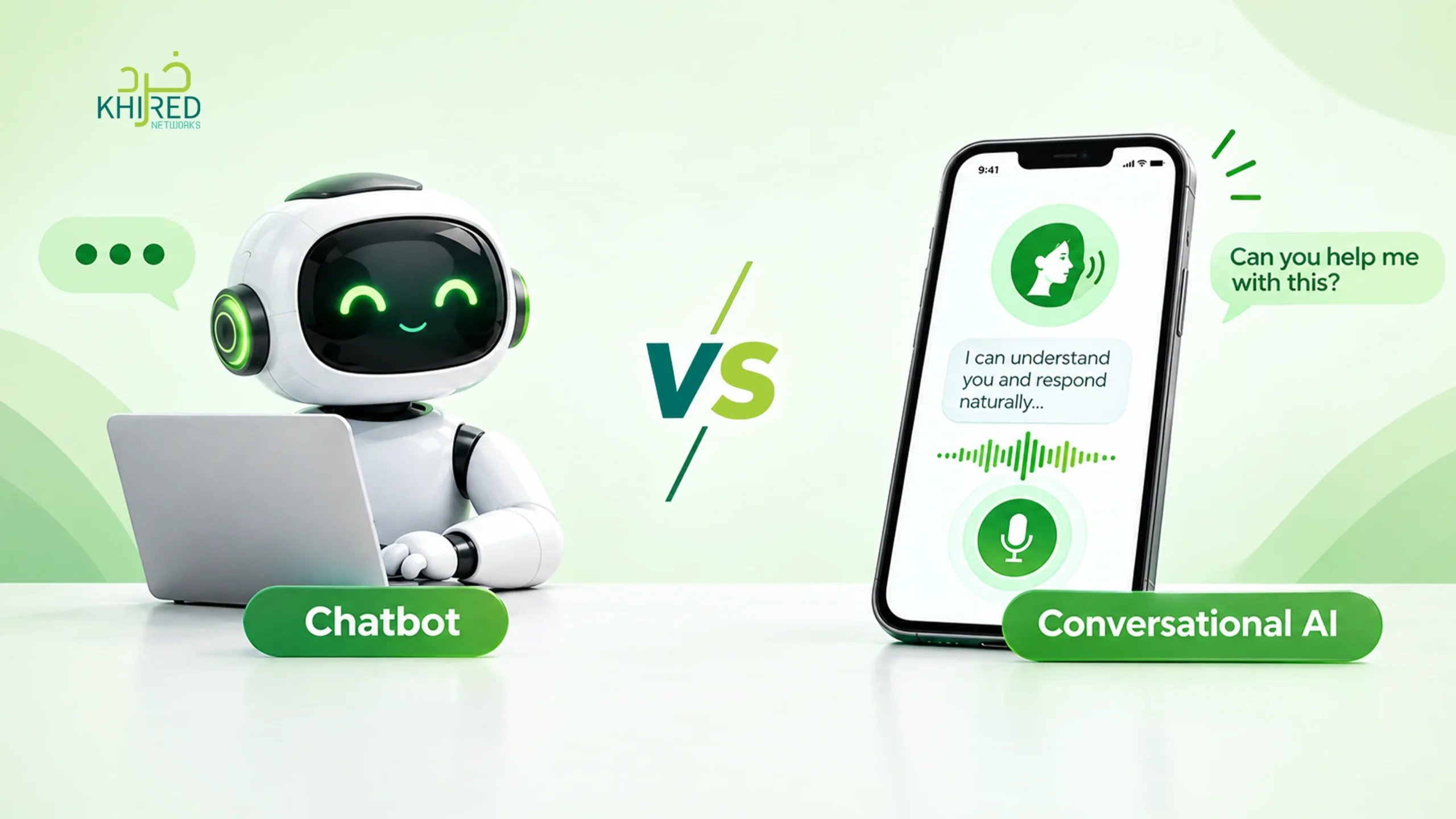
- An AI chatbot follows scripted rules, while conversational AI understands meaning and intent.
- Conversational AI is the underlying technology, and a modern chatbot is one way to deliver it.
- Rule-based chatbots cost roughly 1,000 to 10,000 dollars, while conversational AI runs far higher.
- The global conversational AI market reached 17.7 billion dollars in 2026 (Grand View Research).
- AI agents are the next step, since they take actions rather than only answering questions.
- The right choice depends on query complexity, volume, integration needs, and data sensitivity.
The terms are used as if they mean the same thing. They do not. According to Grand View Research (2026), the global conversational AI market reached 17.7 billion dollars this year, up from 14.3 billion in 2025. Many buyers spending into that market cannot explain what separates a chatbot from conversational AI.
That confusion is expensive. A rule-based chatbot and a conversational AI system solve different problems, cost different amounts, and fail in different ways. Choosing the wrong one wastes budget and frustrates customers.
An AI chatbot is software that answers using preset rules or scripted paths. Conversational AI is a broader technology that understands intent, holds context, and learns from each interaction. This guide explains the real difference and how to choose.
What Is an AI Chatbot?
An AI chatbot is a program that simulates conversation using predefined rules. It matches keywords to scripted answers and follows decision-tree logic. It does not understand meaning.
Most traditional chatbots work on if-then paths. If the user types a known keyword, the bot returns a set reply. If the input falls outside the script, the bot fails or hands off to a human.
This design has clear strengths. Rule-based chatbots are cheap, fast to deploy, and fully predictable. You always know what the bot will say, which matters for compliance-sensitive replies.
The weakness is rigidity. A rule-based bot cannot handle a question it was not scripted for. It also cannot remember what the user said two messages ago. Each turn is treated in isolation.
What Is Conversational AI?
Conversational AI is a set of technologies that let machines understand and respond to human language naturally. It combines natural language processing, machine learning, and often large language models, the same foundation behind how our conversational AI and voice agents work.
The core difference is comprehension. Conversational AI does not just match keywords. It interprets intent, the actual goal behind the words, even when phrasing is unexpected.
It also holds context. The system remembers earlier turns in a conversation and uses them to shape later answers. This makes the exchange feel continuous rather than disconnected.
Finally, it learns. Conversational AI systems improve from interaction data over time. Fin, a customer service AI, reports accuracy gains of roughly one percent every month across its base (Fin AI, 2026).
Here is the point that confuses most buyers. Conversational AI is the technology. A chatbot is a delivery format. A chatbot can be rule-based or powered by conversational AI underneath, a distinction we unpack further in conversational AI versus generative AI.
How Do the Two Technologies Work?
The internal mechanics are where the two diverge most sharply. The table below contrasts them across the dimensions that matter for a buying decision.
| Dimension | Rule-Based AI Chatbot | Conversational AI |
|---|---|---|
| Core logic | If-then decision trees | Intent recognition and context |
| Language handling | Keyword matching only | Natural language processing and understanding |
| Learning | None, manual updates required | Continuous learning from data |
| Context memory | None, each turn isolated | Retains conversation history |
| Response style | Fixed scripted replies | Dynamic, adapted to the user |
| Failure mode | Breaks on unscripted input | Degrades gracefully, asks to clarify |
A rule-based chatbot processes input through a fixed lookup. The developer writes every path by hand. Nothing happens that was not explicitly scripted in advance.
Conversational AI runs input through a language model. The model converts text into meaning, identifies intent, and generates a fitting response. The logic is learned from data, not hand-coded.
Practitioner Insight: The most common mistake we see is a team buying conversational AI for a job a scripted bot would handle. A password reset flow has five fixed steps. It does not need a language model. We often deploy a rule-based bot for the structured 80 percent of queries and route only the messy 20 percent to conversational AI. This cuts cost without hurting experience.
Chatbot vs Conversational AI vs AI Agent
The field now has three generations, not two. Each one adds a capability the last one lacked. Understanding the full ladder prevents another common buying error, one we walk through in more depth in our AI agent development services guide.
A chatbot matches input to preset answers. Conversational AI interprets intent and context. An AI agent goes further, since it takes action to resolve the request end to end through our AI agentic development and integrations work.
The dividing line is what happens after understanding. Conversational AI can tell a customer their refund is eligible. An AI agent can process that refund inside your backend systems without a human.
| Step | Customer Request | Technology That Handles It | Success Metric |
|---|---|---|---|
| 1 | Simple, scripted question (order status, hours, basic FAQ) | Rule-based chatbot | Deflection rate |
| 2 | Open-ended question needing understanding of intent | Conversational AI | Correct information retrieval |
| 3 | Request needing an action completed (refund, update, booking) | AI agent | Full resolution |
This progression matters for how you measure success. A chatbot is judged on deflection. Conversational AI is judged on correct information retrieval. An AI agent is judged on full resolution.
Practitioner Insight: Buyers often ask for conversational AI when they actually want an AI agent. The tell is the goal. If success means the customer gets an answer, conversational AI fits. If success means the task is done, you need an agent with write access to your systems. We scope this at the start, because the integration work for an agent is far larger than for a pure answering layer.
What Are the Use Cases for Each?
The right tool depends on the job. Mapping common tasks to the right technology avoids overspending. The split is usually clear once you name the task.
Use a rule-based chatbot for structured, repetitive flows. Password resets, order status checks, appointment booking, and menu navigation all suit scripted logic. These tasks have fixed steps and known inputs, the kind covered in our chatbot development for enterprises guide.
Use conversational AI for open-ended, varied queries. Customer support across many topics, product guidance, and natural question answering all need real comprehension. Users phrase these in countless ways, as explored in our conversational AI in banking use cases.
Use an AI agent when the task requires action. Processing returns, updating account details, and completing multi-step transactions need a system that can write to your backend, not just talk.
Named Examples
Fin, the customer service AI from Intercom, reports a 76 percent resolution rate across its customer base (Fin AI, 2026). That figure reflects agent-level capability, not simple deflection. The system resolves rather than only answers.
SurveySparrow reports its conversational survey tool reaches 85 percent completion rates, against about 22 percent for traditional static forms (SurveySparrow, 2026). The gain comes from natural, adaptive questioning rather than fixed fields.
How Much Does Each Cost?
Cost is where the choice becomes concrete. The gap between the two is large. Spending conversational AI money on a scripted-bot problem is a common waste.
| Factor | Rule-Based Chatbot | Conversational AI |
|---|---|---|
| Typical setup cost | Roughly 1,000 to 10,000 dollars | Roughly 10,000 to 100,000 dollars and up |
| Deployment time | Days to weeks | Weeks to months |
| Ongoing maintenance | Manual script updates | Model monitoring and retraining |
| Scales with complexity | Poorly | Well |
| Best cost fit | High-volume simple queries | Varied high-value queries |
Figures are approximate and shift with scope and provider. The ratio is the signal, not the exact number. A simple bot is an order of magnitude cheaper to stand up.
The cheaper option is not always the lesser value. For varied, high-stakes queries, a scripted bot fails often and pushes work back to human staff. That hidden cost can dwarf the setup saving, a point also covered in AI chatbot development in the UK.
What Are the Risks and Common Mistakes?
Both technologies fail in predictable ways. Knowing the failure modes early saves budget and reputation. These are the issues we see most often in real deployments.
The first mistake is overspending on simple tasks. Teams buy conversational AI for flows a scripted bot would run reliably. The language model adds cost and latency with no real benefit.
The second mistake is underpowering complex tasks. A rule-based bot placed on varied support queries frustrates users fast. It cannot handle phrasing it was not scripted for, so it breaks.
The third risk is data exposure. Conversational AI often sends user text to a third-party model. For banks, healthcare, and government, that data movement can breach regulation. A private deployment keeps the data inside your infrastructure.
Practitioner Insight: Governance is the step teams skip and regret. A conversational AI system can generate a wrong answer with full confidence. Without a review layer, a hallucinated policy reply reaches a customer unchecked. We always add guardrails: a confidence threshold, a human handoff path, and logging for every response. For regulated clients, we keep the model inside their own environment so no customer data leaves it.
What Changed in 2026?
The line between the categories shifted this year. Large language models made conversational AI far more capable and more affordable to run. The old gap between scripted and intelligent narrowed.
The bigger change is the rise of AI agents. The conversation moved from answering questions to completing tasks. Grand View Research (2026) projects the conversational AI market will grow at a 23.8 percent compound annual rate through 2033.
Enterprise adoption also matured. According to industry surveys in 2026, most large enterprises now use AI in at least one customer interaction function. The question is no longer whether to adopt, but which layer fits each task.
How to Choose Between a Chatbot and Conversational AI
Start with volume and repetition. If most queries follow the same handful of paths, a rule-based chatbot usually wins on cost and speed to deploy.
Weigh query variety next. If customers phrase the same question dozens of different ways, scripted matching breaks down and conversational AI becomes the better fit.
Check what happens after the answer. If the request ends once information is given, conversational AI is enough. If it ends only once an action is completed in your systems, you need an AI agent.
Factor in data sensitivity. Regulated industries should confirm whether the model runs in a private environment before any customer data is shared with it.
Build the business case on volume. High query volume justifies the higher setup cost of conversational AI, since the savings compound over thousands of interactions.
Choosing the Right Layer for Your Business
A chatbot, conversational AI, and an AI agent are not competing choices. They are three layers of the same ladder, and most businesses end up using more than one depending on the task.
Khired Networks builds all three: scripted chatbots for structured flows, conversational AI for open-ended support, and full AI agents for tasks that need action, backed by the RAG systems and knowledge chatbots that keep answers grounded in your own data.
Contact Khired Networks to scope the right layer for your business.
Frequently Asked Questions
Is a chatbot the same as conversational AI?
No. A chatbot is a delivery format that can be rule-based or AI-powered. Conversational AI is the underlying technology that understands intent and context. A modern chatbot often runs on conversational AI underneath.
Which is better, a rule-based chatbot or conversational AI?
Neither is universally better. Rule-based chatbots suit simple, repetitive tasks at low cost. Conversational AI suits varied, open-ended queries that need real understanding. The right choice depends on your query complexity and volume.
What is the difference between conversational AI and an AI agent?
Conversational AI understands language and provides answers. An AI agent goes further and takes action to resolve the request. The agent writes to your backend systems, while conversational AI only responds with information.
How much does conversational AI cost compared to a chatbot?
A rule-based chatbot typically costs 1,000 to 10,000 dollars to set up. Conversational AI usually runs from 10,000 to over 100,000 dollars. Costs vary with scope, integrations, and whether the deployment is private.
Can conversational AI work for regulated industries?
Yes, but it needs careful design. Public model APIs may move sensitive data outside your environment, which can breach regulation. A private deployment keeps data inside your infrastructure and satisfies most compliance requirements.
Do I need conversational AI if I already have a chatbot?
Only if your current bot fails on real queries. If customers hit dead ends or escalate often, your scripted bot is underpowered. If it handles your flows reliably, adding conversational AI may be unnecessary cost.


0 Comments