
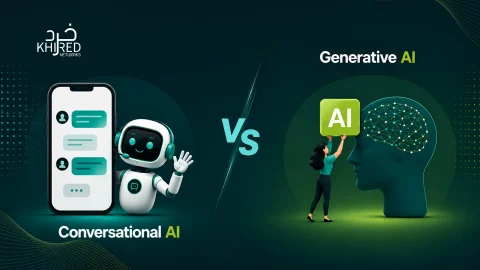
Two AIs. Same interface. Completely different brains
Artificial intelligence is everywhere. You have chatted with a customer support bot that understood your problem. You have asked an AI to draft an email, summarize a document, or generate a social media caption. These experiences feel similar — both involve typing a question and getting an answer. But under the surface, they work very differently.
This confusion is common. Many people ask: Are chatbots generative AI? The answer is not a simple yes or no. Some chatbots are generative. Others are not. Understanding the difference matters because choosing the wrong type of AI for your business leads to frustrated customers, wasted budgets, and missed opportunities.
In this guide, we break down conversational AI vs generative AI in plain language. You will learn how each technology works, where each excels, and how to decide which one solves your specific problem.
Conversational AI vs Generative AI – What are They?
Conversational AI is designed for structured, goal-orientated interactions like customer support and bookings. Generative AI creates new content such as text, code, or images based on prompts. Conversational AI is predictable and controlled, while generative AI is flexible but can produce variable or inaccurate outputs. Many modern systems combine both.
What Is Conversational AI?
Conversational AI refers to technologies that enable computers to understand, process, and respond to human language in a natural, back-and-forth manner. Think of it as a digital conversation partner designed to achieve a specific goal. It consists of answering a customer question, booking an appointment, or troubleshooting a product issue.
How It Works:
Conversational AI systems typically combine several technologies:
- Natural Language Understanding (NLU): Figures out what the user means
- Natural Language Processing (NLP): Breaks down sentence structure
- Dialogue management: Tracks the conversation flow and context
- Response generation: Picks or builds an appropriate reply
Traditional conversational AI uses intent-based models. The system is trained on thousands of example phrases to recognise what a user wants. For instance, “I need a refund,” “Can I get my money back,” and “This purchase didn’t work” all map to the same intent: request_refund.
Where Conversational AI Excels:
|
Use Case |
Why It Works |
|
Customer support |
Handles repetitive queries consistently |
|
Appointment booking |
Follows structured workflows |
|
Order tracking |
Retrieves specific data from systems |
|
FAQ automation |
Answers predictable questions |
|
IT helpdesk |
Follows troubleshooting scripts |
Example:
A hotel booking chatbot asks: “What dates are you checking in?” You reply, “next Friday for three nights.” The bot knows to check availability, calculate rates, and confirm your booking. All within a structured, goal-oriented conversation.
What Is Generative AI?
Generative AI refers to models that create new content. It includes text, images, code, audio, or video, based on patterns learned from massive amounts of training data. Unlike conversational AI, which focuses on understanding and responding, generative AI focuses on creating.
How It Works:
Generative AI models like GPT-5, Claude, and Llama are trained on enormous datasets containing billions of sentences, paragraphs, and documents. They learn statistical patterns; which words typically follow which other words. When you give them a prompt, they predict the most likely next word, then the next, then the next, generating original text that matches the pattern of their training.
Where Generative AI Excels:
|
Use Case |
Why It Works |
|
Content creation |
Drafts blogs, emails, social posts |
|
Code generation |
Writes functions, tests, documentation |
|
Brainstorming |
Generates ideas and variations |
|
Summarisation |
Condenses long documents |
|
Translation |
Converts between languages naturally |
Example:
You ask a generative AI: “Write a thank-you email to a client after a successful project.” The AI drafts a complete, personalised email from scratch. It did not retrieve a template. It created something new based on millions of similar emails it learned from.
Key Differences: Conversational AI vs Generative AI
Understanding what is the difference between conversational AI and generative AI comes down to these core distinctions.
|
Aspect |
Conversational AI |
Generative AI |
|
Primary Purpose |
Understand and respond in goal-driven conversations |
Create new, original content from prompts |
|
Output |
Structured, predictable responses |
Open-ended, creative, variable |
|
Best For |
Customer service, booking, FAQs, task completion |
Content creation, coding, summarisation, ideation |
|
Training Data |
Intent-labelled conversation examples |
Massive, diverse text/image/code datasets |
|
Control |
High — you control the conversation flow |
Low — outputs can vary widely |
|
Risk of Hallucination |
Low — responses are constrained |
High — AI may invent facts |
|
Integration Complexity |
Moderate — requires dialogue management |
Lower — API-based prompting |
Are Chatbots Generative AI?
This is one of the most common questions. The answer depends entirely on the chatbot.
Traditional Chatbots (Not Generative AI): Older or simpler chatbots follow decision trees. “Press 1 for sales, 2 for support.” They do not generate anything. They simply navigate users through predefined options. Most automated phone systems fall into this category.
Intent-Based Chatbots (Not Generative AI): Many customer support chatbots recognise user intent and retrieve pre-written answers from a knowledge base. They are conversational AI, not generative AI. They do not write new responses. They match and deliver existing ones.
LLM-Powered Chatbots (Generative AI): Modern chatbots powered by GPT-5, Claude, or similar models are generative AI. They create each response dynamically based on the conversation context. ChatGPT itself is a generative AI chatbot.
Hybrid Chatbots (Both): Increasingly, businesses combine both approaches. A conversational AI layer handles intent recognition and workflow management, while a generative AI model drafts personalised responses. This offers the best of both worlds — structured reliability plus creative flexibility.
|
Chatbot Type |
Conversational AI? |
Generative AI? |
|
Tree-based menu bot |
Yes (basic) |
No |
|
Intent-based support bot |
Yes |
No |
|
GPT-powered chatbot |
Yes |
Yes |
|
Hybrid customer service bot |
Yes |
Yes |
Hybrid AI: Real-World Example
Fintech – Fraud Detection & Customer Support
Scenario: A digital bank customer receives an alert that their card has been declined. They open the chat support window and type: “I’m traveling abroad and my card just got declined at a restaurant. I need this fixed immediately.”
How Hybrid AI Handles This:
|
Step |
AI Layer |
Action |
|
1 |
Conversational AI |
Identifies intent: fraud_decline_travel |
|
2 |
Conversational AI |
Authenticates user via secure verification flow |
|
3 |
Conversational AI |
Retrieves account details, transaction history, and current location |
|
4 |
Generative AI |
Drafts a clear, empathetic response: “I see you’re in Barcelona. Your card was declined because our system flagged an unusual location. I can temporarily lift the restriction for 7 days. Would you like me to do that?” |
|
5 |
Conversational AI |
Confirms user’s approval and executes the action via backend integration |
|
6 |
Generative AI |
Summarizes what happened and next steps: “Your card is now active for international use until May 28. You’ll receive a confirmation email. Is there anything else I can help with?” |
Why This Works:
The conversational AI ensures security, follows compliance protocols, and executes actions. The generative AI makes the interaction feel human and personalised. The customer receives fast, accurate service without being transferred to a human agent.
Result: Fraud resolution in under 2 minutes. No hold time. No frustrated customer. The bank saves on live agent costs while improving customer satisfaction.
Conversational AI vs Generative AI: Which One Does Your Business Need?
Choosing between conversational vs generative AI depends on your specific use case.
Choose Conversational AI When:
- You need to automate customer support for repetitive questions
- You want to handle bookings, orders, or account inquiries
- Accuracy and predictability are critical (finance, healthcare, legal)
- Your conversations follow structured workflows
- You cannot tolerate incorrect or “hallucinated” information
Choose Generative AI When:
- You need to create content — blogs, emails, social posts, ads
- You want to assist developers with code generation
- Brainstorming and ideation are part of your workflow
- Summarising documents or translating languages adds value
- Some creative variation is acceptable
Choose Both (Hybrid) When:
- You run a customer support centre that handles both routine and complex queries
- The bot handles simple requests alone and then drafts personalised responses for human agents
- You want conversational structure plus generative flexibility
When to Avoid Generative AI
|
Scenario |
Why to Avoid |
|
Financial compliance reporting |
Regulators require auditable, non-invented data |
|
Medical diagnosis or treatment advice |
Hallucinations risk patient safety |
|
Legal contract generation |
Missing or incorrect clauses create liability |
|
Customer refund decisions |
Inconsistent outputs lead to disputes |
|
Identity verification |
Requires deterministic, rule-based logic |
When to Avoid Conversational AI
|
Scenario |
Why to Avoid |
|
Open-ended research assistance |
Cannot answer questions outside training intents |
|
Creative writing or brainstorming |
Does not generate original content |
|
Unstructured customer feedback analysis |
Needs pattern matching, not conversation flow |
|
Ideation sessions for marketing |
Requires generative, not retrieval-based, responses |
|
Novel problem-solving |
Limited to predefined paths |
Can the Two Work Together?
Absolutely. In fact, the most powerful enterprise AI systems combine both approaches.
Example: Hybrid Customer Support
A customer asks: “My package was supposed to arrive yesterday but tracking still says ‘in transit.'”
- Conversational AI layer identifies the intent (delivery inquiry) and gathers order details.
- The generative AI layer drafts a personalised response: “I see order #12345 shipped on May 10. The latest tracking update was in Manchester at 8pm yesterday. Delivery is now expected by the end of the day tomorrow. Would you like me to notify you when it is out for delivery?”
- Conversational AI layer manages the follow-up (capturing the notification preference and closing the loop).
The result: A conversation that feels natural and helpful, backed by structured reliability.
Where Does Agentic AI Fit?
Agentic AI represents the next evolution beyond both conversational and generative AI. While conversational AI understands and responds, and generative AI creates content, agentic AI acts.
An AI agent does not just answer questions or draft text. It sets goals, makes plans, executes multi-step actions, and adapts when things change — all without constant human prompting.
How It Goes Beyond Both:
|
Capability |
Conversational AI |
Generative AI |
Agentic AI |
|
Understands and responds |
Yes |
Yes |
Yes |
|
Creates new content |
No |
Yes |
Yes |
|
Plans multi-step tasks |
No |
No |
Yes |
|
Executes actions independently |
No |
No |
Yes |
|
Adapts to changing conditions |
No |
No |
Yes |
|
Uses tools (APIs, databases, calendars) |
Limited |
Limited |
Native |
Example:
A conversational AI can tell you the weather. A generative AI can write a packing list. An agentic AI can check your calendar, book a flight that fits your schedule, reserve a hotel, add events to your calendar, monitor for price drops, and rebook automatically if a better deal appears. All without you saying another word.
Agentic AI Uses Both Conversational + Generative AI:
Agentic AI is not a replacement. It is an orchestrator. It uses:
- Conversational AI to understand user intent and maintain dialogue context
- Generative AI to plan responses, summarise information, and explain decisions
- Tool use to take actions — updating CRMs, sending emails, querying databases, calling APIs
Think of the three AI types as a maturity model.
- Conversational AI talks.
- Generative AI creates.
- Agentic AI thinks, plans, and acts.
For businesses ready to move beyond chatbot development and content generators, agentic AI delivers end-to-end automation. And at its core, it leverages the best of both conversational and generative AI to get the job done.
Common Misconceptions
Misconception 1: All AI chatbots are generative AI. False. Many effective chatbots use intent recognition and response retrieval. They generate nothing — they match.
Misconception 2: Generative AI is always better than conversational AI. False. Generative AI is worse for tasks requiring predictable, accurate, repeatable answers. It can hallucinate. Conversational AI gives you control.
Misconception 3: You must choose one or the other. False. The best enterprise solutions combine both. Use conversational AI for structure. Use generative AI for creative drafting.
Misconception 4: Generative AI understands conversation. Partially true. It predicts text based on patterns. It does not truly “understand” context or maintain memory without additional engineering. Conversational AI is specifically designed for multi-turn dialogue.
Misconception 5: Agentic AI is just a more advanced chatbot.
False. Chatbots respond. Agentic AI acts. It sets goals, plans multi-step tasks, uses tools, and adapts to change — without constant human prompting. A chatbot tells you the weather. Agentic AI books the umbrella-free venue, reschedules if it rains, and notifies your team. Different category entirely.
Conversational AI vs Generative AI – Questions
|
Question |
Conversational AI |
Generative AI |
|
What does it do? |
Understands and responds in goal-driven conversations |
Creates new content from prompts |
|
How predictable is it? |
Highly predictable |
Variable, creative |
|
Can it hallucinate? |
Rarely (responses are constrained) |
Frequently (invents facts) |
|
Best example? |
Customer support chatbot |
ChatGPT writing an email |
|
Typical cost? |
Moderate |
Pay-per-token or subscription |
|
Setup complexity? |
Moderate (intent training required) |
Low (API access) |
Conclusion
Conversational AI is about understanding and responding within structured, goal-oriented conversations. It is reliable, predictable, and ideal for customer support, bookings, and task automation.
Generative AI is about creating — generating original text, code, images, or ideas. It is flexible, creative, and ideal for content creation, brainstorming, and summarisation.
The question is not which is “better.” The question is which solves your specific problem. Many businesses need both. The smartest approach is understanding the strengths of each and combining them where it makes sense.
Still unsure? Start with your use case. If you need accurate, repeatable answers to customer questions, lean conversational. If you need fresh content or creative drafts, lean generative. If you need both — build hybrid.
Ready to Build Smarter Conversations?
Choosing the right AI partner for your business does not have to be complicated. Whether you need a conversational AI for customer support, a generative AI for content creation, or a hybrid system that does both — Khired Networks can help.
We specialise in designing and deploying conversational AI solutions tailored to your specific use cases. From intent-based support bots to hybrid LLM-powered assistants, we build systems that understand your customers and deliver results.
Contact Khired Networks today for a free consultation. Let us discuss your needs and build a conversational AI that works for you.
Frequently Asked Questions
Are chatbots generative AI?
Not necessarily. Traditional chatbots use decision trees or intent recognition without generating new content. Only LLM-powered chatbots like ChatGPT are generative AI. Many customer support chatbots are conversational AI, not generative AI.
What is the difference between conversational AI and generative AI?
Conversational AI understands and responds in goal-driven conversations like a customer service bot. Generative AI creates new content from prompts like ChatGPT writing an email. The former focuses on structured interaction; the latter on creative generation.
Can conversational AI and generative AI work together?
Yes. Hybrid systems use conversational AI for intent recognition and workflow management, while generative AI drafts personalised responses. This combines reliability with flexibility, especially in customer support.
Which is better for customer service — conversational or generative AI?
Conversational AI is generally better for routine, high-volume customer service because responses are predictable and accurate. Generative AI can hallucinate or go off topic. However, hybrid approaches are gaining popularity for handling complex, personalised queries.
Is ChatGPT conversational AI or generative AI?
ChatGPT is primarily generative AI. It creates responses dynamically. However, it also maintains conversation context, giving it conversational capabilities. Modern LLM chatbots blur the line but are technically generative AI with dialogue management features.


0 Comments
Trackbacks/Pingbacks