
A fintech startup builds a fraud detection model. It hits 95% accuracy in testing. Investors are impressed. The model goes live.
Three months later, fraud slips through undetected. Not because the model was bad because it was never updated.
User behaviour changed. Transaction patterns shifted. The model did not.
This is the most common way AI projects fail: not in development, but in operations. The engineering team builds something that works in a notebook and assumes the hard part is done. It is not.
That is the gap that DevOps vs MLOps addresses and where the confusion starts for most teams.
What Is DevOps?
DevOps is a set of engineering practices that combines software development and IT operations to deliver applications faster and with fewer production failures. The core idea is that development and operations teams should not work in separate silos. They should share responsibility for the full software lifecycle.
Core Components of DevOps
- Continuous Integration (CI): Code is merged and tested automatically with every change.
- Continuous Delivery (CD): Tested code is deployed to production with minimal manual intervention.
- Infrastructure as Code (IaC): Servers and environments are defined and provisioned through code, not manual configuration.
- Monitoring: System health, uptime, and performance are tracked in real time.
- Feedback loops: Incidents and performance data feed back into the development cycle.
DevOps works well for SaaS platforms, web applications, APIs, microservices, and cloud-native systems — anything where the software logic is deterministic and the primary operational risk is uptime and release reliability.
Where DevOps Falls Short for AI
DevOps is built on an assumption that breaks down for AI: code behaves predictably.
Machine learning models do not. A model trained in January on transaction data from November may behave completely differently by March — not because the code changed, but because the data did.
This creates failure modes that DevOps tooling and processes were never designed to handle:
- Data drift: The statistical distribution of input data changes over time, causing the model to make increasingly poor predictions on real-world inputs.
- Model decay: Prediction quality degrades silently. There are no exceptions, no error logs, no deployment failures — just gradually worsening outputs that go unnoticed until the business impact is obvious.
- Training environment inconsistency: The environment where a model was trained differs from production, leading to results that cannot be reproduced or debugged.
- No retraining pipeline: When model performance drops, there is no automated mechanism to retrain it. Someone has to notice, escalate, and manually kick off a new training run.
- Lack of lineage and auditability: Without MLOps, there is no record of which data version trained which model, what hyperparameters were used, or why a particular prediction was made.
Standard DevOps monitoring catches system failures. It does not catch a model that has quietly become 15% less accurate over six weeks.
What Is MLOps?
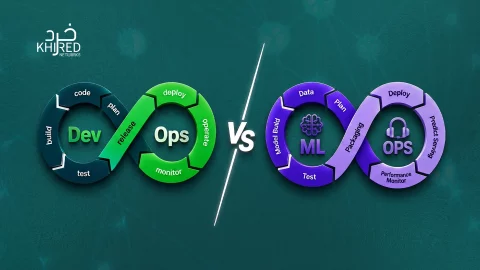
MLOps (Machine Learning Operations) is the engineering discipline that manages the full lifecycle of machine learning models. It consists of data ingestion and model training through deployment, monitoring, and continuous retraining.
It builds on DevOps principles but adds the data and model management layer that AI systems require. The fundamental difference is this: in traditional software, you version the code. In MLOps, you version the code, the data, the model, and the training configuration because any of these can cause a production failure.
According to the Google Cloud Architecture Center, most organisations at MLOps maturity level 0 (manual processes, no pipelines) experience significant model degradation within months of deployment. Moving to automated pipelines and monitoring reduces this risk substantially.
The MLOps Lifecycle
Unlike a traditional CI/CD pipeline, MLOps includes additional stages:
- Data collection and validation — Verify that incoming data meets quality and distribution expectations before training.
- Feature engineering — Transform raw data into the representation the model expects, with versioned pipelines.
- Experiment tracking — Log every training run: hyperparameters, dataset versions, evaluation metrics.
- Model training and tuning — Run training at scale, with reproducible results.
- Model evaluation — Test for accuracy, bias, and reliability against domain-specific benchmarks, not just aggregate metrics.
- Model deployment — Package and serve the model through a versioned registry with rollback capability.
- Monitoring — Track prediction quality, data drift, latency, and system health in real time.
- Automated retraining — When performance drops below a threshold, trigger a new training run without manual intervention.
The critical point: models must evolve as data changes. MLOps is the infrastructure that makes that evolution systematic rather than reactive.
DevOps vs MLOps: Key Differences
|
Dimension |
DevOps |
MLOps |
|
Primary focus |
Code and infrastructure |
Data and ML models |
|
Output type |
Deterministic |
Probabilistic |
|
Deployment trigger |
Code changes |
Data changes or performance degradation |
|
Versioning |
Code and configuration |
Code, data, model weights, and experiments |
|
Testing |
Unit tests, integration tests |
Data validation, model evaluation, bias testing |
|
Monitoring |
System uptime and performance |
Prediction quality, data drift, model accuracy |
|
Failure mode |
Exceptions and downtime |
Silent accuracy degradation |
|
Team composition |
Developers and ops engineers |
Data scientists, ML engineers, data engineers |
|
Retraining |
Not applicable |
Automated, triggered by performance thresholds |
The key column here is failure mode. DevOps failures are loud, the service crashes, an alert fires, someone gets paged. MLOps failures are quiet. The API keeps returning 200. The inference latency looks fine. The model is just wrong, and no one knows until the business notices.
Real-World Example: Fraud Detection
Back to the fintech startup.
DevOps handles:
- Deploying the fraud detection API to production
- Auto-scaling the infrastructure under peak transaction volume
- Monitoring server uptime, latency, and error rates
- Managing the CI/CD pipeline for application code changes
MLOps handles:
- Training and versioning the fraud detection model
- Tracking which dataset version produced which model performance
- Monitoring prediction accuracy as transaction patterns evolve
- Detecting when the input data distribution shifts (e.g., a new payment method gains traction)
- Automatically triggering retraining when accuracy drops below the defined threshold
- Deploying the updated model to production with a rollback checkpoint
Without DevOps, the system is unstable. Without MLOps, the model quietly becomes useless. Most teams build the former and neglect the latter.
When DevOps Alone Is Enough
DevOps is sufficient when:
- The application has no machine learning components
- Any models used are static and updated infrequently (quarterly releases, for example)
- The system’s correctness depends on code logic, not on data patterns
- Model outputs do not materially affect business decisions in real time
Practical examples:
- CMS platforms and e-commerce sites without personalisation
- Rule-based systems with fixed decision logic
- Static reporting dashboards
- CRUD APIs where business logic is deterministic
If this describes your system, a mature DevOps setup covers your operational needs.
When MLOps Becomes Essential
MLOps is necessary when:
- Predictive model outputs affect business decisions (approvals, recommendations, pricing)
- Input data changes frequently or unpredictably
- Model accuracy degradation has direct financial, clinical, or compliance consequences
- Multiple teams collaborate on model development and need reproducible results
- You need to demonstrate model behaviour to regulators or auditors
Industries where MLOps is effectively mandatory:
- Financial services: Credit scoring, fraud detection, AML screening
- Healthcare: Diagnostic support, clinical documentation, treatment recommendations
- E-commerce: Demand forecasting, personalisation, dynamic pricing
- Legal and compliance: Contract review, regulatory classification
- Manufacturing: Predictive maintenance, quality control
In regulated industries, financial services, healthcare, insurance, it is not just an operational improvement. It is a compliance requirement. The EU AI Act mandates logging, monitoring, and human oversight for high-risk AI systems. MLOps infrastructure is how you meet those requirements in practice.
The Hidden Cost of Skipping MLOps
Teams delay MLOps investment because it seems like overhead. The real cost calculation looks different.
Research from Evidently AI’s 2024 ML Monitoring Report found that production ML models without monitoring frameworks lost an average of 20–30% predictive accuracy within six months of deployment. For a fraud detection model, a 20% accuracy drop does not mean 20% more fraud. It means the false negative rate may spike disproportionately in exactly the fraud vectors the model was most relied upon to catch.
Beyond accuracy, the operational risks include:
- Compliance exposure: In regulated industries, deploying a degraded model and not noticing constitutes a governance failure, not just a technical one.
- Trust damage: When AI-driven decisions surface as wrong, the reputational impact is attributed to the organisation, not the model.
- Debugging cost: Without experiment tracking and model versioning, diagnosing a production issue means recreating months of work from scratch.
- Retraining overhead: Ad-hoc retraining without pipelines is expensive and error-prone. Each incident becomes a manual project.
The investment in MLOps infrastructure pays back through avoided incidents, not through visible additions.
DevOps and MLOps Together
This is not a choice between two competing approaches. In any serious AI system, both are active simultaneously.
DevOps manages:
- Application infrastructure and deployment
- CI/CD pipelines for application code
- Container orchestration (Docker, Kubernetes)
- Infrastructure security, scaling, and uptime
MLOps manages:
- Data pipelines and feature stores
- Model training infrastructure and experiment tracking
- Model registry and versioning
- Model serving and inference APIs
- Drift detection and automated retraining
How they connect: The model registry is the handoff point. MLOps packages and validates a new model version. DevOps deploys it to the serving infrastructure. Monitoring spans both layers — system health on the DevOps side, prediction quality on the MLOps side.
A fully automated AI system has no manual steps between “new data arrives” and “updated model is serving in production.” That requires both disciplines working as a single pipeline.
Popular Tools for Each
DevOps Tooling
|
Category |
Tools |
|
CI/CD |
GitHub Actions, Jenkins, GitLab CI |
|
Containers |
Docker, Kubernetes |
|
Infrastructure as Code |
Terraform, Pulumi |
|
Monitoring |
Prometheus, Grafana, Datadog |
|
Secrets management |
HashiCorp Vault, AWS Secrets Manager |
MLOps Tooling
|
Category |
Tools |
|
Experiment tracking |
MLflow, Weights & Biases |
|
Model registry |
MLflow, SageMaker Model Registry |
|
Data versioning |
DVC |
|
Pipeline orchestration |
Kubeflow, Prefect, Airflow |
|
Feature stores |
Feast, Tecton |
|
Model serving |
Seldon, KServe, TorchServe |
|
Drift detection |
Evidently AI, WhyLabs |
|
LLMOps |
LangSmith, Helicone, PromptLayer |
MLOPs tool selection depends on your cloud environment, team size, and compliance requirements. AWS SageMaker, Azure ML, and Google Vertex AI each provide managed MLOps platforms that bundle many of these capabilities. Thus, useful for teams that want a unified environment rather than assembling a toolchain from scratch.
LLMOps: The Next Layer
Standard MLOps tooling was designed for classical ML models, regression, classification, and recommendation systems. Large language models introduce additional operational challenges that require a dedicated practice: LLMOps.
What LLMOps adds on top of MLOps:
- Prompt version management: Prompts are part of the model’s behaviour. Changes to prompts need versioning, testing, and rollback capability just like model weight changes.
- Output evaluation at scale: LLM outputs are probabilistic and open-ended. Evaluating quality requires automated scoring (relevance, groundedness, toxicity) plus human evaluation sampling.
- Token cost tracking: LLM inference is priced by token consumption. Without cost attribution per request type, cloud spend is opaque and difficult to optimise.
- Latency optimisation: LLM inference is slower than classical model inference. Caching, batching, and model routing (sending simpler queries to smaller, cheaper models) are standard production optimisations.
- Hallucination monitoring: LLM outputs can be confidently wrong. Production LLMOps includes automated groundedness checks against retrieval sources where applicable.
Teams deploying GPT-4, Claude, Gemini, or fine-tuned open-source LLMs in production need LLMOps practices on top of their MLOps foundation, not instead of it.
How to Decide
|
Your system |
What you need |
|
Code-driven logic, no ML |
DevOps |
|
Static ML model, infrequent updates |
DevOps + basic model versioning |
|
A dynamic ML model affecting business decisions |
DevOps + MLOps |
|
LLMs in production |
DevOps + MLOps + LLMOps |
|
Regulated industry AI (healthcare, finance) |
DevOps + MLOps + governance layer |
The decision is not philosophical; it follows directly from what your system does and how frequently the model needs to change. If your model touches revenue, risk, or patient outcomes, MLOps is not optional. It is the operational baseline.
Conclusion
DevOps is the foundation. MLOps is what you build on top of it when the system makes predictions that matter.
Most teams get this backwards. They invest heavily in CI/CD for application code and treat model operations as an afterthought. The model goes live, performs well for a few months, and then silently degrades while the team assumes it is still doing its job.
The fix is not complicated. It requires experiment tracking, a model registry, drift monitoring, and an automated retraining trigger. Those four components prevent most production ML failures.
If you are not sure where your production gaps are, an MLOps audit is the fastest way to find out.
Khired Networks provides end-to-end MLOps consulting services, from infrastructure audit and gap analysis through pipeline build, model monitoring, and LLMOps implementation.
Book a free MLOps assessment to see what your current AI infrastructure is missing.
Frequently Asked Questions
What is the main difference between DevOps and MLOps?
DevOps manages the lifecycle of application code, build, test, deploy, monitor. MLOps manages the lifecycle of machine learning models, which includes training data, model weights, experiments, and continuous retraining as data changes. Both are needed in AI systems; they address different failure modes.
Do all AI projects need MLOps?
No. Projects using static, infrequently updated models with low business impact can rely on basic DevOps. MLOps is necessary when model predictions affect business outcomes, input data changes over time, or the cost of silent accuracy degradation is high.
Can DevOps engineers handle MLOps?
DevOps engineers can manage the infrastructure and CI/CD components of an MLOps stack. The data pipeline design, model evaluation frameworks, drift detection configuration, and experiment tracking require additional expertise in data engineering and machine learning. Most teams start with a DevOps engineer plus an ML engineer working together.
What is the difference between DataOps, DevOps, and MLOps?
DataOps moves and prepares data. DevOps builds and deploys software. MLOps manages ML models in production, including versioning, drift detection, and retraining. DataOps supplies the data, DevOps delivers the app, MLOps keeps the model accurate.
What is the difference between AIOps, DevOps, and MLOps?
AIOps uses AI to automatically detect and fix IT incidents. DevOps delivers software applications. MLOps manages ML models. DevOps builds the system, MLOps runs the models, and AIOps keeps everything healthy.


0 Comments
Trackbacks/Pingbacks