
TL;DR
- Global corporate AI investment reached $581.7 billion in 2025, more than doubling year-over-year (Stanford AI Index, 2026)
- 87% of AI projects fail to reach production — the leading cause is building too much before validating whether users want what was built (Gartner)
- An AI MVP is not a prototype. A prototype runs in demos. An AI MVP runs with real users and real data.
- AI-powered MVPs cost $35,000–$300,000+ in 2026 depending on complexity — API-first builds are significantly cheaper than custom model builds; the right starting point for most enterprises is the API-first tier
- Foundation model API costs have dropped 60–80% over 18 months; fine-tuning costs have fallen from $100,000+ to $500–$3,000 for domain-specific models (2025 market data)
- AI coding tools (GitHub Copilot, Cursor) now generate up to 46% of code written by active users, reducing development timelines by 20–35% (McKinsey, 2025; TechCrunch, 2025)
- The single biggest cause of timeline overruns: data problems discovered after development starts — solve the data layer in discovery, not later
Stanford’s 2026 AI Index reports that global corporate AI investment reached $581.7 billion in 2025 — more than double the previous year. Despite that investment, Gartner’s research shows that 87% of AI projects never reach production. Most die somewhere between the whiteboard and actual users.
The enterprises that beat those odds almost always share one trait. They built a focused, well-scoped AI MVP first, validated real demand quickly, and only then committed to building at scale. The ones that failed started with the full vision — every feature, every integration, the enterprise tier — and discovered after $300,000 and six months that the core assumption was wrong.
This guide covers the complete AI MVP development process for enterprises in 2026: what an AI MVP actually is (and what it is not), how much it costs, how long it takes, how to build it without the most expensive mistakes, and how Khired Networks delivers production-ready AI MVPs that enterprise teams can actually ship.
What Is an AI MVP? (And What It Is Not)
The term “Minimum Viable Product” was popularised by Eric Ries in The Lean Startup. In 2026, the definition needs an enterprise-specific upgrade.
An AI MVP is the smallest, fastest-to-build version of an AI-powered product that delivers a genuine, measurable outcome to a defined user group. It is not a proof of concept. It is not a demo that runs in a controlled environment. It is not a research prototype.
The distinction matters:
| Proof of Concept | Prototype | AI MVP | |
|---|---|---|---|
| Runs with | Synthetic or curated data | Controlled test data | Real users, real data |
| Purpose | Prove technical feasibility | Demonstrate experience | Validate business value |
| Success metric | “It works” | “It feels right” | “People use it and it creates value” |
| Infrastructure | None | Minimal | Production-grade |
| AI reliability required | Low — can fail | Medium — can be imperfect | High — must be trustworthy enough to use |
| What it informs | Architecture decision | Design decisions | Build vs. don’t build decision |
In 2026, user expectations have raised the bar. People expect fast onboarding, stable performance, and genuine usefulness from day one. An AI MVP still needs to be lean — but it cannot feel like a science experiment.
Three constraints unique to AI MVPs that traditional MVPs do not face:
1. Data dependency. Your AI feature needs data to function. No data equals no AI. The MVP plan must address how you will get initial training data, seed data, or inference-time retrieval data before the first user signs up.
2. Inference cost. A traditional MVP with 1,000 users costs roughly the same to run as one with 10. An AI MVP with 1,000 users running 50 queries each costs 50× more in inference than 10 users. Pricing models must account for this from day one.
3. Evaluation difficulty. When a feature is a database query, you know if it returned the right result. When the feature is an LLM response, “right” is subjective. The MVP needs a feedback loop to evaluate AI output quality before scaling.
Why Enterprises Build AI MVPs
The enterprise context for AI MVP development differs from startup MVP development in important ways. Enterprises are not trying to find product-market fit from scratch. They are trying to:
- Validate automation ROI before committing to a full internal AI platform build
- Pilot AI in one workflow before rolling out enterprise-wide
- Build a working demo for board or leadership approval of a larger AI investment
- Win internal adoption for an AI initiative by showing a working product to the teams who will use it
- Reduce vendor dependency by proving the enterprise can build AI capabilities internally
The specific enterprise use cases where AI MVPs deliver measurable, validatable value in 2026:
| Enterprise Function | AI MVP Use Case | Measurable Outcome |
|---|---|---|
| Customer Support | AI support chatbot reducing tier-1 ticket volume | % of queries resolved without human agent |
| Legal / Compliance | Contract review AI surfacing key clauses | Hours saved per contract reviewed |
| Finance | Document extraction from invoices and statements | Manual processing hours eliminated per week |
| HR | Candidate screening and shortlisting tool | Time to shortlist reduction |
| Engineering | Internal knowledge base RAG assistant | Time to answer for developer queries |
| Sales | CRM data enrichment and lead scoring | Conversion rate lift on scored leads |
| Operations | Workflow routing and classification agent | Manual routing labour hours saved |
In each case, the AI MVP is not the final system. It is the working proof that the AI approach solves the specific problem — with real data from the enterprise’s environment, not a vendor’s demo dataset.
The Enterprise AI MVP Cost Breakdown (2026)
MVP pricing in 2026 is up approximately 15% from 2025, driven by talent shortages in AI/ML engineering (Softermii, December 2025). Costs vary significantly by complexity, team location, and how much custom model work is involved.
Tier 1: API-First AI MVP ($35,000–$70,000)
The starting point for most enterprise AI MVPs. You are not training a custom model from scratch. You are connecting to pre-built foundation model APIs — OpenAI GPT-4o, Anthropic Claude, Google Gemini, AWS Bedrock — and building the enterprise product layer around them.
The work involves:
- API integration and prompt engineering
- User interface and access control
- RAG pipeline setup for internal document retrieval
- Authentication and basic audit logging
- Deployment and monitoring
Timeline: 6–10 weeks
What you get: A working product with real users and real data — feedback you can act on immediately.
What you defer: Custom-trained model, advanced fine-tuning, enterprise-grade compliance infrastructure.
Tier 2: RAG + Workflow Automation MVP ($70,000–$140,000)
For enterprises that need AI integrated into existing workflows — not just a standalone enterprise chatbot. Includes vector databases, retrieval pipelines over internal document stores, agent loops for multi-step tasks, and integration with existing enterprise systems (CRM, ERP, ticketing).
The work involves:
- RAG pipeline with hybrid search over internal document corpus
- Tool-calling agent architecture for multi-step workflow automation
- Integration with one or two existing enterprise systems via API
- Human-in-the-loop review interface for high-stakes outputs
- Role-based access control and basic compliance logging
Timeline: 10–16 weeks
What you get: AI that works inside your existing operational environment, not alongside it.
What you defer: Full enterprise security certification, multi-region deployment, advanced analytics.
Tier 3: Custom Model or Enterprise-Grade AI Platform ($140,000–$300,000+)
For enterprises with proprietary data that foundation models genuinely cannot handle — medical records, highly specialised technical documentation, regulated financial data — or those deploying AI in compliance-heavy environments (HIPAA, GDPR, SOC 2, FCA).
The work involves:
- Fine-tuning or full custom model training on proprietary data
- Enterprise security architecture: data isolation, encryption, audit trails
- Multi-agent orchestration for complex workflow automation
- Compliance documentation and governance infrastructure
- Pilot deployment with structured evaluation and sign-off
Timeline: 14–24 weeks
Important note: Fine-tuning costs have dropped dramatically. Domain-specific fine-tuning now costs $500–$3,000 compared to $100,000+ two years ago (2025 market data). The cost driver at this tier is infrastructure, compliance, and integration work — not model training.
Additional Costs to Plan For
Hidden costs add 20–35% to most AI MVP budgets if not planned upfront (Techverx, 2026):
| Cost Category | Estimate | Notes |
|---|---|---|
| Data preparation and labeling | 10–20% of build cost | Often underestimated; data quality problems are the leading cause of timeline overruns |
| AI output evaluation setup | 5–10% of build cost | Feedback loops, accuracy logging, human review tooling |
| Compliance architecture | 20–40% premium for regulated industries | Healthcare, financial services, government |
| Post-launch model monitoring | $500–$3,000/month | Ongoing — drift detection, performance monitoring, retraining |
| Inference costs at scale | Variable — see note | Plan from day one: 1,000 users × 50 queries/day × API pricing |
| Iteration budget (V1.1) | 15–25% of build cost | Budget for the first improvement cycle before launch |
Engagement Rate by Hour: Team Location vs Delivery Quality
| Region | Blended Hourly Rate | 12-Week MVP Cost Estimate | Notes |
|---|---|---|---|
| US / UK | $100–$200/hr | $100,000–$200,000+ | Highest expertise; highest cost; fastest alignment |
| Western Europe | $70–$100/hr | $70,000–$130,000 | Strong engineering depth; similar time zone to UK/EU |
| Eastern Europe | $50–$80/hr | $40,000–$100,000 | Balanced quality and cost; English-fluent; recommended for complex builds |
| South Asia (Pakistan, India) | $25–$50/hr | $20,000–$60,000 | Strong AI/ML talent pool; significant cost advantage; growing enterprise track record |
| LATAM | $40–$70/hr | $30,000–$80,000 | Agile; English-fluent; US timezone overlap |
The rate trap: The hourly rate is the least important number in this comparison. Projects with seemingly low rates frequently cost 2–3× more overall due to hidden inefficiencies, scope misunderstandings, and code quality issues requiring rewrites (Accelerance, 2026). The relevant comparison is total cost to a working, production-ready product — not hourly rate.
Khired Networks provides AI MVP development with a senior engineering team delivering production-grade AI systems — at South Asia pricing with the quality standard of a Western engineering firm.
The AI MVP Tech Stack for 2026
The standard AI MVP tech stack in 2026 is well-established. For most enterprise MVPs, there is no reason to deviate from it.
| Layer | Recommended Choice | Why |
|---|---|---|
| Backend API | FastAPI (Python) | The Python AI ecosystem is unmatched — LangChain, LlamaIndex, Hugging Face, vector libraries all native |
| Foundation model | GPT-4o mini (general) / Claude Haiku (regulated) | GPT-4o mini: $0.15/M input tokens, GPT-4 class quality at a fraction of the cost |
| Vector database | Supabase (pgvector) for small–medium; Qdrant for large | Supabase: PostgreSQL + auth + file storage + pgvector in one managed service with generous free tier |
| Retrieval | Hybrid search (BM25 + dense vector) | Pure vector search systematically fails on enterprise exact-term queries; hybrid eliminates the failure mode |
| Frontend | Next.js (React) | Standard enterprise web stack; wide talent pool |
| Authentication | Auth0 or Supabase Auth | SSO, RBAC, and enterprise identity provider integration |
| Deployment | AWS / GCP / Azure | Match your enterprise’s existing cloud provider to minimise integration friction |
| LLM orchestration | LangChain / LangGraph | Standard for RAG pipelines and agent workflows; extensive documentation |
| Monitoring | LangSmith (LLM observability) + Datadog or CloudWatch | LLM-specific observability for prompt quality, latency, and cost tracking |
What to skip for V1:
- Custom model training
- Multi-region deployment
- Advanced analytics dashboards
- Complex multi-agent orchestration
- Enterprise security certifications (SOC 2, ISO 27001) — plan for post-validation
The AI MVP Build Process: Week by Week
Week 1–2: Discovery and Architecture
Inputs: Business problem definition, existing data inventory, enterprise systems landscape
Outputs: Scoped feature list, data architecture decision, tech stack selection, project kickoff
The most important two weeks of the entire build. The single biggest cause of timeline overruns is data problems discovered after development starts. Solve the data layer here.
Activities:
- Define the one core user action that validates the AI feature (the “aha moment”)
- Audit existing data: availability, structure, quality, access permissions
- Decide on AI approach: API-first, RAG, fine-tuning, or agent — based on the specific problem and data available
- Ruthlessly cut scope: anything not directly testing the core hypothesis defers to V2
- Define success metrics before building — not after
Pass/fail condition: Can you demo the core AI concept (even with mock data) to a stakeholder and get a “yes, this solves the problem” by end of week 2?
Week 3–5: Core AI Feature Build
Inputs: Approved scope, data pipeline design, tech stack
Outputs: Working AI feature in a development environment; internal demo-ready
The AI feature at the core of the product must work reliably before anything else is built around it. A chatbot that gives wrong answers 30% of the time is not an MVP — it is a broken product.
Activities:
- Set up foundation model API integration and prompt engineering
- Build data pipeline: ingestion, preprocessing, storage, retrieval
- Implement RAG or agent logic based on architecture decision
- Build the minimal feedback loop — log every input, output, and user action from day one
- First internal demo to stakeholders
Pass/fail condition: Core AI feature works on real enterprise data, not just synthetic test cases.
Week 6–8: Product Layer Build
Inputs: Working AI core, approved UX wireframes
Outputs: Connected frontend, authentication, basic admin controls
Activities:
- Build user interface — minimal but usable; no polish at this stage
- Integrate authentication and role-based access control
- Connect frontend to AI backend via API
- Implement basic audit logging for enterprise accountability
- Initial integration with one existing enterprise system if in scope
Week 9–10: Integration, Testing, and Hardening
Inputs: Connected product
Outputs: Production-ready MVP
Activities:
- End-to-end integration testing on real data
- Performance testing at expected initial user load
- Security review — input sanitisation, API key handling, data access controls
- AI output evaluation: define and run accuracy tests on a representative query set
- Deployment to production environment
Week 11–12: Pilot Launch and Validation
Inputs: Production-deployed MVP
Outputs: User feedback, AI performance data, go/no-go decision for full build
Activities:
- Controlled rollout to 5–20 internal users or first enterprise pilot client
- Collect quantitative data: usage rates, AI output acceptance rates, error rates
- Collect qualitative feedback: what works, what doesn’t, what’s missing
- Weekly review of AI quality metrics: are users accepting the AI output or overriding it?
The go/no-go decision: If users are using the AI feature and finding genuine value — even imperfect value — you have validated the approach. If users are consistently overriding the AI output or not using it, the signal is equally valuable: you have learned what to change without spending $500,000 to discover it.
Architecture Diagram: Enterprise AI MVP Stack
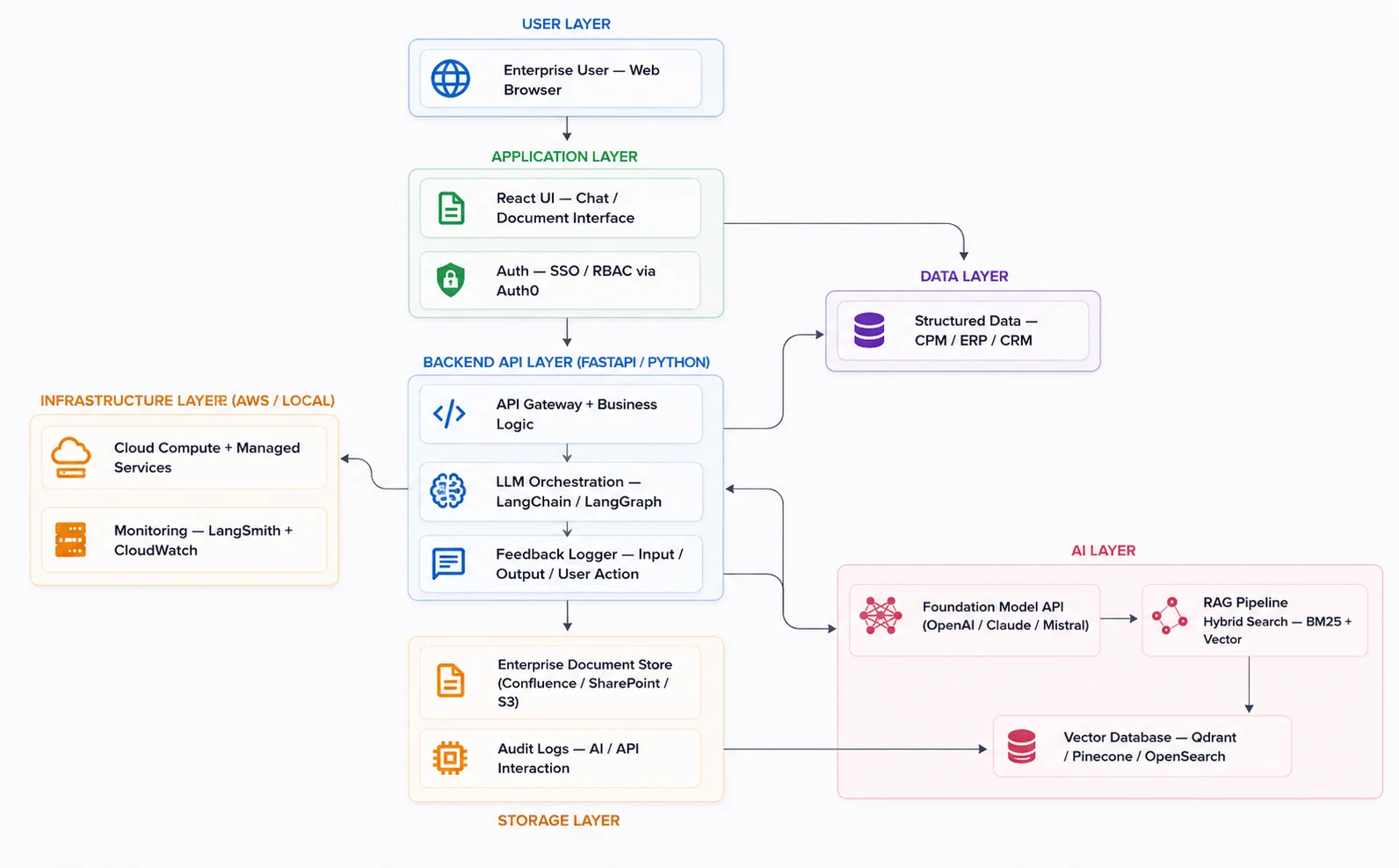
Figure 1: Enterprise AI MVP architecture — showing the full stack from user interface through LLM orchestration, RAG pipeline, and enterprise data integration. The feedback logger captures every AI interaction from day one for evaluation and iteration.
The Six Most Expensive AI MVP Mistakes Enterprises Make
Mistake 1: Building a Custom Model Before Validating the Use Case
Fine-tuning a domain-specific model takes 2–8 weeks to prepare, plus the compute cost. If validation fails — if users don’t actually want what you built — you have spent weeks on model work before discovering the core assumption was wrong.
Start with API calls. Fine-tune after you have user data that confirms the use case. Foundation model APIs are now cheap enough that API-first development is the correct default for nearly all MVP stages.
Mistake 2: Treating “AI” as the Product
“We use AI” is not a value proposition. “We help legal teams review contracts 10× faster” is. Enterprises that lead with the AI technology rather than the business outcome they are solving for build AI MVPs that impress in demos and fail in adoption. Design the MVP around the outcome — the AI is the mechanism, not the product.
Mistake 3: Skipping the Feedback Loop
Logging user inputs, AI outputs, and user actions is not optional. It is how you improve the AI after launch. It is also how you know whether the MVP is succeeding or failing in the first two weeks of use.
Add the feedback loop in week one of development. Teams that add it after launch are flying blind during the most important validation period.
Mistake 4: Waiting for the AI to Be “Perfect” Before Launching
Launch at 80% quality, learn from real usage, improve from there. Teams that wait for 95% accuracy before exposing the MVP to users typically discover — months later — that the 20% of cases they were trying to handle before launch are actually edge cases that occur less than 5% of the time in production. The remaining 95% of real queries work fine at launch quality. Ship and learn.
Mistake 5: Underestimating Data Problems
The single biggest cause of AI MVP timeline overruns is data problems discovered after development starts. Enterprise data is rarely in the format AI systems need. Documents are in incompatible formats. Metadata is missing. Access permissions are inconsistent. Historical data has gaps.
Conduct a real data audit in week one of discovery. Not a theoretical inventory — an actual attempt to access and process the data your AI will need to work on.
Mistake 6: Adding Enterprise Infrastructure Too Early
SSO, SOC 2 compliance, audit logs, multi-region deployment, GDPR documentation — these are V2 decisions for most AI MVPs. Adding them before validating the core AI use case doubles the build time and budget without increasing the likelihood that users will adopt the product. Plan for compliance infrastructure after validation confirms the MVP is worth scaling.
What Changed in 2026: Why AI MVPs Are Faster and Cheaper Than They Were
Foundation model costs have fallen 60–80%. OpenAI, Google, and Anthropic have cut API pricing by 60–80% over the past 18 months (a16z AI report). Foundation model API costs are expected to continue falling through 2026, making API-first MVP builds cheaper every quarter.
Open-source models have closed the quality gap. Meta’s Llama, Mistral, and Qwen have closed the quality gap with proprietary models for many enterprise use cases. Teams can now self-host capable models and eliminate ongoing API fees — reducing cost at scale without sacrificing quality.
AI coding tools have cut engineering hours by 20–35%. GitHub Copilot surpassed 20 million cumulative users by July 2025, now generating an average of 46% of code written by active users (TechCrunch, July 2025). McKinsey (2025) documents a 20–35% reduction in engineering hours for standard development tasks. The same 12-week MVP that cost $150,000 in 2023 can be built for $80,000–$100,000 in 2026 by an experienced AI-first team.
The Gartner failure rate has not improved. 87% of AI projects still fail to reach production. The reasons are organisational, not technical — poor scope definition, underestimated data complexity, insufficient user involvement, and building too much before validating. The tools have never been better. The discipline remains the constraint.
Real Production Example
A document intelligence MVP built for a fintech client reduced review time from 14 hours per week to under 2 hours. The MVP went live in 11 weeks and validated three enterprise pilots. The architecture was API-first: FastAPI backend, GPT-4o for document extraction, Supabase for storage, LangChain for orchestration. No custom model. No fine-tuning. No enterprise infrastructure beyond basic auth and audit logging.
The lesson: the simplest architecture that solves the specific problem is almost always the correct architecture for an AI MVP. Complexity deferred is complexity that does not delay validation.
Enterprise AI MVP Evaluation Framework
Before signing off on an AI MVP for full-scale investment, run these four validation checks:
| Validation Dimension | What to Measure | Threshold for Proceeding |
|---|---|---|
| AI Output Quality | User acceptance rate — how often do users accept, not override, the AI output? | 60%+ acceptance rate on core use case |
| Usage Adoption | Are target users using the tool without being prompted? | 40%+ weekly active usage among pilot users |
| Time-to-Value | How quickly does a new user experience the core value proposition? | Within one session for most enterprise MVPs |
| Quantified ROI | Can you measure a specific process improvement? | At least one metric showing measurable reduction in time, cost, or error rate |
If all four thresholds are met, the signal is clear: scale. If one or two are not met, the signal is equally clear: identify and fix the specific failure before scaling.
How Khired Networks Delivers AI MVPs for Enterprises
Khired Networks is an AI-first engineering company that builds production-ready AI MVPs for enterprise clients — from discovery and architecture through deployment and post-launch support.
Our AI MVP engagements follow the 12-week process described in this guide, with one team owning the complete build: data pipeline to model integration to frontend to deployment. No coordination overhead between agencies. No scope ambiguity between strategy and execution teams.
What we build:
- RAG systems and AI knowledge bases over enterprise document stores
- Conversational AI for customer support, internal helpdesk, and sales automation
- Document intelligence systems for contract review, invoice processing, and regulatory analysis
- AI agent pipelines for workflow automation across CRM, ERP, and ticketing systems
- LLM fine-tuning and custom model adaptation for specialised domain requirements
Why enterprises choose Khired:
- Senior ML engineers and AI architects with production deployment experience
- API-first approach for most MVPs — faster delivery, lower cost, immediate validation
- Pre-built evaluation and monitoring infrastructure included in every engagement
- Pakistan-based team with South Asia pricing and Western delivery standards
Frequently Asked Questions
What is an AI MVP and how is it different from a traditional MVP?
An AI MVP is the smallest, fastest-to-build version of an AI-powered product that delivers a genuine, measurable outcome to real users with real data. A traditional MVP defers complexity. An AI MVP adds three unique constraints a traditional MVP doesn’t face: data dependency (the AI needs data to function before users arrive), inference cost at scale (AI MVPs have usage-variable compute costs that traditional apps don’t), and evaluation difficulty (AI output quality is subjective and requires a specific feedback mechanism).
How much does an AI MVP cost to build in 2026?
API-first AI MVPs — connecting to foundation model APIs with a RAG pipeline and product layer — typically cost $35,000–$70,000 with a 6–10 week timeline. RAG and workflow automation MVPs with enterprise system integration typically cost $70,000–$140,000 with a 10–16 week timeline. Custom model or enterprise-grade compliance MVPs cost $140,000–$300,000+. Hidden costs — data preparation, compliance architecture, monitoring, iteration budget — add 20–35% to most AI MVP budgets if not planned upfront.
How long does it take to build an AI MVP?
With an experienced AI-first engineering team, a well-scoped API-first AI MVP can go from discovery to production in 6–10 weeks. RAG and workflow integration MVPs take 10–16 weeks. Complex custom model or compliance-heavy builds take 14–24 weeks. The single most common cause of timeline overruns is data problems discovered mid-build — enterprises that conduct a thorough data audit in week one consistently deliver closer to their planned timeline.
Should we build with a foundation model API or train a custom model?
Start with a foundation model API for almost all MVP stages. Fine-tuning costs have dropped dramatically — from $100,000+ to $500–$3,000 for domain-specific fine-tuning in 2025 — but the timeline overhead of custom model work before validating the use case is rarely worth it. Validate that users want the AI output first. Optimise the model after you have real user data confirming the approach works.
What are the most common reasons AI MVPs fail?
The leading causes are: building too much before validating core user adoption, underestimating data quality problems, skipping the feedback loop that enables post-launch improvement, treating “AI” as the value proposition rather than the outcome the AI enables, and waiting for AI perfection before launch. Gartner’s finding that 87% of AI projects fail to reach production is overwhelmingly an organisational and process failure, not a technical one.


0 Comments
Trackbacks/Pingbacks