
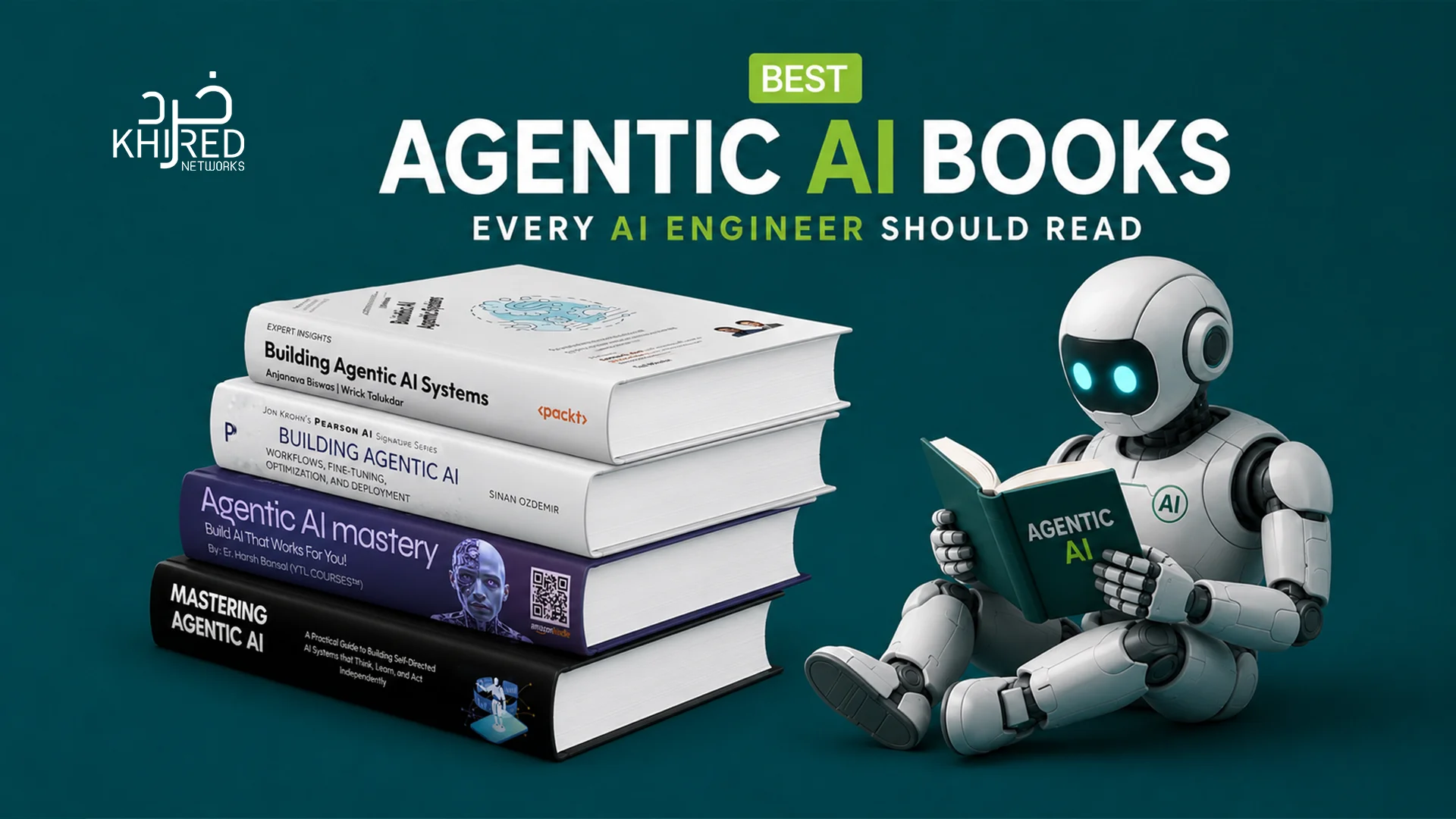
2025 has been heralded as the year of agents. Beyond the hype, building applications that integrate agents is becoming a widely useful skill. But most content online is fragmented, outdated, or written by someone who has never deployed anything into production.
Books still win when you need depth and coherence. A well-structured book gives you a mental model — not just a copy-pasteable code snippet that breaks when the framework updates next month.
The problem is knowing which books to read. Agent-specific content is scattered across blog posts, framework docs, and research papers, with only a handful of books that genuinely address the engineering challenges of production agentic systems.
Most “AI” books still focus on machine learning fundamentals or basic LLM prompting — not on the orchestration, memory management, tool use, observability, and failure handling that separate a demo agent from one you can actually ship.
This list covers both. Fifteen books — categorised by what they teach — selected for engineers who are building serious agentic systems, not just following along with tutorials.
How to use this list: Start with your weakest layer. If you do not understand how LLMs actually work, start with Raschka (#12) or Alammar & Grootendorst (#13). If you understand the LLM layer but struggle with agent architecture, start with the first category. If you are shipping agents but hitting production reliability problems, start with Iusztin & Labonne (#11).
Category 1: Core Agent Architecture & Design Patterns
1. Building Agentic AI Systems
Authors: Anjanava Biswas and Wrick Talukdar Publisher: Packt | Year: 2024
This book dives deep into building autonomous AI agents that can reason, plan, interact with external environments, and take sequences of actions to complete goals. If you’ve been following projects like Auto-GPT, BabyAGI, or LangGraph and want to go beyond reading about them to actually building your own agentic systems, this is the guide. It covers the architectural patterns and design considerations that separate toy demos from robust, deployable agents.
What you will learn:
- How to structure agent reasoning loops without them becoming brittle
- Memory and context management at the architecture level
- Tool integration patterns and failure handling strategies
- Multi-agent coordination fundamentals
Best for: Engineers who want the complete picture of agentic system design — from concept to deployable implementation.
One-line verdict: The most comprehensive single-volume treatment of agentic AI architecture currently available. Start here if you are new to agents.
2. Building Agentic AI
Author: Sinan Ozdemir Publisher: Pearson / Addison-Wesley | Year: 2025
Sinan Ozdemir’s O’Reilly title approaches agentic AI from the angle of an engineer who has built production systems, not a researcher describing what they could be. The book covers the practical mechanics of agent loops, prompt chaining, tool use, and the decision-making architectures that make agents useful for real tasks.
What you will learn:
- The agent loop: perceive, plan, act, observe
- How to architect tool-calling agents that do not hallucinate their way to failure
- Memory patterns: episodic, semantic, and procedural
- Evaluating and testing agent behaviour before deploying to users
Best for: Mid-level engineers who have used LLMs in applications but are new to designing genuinely autonomous systems.
One-line verdict: Practically focused and current — the O’Reilly quality standard applied to agentic AI.
3. Agentic AI Mastery
Author: Tung Knowya Year: 2025
Knowya’s book takes a pattern-based approach to agentic AI — organising content around the recurring design challenges every agent engineer encounters rather than walking through framework documentation. The result is a book that remains useful even as frameworks evolve, because it focuses on why patterns exist rather than how to implement them in a specific library.
What you will learn:
- Eleven core agent design patterns with implementation examples
- How to handle long-horizon task planning with bounded context
- When to use single agents versus multi-agent systems
- Agent safety and boundary enforcement patterns
Best for: Engineers who have built their first agents and are looking to level up their design thinking beyond trial and error.
One-line verdict: The design patterns approach means this book stays relevant longer than framework-specific alternatives.
4. Designing Multi-Agent Systems
Author: Victor Dibia | Year: 2025
Unique angle: Framework-agnostic. Instead of teaching you LangChain or CrewAI, it teaches the patterns those frameworks implement. You build everything from first principles.
For completeness, the book’s GitHub repo also contains examples of the same concepts implemented using the Microsoft Agent Framework (successor to AutoGen and Semantic Kernel), Google ADK, and LangGraph. Best for: Engineers who want to understand multi-agent systems deeply, not just use a framework.
What you will learn:
- Multi-agent system topologies: supervisor, peer-to-peer, hierarchical, pipeline
- How to define agent roles and responsibilities in a coordinated system
- Orchestration patterns for task delegation and result aggregation
- Observability and debugging in multi-agent environments
Best for: Engineers transitioning from single-agent to multi-agent system design, or teams evaluating which orchestration framework to adopt.
One-line verdict: The only book that teaches multi-agent patterns without coupling you to a specific framework — the correct way to build lasting knowledge.
5. Building Applications with AI Agents
Author: Michael Albada Publisher: O’Reilly | Year: 2025
Author Michael Albada provides a practical and research-based approach to designing and implementing single- and multiagent systems. It simplifies the complexities and equips you with the tools to move from concept to solution efficiently. Albada spent years at Uber, ServiceNow, and Microsoft building large-scale multi-agent systems for cybersecurity — and that production experience shows in how the book handles the difficult edge cases other books gloss over.
What you will learn:
- How to choose between LangGraph, AutoGen, and OpenAI Agents SDK for your use case
- Core components: tools, memory, planning, and orchestration in depth
- Agent planning, reasoning, and execution patterns
- Evaluation and observability for multi-agent systems
Best for: Engineers and teams comparing orchestration frameworks, or building agents for specific industries including healthcare, finance, and legal.
One-line verdict: Grounded in real production experience at Uber and Microsoft — rare for a book in this space.
6. AI Agents in Action (Second Edition)
Author: Micheal Lanham Publisher: Manning | Year: 2025
AI Agents in Action shows developers how to build agents they can ship, trust, and maintain. Covers reasoning and planning patterns including ReAct, Reflexion, Tree-of-Thought, and Sequential Thinking. For intermediate Python programmers. The second edition is a substantial revision covering the Model Context Protocol (MCP), containerised deployment, and voice agent orchestration alongside refreshed coverage of LangChain, Prompt Flow, CrewAI, and more.
What you will learn:
- ReAct, Reflexion, Tree-of-Thought, and Sequential Thinking — the reasoning patterns that power production agents
- Multi-agent collaboration and group chat systems using AutoGen and CrewAI
- Agent memory: knowledge management, RAG integration, and feedback loops
- Voice agent orchestration and speech/vision capabilities
Best for: Hands-on engineers who learn by building and want working code alongside the conceptual framework.
One-line verdict: The most comprehensive Manning title on agents — practical, code-heavy, and substantially updated in the 2025 second edition.
7. AI Agents in Action
Authors: Jay Alammar and Maarten Grootendorst Format: Free online guide (illustrated) | Year: 2024–2025
This is not a traditional book — it is a free, extensively illustrated web guide from two of the clearest communicators in the applied ML space. Jay Alammar (known for “The Illustrated Transformer”) and Maarten Grootendorst apply their visual approach specifically to agent concepts: how agent loops work, how tool use is structured, how memory is managed. The guide is linked here because it fills a role no paid book fills: a genuinely approachable visual entry point to agent concepts before committing to a full text.
What you will learn:
- How agent components — memory, tools, planning, perception — fit together visually
- The mental models experienced engineers use to reason about agent behaviour
- Common failure modes illustrated with clear visual diagnoses
Best for: Engineers who think visually, teams onboarding new members, and anyone who has struggled to explain agents to non-technical stakeholders.
One-line verdict: Builds intuition faster than any text-only book — and it is free. Read this before any other item on this list.
8. An Illustrated Guide to AI Agents
Authors: Tom Taulli and Gaurav Deshmukh Publisher: Apress | Year: 2025 (May)
<cite index=”48-1″>Tom Taulli is a consultant to various companies, including Aisera, a venture-backed generative AI startup. He has written several books on AI and has taught IT courses for UCLA, Pluralsight, and O’Reilly Media. Gaurav Deshmukh is a technology leader with over a decade of experience at Guidewire, Cigna, Home Depot, and Amdocs.</cite> The book provides step-by-step guidance on building agents across five frameworks — AutoGen, LangChain, LangGraph, CrewAI, and Haystack.
What you will learn:
- How to implement agents with AutoGen, LangChain, LangGraph, CrewAI, and Haystack
- Practical use cases: product launch agents, financial plan agents, customer service agents, RAG agents
- The trade-offs between each framework for different workloads
- Deployment and monitoring considerations for production agent systems
Best for: Engineering teams evaluating or integrating multiple agent frameworks, and engineers who want hands-on exposure to the full framework landscape.
One-line verdict: The most comprehensive multi-framework treatment available — essential for teams who need to choose and justify their framework stack.
Category 2: Underlying LLM & Framework Engineering
9. AI Engineering
Author: Chip Huyen | Year: 2025
Chip Huyen has been one of the clearest voices in applied machine learning for years, and AI Engineering (O’Reilly, 2025) is arguably her most practical work yet. It covers the full stack of building production LLM applications, from evaluation frameworks and prompt design to agent architectures and real deployment tradeoffs. Huyen’s framing is consistently engineering-first, not research-first, which makes it practical in a way a lot of books in this category miss.
What you will learn:
- Production LLM system design: evaluation, latency, cost, and reliability trade-offs
- Agent architecture patterns from an engineering systems perspective
- Prompt design as a discipline — not a collection of tricks
- How to build AI systems that degrade gracefully rather than fail catastrophically
Best for: The single most important book on this list for engineers who want a complete systems-level mental model. Read this regardless of your current level.
One-line verdict: If you only read one book about shipping AI systems, make it this one.
10. Generative AI Design Patterns
Authors: Valliappa Lakshmanan and Hannes Hapke Publisher: O’Reilly | Year: 2025 (November)
<cite index=”41-1″>Generative AI enables powerful new capabilities, but they come with serious limitations. This book codifies research and real-world experience into 32 tried-and-true design patterns. Each pattern describes a problem, shows a proven way to solve it with a fully coded example, and discusses trade-offs.</cite> Lakshmanan previously co-authored Machine Learning Design Patterns and was Director for Data Analytics and AI Solutions at Google Cloud — the institutional depth shows in the quality of the pattern library.
What you will learn:
- 32 reusable patterns for generative AI system design across content control, RAG, reasoning, reliability, and agents
- Agent-specific patterns: Tool Calling, Code Execution, Multi-agent (Chapter 7)
- Chain-of-Thought, Tree-of-Thought, and structured prompting for reliable reasoning
- Guardrail and safety patterns for production deployments
Best for: Engineers who want a reference book they will return to repeatedly — not a cover-to-cover read but a pattern library for real system design decisions.
One-line verdict: The patterns book the field needed — 32 problems with proven solutions and trade-off discussions.
11. LLM Engineer’s Handbook
Authors: Paul Iusztin and Maxime Labonne | Year: 2024
Published by Packt in late 2024, LLM Engineer’s Handbook reads like it was written by engineers who have hit the same walls you are going to hit. It walks through the full LLMOps pipeline, from feature engineering and fine-tuning to RAG architecture and building systems that stay reliable under real load.
The writing is dense with code and architecture diagrams, which is exactly what you want when you are trying to ship something. There is also a useful chapter on cost optimisation and batching strategies for production agents, areas that get glossed over in most tutorials but become real concerns the moment you start processing meaningful volume.
What you will learn:
- The end-to-end LLMOps pipeline: from data to deployed, monitored system
- Fine-tuning strategies including LoRA and QLoRA with production considerations
- RAG at scale: chunking, embedding, indexing, and retrieval under real load
- Cost optimisation and batching for high-volume agent workloads
Best for: Engineers building production LLM infrastructure who need a complete reference from fine-tuning through deployment and monitoring.
One-line verdict: The most complete single reference for the engineering layer beneath agents — dense, code-heavy, and indispensable.
12. Build a Large Language Model (from Scratch)
Author: Sebastian Raschka | Year: 2024
If you only read one book to truly understand how LLMs work under the hood, make it this one. Sebastian Raschka is one of the most respected educators in the ML community, and this book earns that reputation.
You’ll build a transformer-based LLM from the ground up using PyTorch — covering tokenization, attention mechanisms, model architecture, and training strategies with no hand-waving. Most people who “work with LLMs” are just calling APIs. This book is for the ones who want to know what’s actually happening inside. That knowledge pays dividends across every other book on this list.
What you will learn:
- Transformer architecture from scratch in PyTorch — attention, positional encoding, feedforward layers
- Tokenization, vocabulary construction, and embedding spaces
- Pre-training and fine-tuning from first principles
- Why agent behaviour is predictable or unpredictable based on model internals
Best for: Engineers who call LLM APIs daily but want to understand what is actually happening inside — knowledge that makes every other book on this list more useful.
One-line verdict: The foundation beneath every other book on this list — read this before you build anything serious.
13. Hands-On Large Language Models
Authors: Jay Alammar and Maarten Grootendorst | Year: 2024
Jay Alammar and Maarten Grootendorst’s 2024 O’Reilly book brings visual clarity to applied LLM work. It is one of the best ways to build a genuine mental model of how language models behave under different conditions, which matters a lot when you are designing agents that need to reason, plan, and use tools consistently.
The book covers embeddings, semantic search, text classification, and generation in a way that directly informs how you would design the components inside an agent system.
What you will learn:
- How embeddings work and how to use them effectively in agent memory and RAG systems
- Semantic search implementation — the backbone of most production RAG pipelines
- Text classification, generation, and fine-tuning with Hugging Face Transformers
- The mental model of language model behaviour that helps you predict and debug agent outputs
Best for: Engineers who want applied LLM knowledge with Alammar’s signature visual clarity — particularly useful for those building agent memory and retrieval systems.
One-line verdict: Builds the practical mental model of LLM behaviour that makes agent debugging far less mysterious.
Category 3: Production, Operations & the Full Stack
14. Building Generative AI Agents
Authors: Tom Taulli Publisher: O’Reilly | Year: 2025
Building LLM-Powered Applications is aimed squarely at practitioners building real products. Alto covers LangChain, prompt engineering, memory, chains, and agents in a hands-on way right from the first chapter.
The code examples are current, the architecture patterns are immediately applicable, and there is enough breadth to get from zero to a working prototype faster than most resources allow. Where it stands out for agentic AI is the coverage of agent memory and tool integration — a focused, practical look at structuring agent loops, handling failures gracefully, and chaining models or tools together without things becoming brittle.
What you will learn:
- LangChain fundamentals applied directly to agent construction
- Agent memory architectures and tool integration patterns
- How to handle agent failures gracefully in production
- The trade-offs in any AI-powered system: latency vs accuracy, cost vs capability, automation vs human oversight
Best for: Engineers who want to move from zero to a working LangChain-based agent with proper memory and tool handling, faster than any other book on this list.
One-line verdict: The fastest path from zero to a working production-grade agent prototype.
15. Generative AI with LangChain (Second Edition)
Author: Ben Auffarth | Year: 2024 (Second Edition)
The second edition of this widely read LangChain book is updated with the latest LangChain capabilities, including LangGraph for multi-agent workflows. It offers end-to-end project examples that help developers move from prototypes to production — combining LangChain, LangGraph, multi-agent setups, streaming, and RAG in one volume.
What you will learn:
- LangChain and LangGraph for building multi-agent workflows
- RAG pipeline construction from document ingestion through query handling
- Multi-agent coordination using LangGraph’s stateful graph model
- Streaming, evaluation, and production deployment patterns
Best for: Engineers who are committed to the LangChain/LangGraph ecosystem and want the most current, comprehensive reference for that stack.
One-line verdict: The definitive LangChain + LangGraph reference — saves months of trial-and-error navigating the framework’s rapid evolution.
Recommended Reading Order
Not all 15 books need to be read sequentially. Here is a suggested path based on where you are right now.
If you are new to LLMs and agents: Build a Large Language Model from Scratch (#12) → Hands-On Large Language Models (#13) → An Illustrated Guide to AI Agents (#8) → Building Agentic AI Systems (#1)
If you understand LLMs but are new to agent architecture: Building Agentic AI Systems (#1) → Designing Multi-Agent Systems (#4) → Building Applications with AI Agents (#5) → Generative AI Design Patterns (#10)
If you are building agents in production and hitting reliability problems: AI Engineering by Chip Huyen (#9) → LLM Engineer’s Handbook (#11) → Mastering Agentic AI (#6) → AI Engineering Bible (#15)
If you are a technical lead evaluating frameworks for your team: Designing Multi-Agent Systems (#4) → Building Applications with AI Agents (#5) → Building Generative AI Agents (#14) → Generative AI Design Patterns (#10)
Quick Comparison Table
| # | Title | Author(s) | Publisher | Year | Best For | Level |
|---|---|---|---|---|---|---|
| 1 | Building Agentic AI Systems | Biswas & Talukdar | Packt | 2024 | Full architecture overview | Intermediate |
| 2 | Building Agentic AI | Sinan Ozdemir | O’Reilly | 2025 | Production-focused agent design | Intermediate |
| 3 | Agentic AI Mastery | Tung Knowya | — | 2025 | Design pattern thinking | Intermediate–Advanced |
| 4 | Designing Multi-Agent Systems | Victor Dibia | O’Reilly | 2025 | Framework-agnostic multi-agent | Intermediate–Advanced |
| 5 | Building Applications with AI Agents | Michael Albada | O’Reilly | 2025 | Framework comparison + industry | Intermediate |
| 6 | AI Agents in Action (2nd Ed.) | Micheal Lanham | Manning | 2025 | Hands-on implementation | Intermediate |
| 7 | An Illustrated Guide to AI Agents | Alammar & Grootendorst | Free/Online | 2025 | Visual entry point | Beginner |
| 8 | Building Generative AI Agents | Taulli & Deshmukh | Apress | 2025 | Multi-framework implementation | Intermediate |
| 9 | AI Engineering | Chip Huyen | O’Reilly | 2025 | Complete systems mental model | All levels |
| 10 | Generative AI Design Patterns | Lakshmanan & Hapke | O’Reilly | 2025 | Pattern reference library | Intermediate |
| 11 | LLM Engineer’s Handbook | Iusztin & Labonne | Packt | 2024 | LLMOps & infrastructure | Advanced |
| 12 | Build a Large Language Model | Sebastian Raschka | Manning | 2024 | LLM internals from scratch | Beginner–Intermediate |
| 13 | Hands-On Large Language Models | Alammar & Grootendorst | O’Reilly | 2024 | Applied LLM engineering | Beginner–Intermediate |
| 14 | Building LLM-Powered Applications | Valentina Alto | Packt | 2024 | Fast path to working LangChain agents | Intermediate |
| 15 | Generative AI with LangChain (2nd Ed.) | Ben Auffarth | Packt | 2024 | LangChain + LangGraph reference | Intermediate |
Frequently Asked Questions
Which agentic AI book should I read first?
It depends on your current knowledge level. If you are unfamiliar with how LLMs work under the hood, start with Sebastian Raschka’s Build a Large Language Model from Scratch — that foundational knowledge makes every other book on this list more useful. If you already understand LLMs and want to start building agents, start with Building Agentic AI Systems by Biswas and Talukdar, which gives the most complete single-volume treatment of agent architecture available in 2026.
Are these books still relevant given how fast the AI field moves?
Yes — with one caveat. Books that teach framework-specific API syntax become outdated quickly because LangChain, CrewAI, and AutoGen update constantly. Books on this list that focus on underlying patterns, principles, and architecture (Dibia, Knowya, Raschka, Huyen) remain relevant regardless of which framework is current. When evaluating any AI book, ask: “Is this teaching me how to think, or just how to use a specific version of a specific tool?”
What is the difference between agentic AI books and standard LLM engineering books?
Standard LLM engineering books focus on building applications where the model responds to a prompt — RAG systems, chatbots, summarisation tools. Agentic AI books focus on building systems where the model takes actions, uses tools, manages memory, plans multi-step tasks, and operates autonomously over extended time horizons. The engineering challenges are qualitatively different: agent systems need to handle failure cascades, memory management, tool errors, and non-deterministic execution in ways that standard LLM applications do not.
Which book is best for engineers working in regulated industries?
Mastering Agentic AI by Ted Winston (governance and oversight patterns) and the AI Engineering Bible by Caldwell (enterprise architecture and audit frameworks) are the most directly relevant for engineers in healthcare, finance, or legal environments. Victor Dibia’s Designing Multi-Agent Systems also addresses human-in-the-loop patterns essential for regulated deployments. For GCC and DIFC-regulated environments specifically, these three combined with your institution’s regulatory guidance provide the complete picture.


0 Comments