
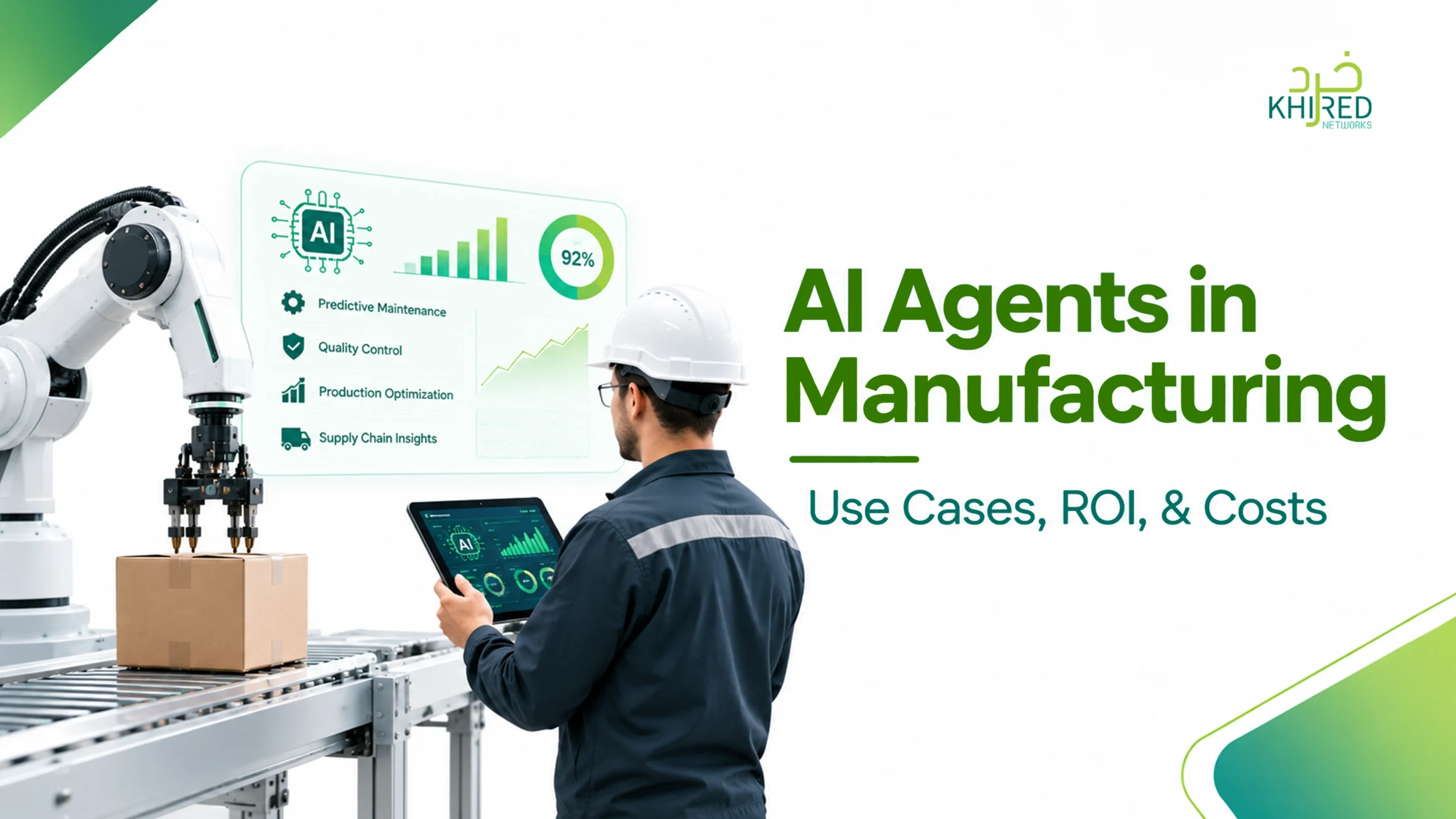
SUMMARY
- According to Future Market Insights, the industrial AI agents market was valued at $5.5 billion in 2025 and is projected to reach $6.88 billion in 2026, growing toward $90.8 billion by 2036 at a CAGR of 25.01%
- AI agents in production deliver an average 171% ROI, with enterprise deployments averaging 540% ROI within 18 months as they scale
- 28% of manufacturers were already running AI agents in production environments in 2025, up from near zero two years earlier
- According to Deloitte, unplanned downtime alone costs the global manufacturing industry up to $50 billion annually, predictive maintenance agents address this directly
- Agent-based automation has been integrated into the digital strategies of approximately 75% of manufacturers globally
- 41% of SMB manufacturers are already running AI agent pilots, with inventory management, quality inspection, and reporting as the most common entry points
- The manufacturers generating the most measurable ROI in 2026 are not deploying AI broadly. They are deploying focused agents against one high-volume, repetitive, data-rich workflow and scaling from there
Most factories already generate enormous volumes of operational data. Sensor readings. ERP records. Shift reports. Procurement history. Quality logs. The data exists. The problem is what happens to it.
Most of it sits in dashboards that nobody has time to monitor consistently. Anomalies are spotted hours or days after they begin. Maintenance work orders are raised manually after a machine flags an error. Procurement teams find out about supplier slippage when it becomes a production delay.
AI agents in manufacturing change this completely.
They do not wait to be asked. They watch operational data continuously, identify the signal that matters, and take the next step: raising the work order, updating the ERP, alerting the right team, rescheduling the production run before a human has noticed the problem.
This guide covers what AI agents actually do in manufacturing settings, the 10 most commercially productive use cases, the ROI evidence from real deployments, what they cost in the UK and USA, and how to start without overcommitting.
What Are AI Agents in Manufacturing?
An AI agent is not a dashboard. It is not a chatbot. It is not RPA.
It is an autonomous software system that perceives operational data from sensors, ERP systems, SCADA platforms, and business tools, reasons through what that data means, and takes action, without a human directing each step, the same design principle behind our AI agentic development and integrations work.
Here is what makes that different in practice.
| Automation Type | How It Works | Limitation |
|---|---|---|
| RPA | Follows fixed scripts on structured data | Breaks when conditions change or exceptions arise |
| AI Copilot | Suggests actions, human approves every step | Passive, cannot act autonomously |
| AI Dashboard | Surfaces data for human review | Human must notice, interpret, and act |
| AI Agent | Perceives, reasons, acts, escalates autonomously | Requires careful scoping and governance |
A predictive maintenance copilot tells an engineer that a bearing might fail. An AI agent detects the anomaly, cross-references maintenance schedules, checks parts availability, raises a work order in the ERP, and alerts operations, before the shift supervisor has finished their coffee.
That distinction between recommending and acting is the entire commercial case for industrial AI agents in 2026.
10 Real-World AI Agent Use Cases in Manufacturing
These ten use cases show where manufacturers are deploying agentic AI today, and the operational gains they are achieving.
1. Predictive Maintenance and Equipment Monitoring
What the agent does: Ingests sensor data continuously: vibration, temperature, pressure, power draw. Detects early failure signatures. Cross-references equipment history, maintenance schedules, and parts availability. Raises a maintenance work order automatically when a threshold is crossed.
Why it matters: According to Deloitte, unplanned downtime costs the global manufacturing industry up to 50 billion dollars annually. The cost is not just the repair. It is idle lines, missed delivery windows, and emergency parts procurement at premium rates.
What it delivers: Documented deployments report reductions in unplanned downtime of 20 to 40 percent, with maintenance teams spending time on confirmed faults rather than reactive callouts.
2. Quality Defect Detection and Routing
What the agent does: Monitors vision or inline inspection data. Groups related defect alerts by batch and machine. Pulls the relevant production and material data. Routes a structured defect report to quality teams rather than a raw alert nobody triages.
Why it matters: Manual defect logging is inconsistent and slow. By the time a pattern is identified in a weekly report, the root cause has often produced further defective output.
What it delivers: Faster root-cause identification, reduced scrap rates, and quality team time redirected from data collection to resolution.
3. Supply Chain Coordination and Disruption Management
What the agent does: Monitors supplier confirmations against production schedules. When a supplier slip is detected, re-runs the supply plan against ERP data. Surfaces the orders and customers at risk. Proposes reallocations for a planner to approve.
Why it matters: Supply chain coordination across multi-modal logistics is one of the most exception-heavy functions in manufacturing. Human coordinators spend enormous time on status calls and manual system updates.
What it delivers: According to production deployment data from Assistents.ai, coordinating port-to-inland logistics operations through AI agents produced higher predictability of throughput and a measurable reduction in coordination overhead for a global operator with over 20 billion dollars in annual revenue.
4. SAP and ERP Order Processing Automation
What the agent does: Interprets incoming order triggers from email, EDI, PDFs, and web forms. Validates data against business rules. Creates sales orders in SAP automatically. Flags exceptions for human approval with full audit trails.
Why it matters: Manual ERP data entry is a consistent source of errors and delays. For manufacturers processing high order volumes, the operational drag compounds daily.
What it delivers: Documented outcomes include reductions in manual processing effort, faster order-to-confirm cycles, fewer data-entry errors, and improved auditability for sales order creation.
5. Procurement Automation and RFQ Management
What the agent does: Identifies sourcing requirements. Matches to qualified suppliers. Generates and distributes RFQ documents. Collects responses. Surfaces price and lead-time comparisons for procurement teams. Monitors vendor performance continuously.
Why it matters: Slow procurement cycles mean missed pricing windows. Poor vendor visibility means supply risk goes undetected until it becomes a production problem.
What it delivers: In a pharma supply chain deployment covering over 7,500 SKUs, AI agents reduced procurement cycle times, improved sourcing visibility, and produced better price competitiveness through continuously updated supplier analytics.
6. Inventory Intelligence Across Distributed Locations
What the agent does: Monitors stock levels against demand signals in real time across multiple locations. Flags replenishment needs. Surfaces pricing exceptions and promotional performance. Answers inventory queries in natural language from operations teams.
Why it matters: National operations at scale suffer from information latency. By the time a weekly report surfaces a stock issue, the sales opportunity is already lost.
What it delivers: In a deployment for a 700-store retail operation, AI inventory agents reduced manual helpdesk burden and improved store-level stock visibility across hundreds of cities simultaneously.
7. Competitive Pricing and Market Monitoring
What the agent does: Monitors e-commerce channels, competitor portals, and distributor networks continuously. Tracks pricing moves, promotional shifts, availability changes, and ratings trends. Alerts leadership when a significant competitive event, such as a price undercut or a new product launch, is detected.
Why it matters: In price-sensitive manufacturing categories such as HVAC, consumer electronics, FMCG, and CPG, a competitor’s pricing move can shift significant volume within days. Manual monitoring across dozens of portals is not scalable.
What it delivers: For a major HVAC manufacturer, AI agents replaced manual portal checks with continuous monitoring, producing faster competitive response cycles and earlier identification of pricing gaps across distribution channels. This is particularly relevant for CPG manufacturers, where promotional timing and pricing parity are direct revenue drivers.
8. Energy Management and Consumption Optimisation
What the agent does: Ingests energy data from campus utilities, building management systems, and IoT sensors. Applies forecasting models to predict consumption patterns. Detects inefficiencies. Generates optimisation recommendations. Triggers proactive alerts when consumption deviates from expected patterns.
Why it matters: Energy is a significant and controllable manufacturing cost. Most manufacturers have the sensor infrastructure to monitor consumption but lack the analytical layer to act on it consistently.
What it delivers: In a campus-scale deployment, AI energy agents delivered improved energy visibility, faster detection of inefficiencies, and reduced manual monitoring effort with demonstrable operational savings through early-alert-driven intervention.
9. Tender and Document Processing
What the agent does: Handles the full lifecycle of complex tender documents: retrieval, classification, data extraction (including from PDFs using vision-language models), validation against system records, change analysis, quote locking, and audit trail maintenance.
Why it matters: Document-heavy procurement workflows, including tenders, contracts, compliance filings, and technical specifications, are a major source of operational drag in manufacturing project management.
What it delivers: In a deployment for a commercial works specialist, a multi-agent document workbench achieved approximately 90 percent faster tender processing and a 95 percent extraction accuracy rate for standard formats, with reduced bid risk through automated revision detection.
10. Agentic Business Intelligence and Shift Reporting
What the agent does: Pulls data from ERP, CRM, and operational databases on a defined schedule. Finds anomalies. Produces a structured management-ready report or a full shift handover summary automatically. Leadership can query data in natural language, such as asking why fulfilment cost spiked in a particular region.
Why it matters: The bottleneck in most manufacturing analytics is not the data. It is the analyst queue and the human handoff between insight and action. Agentic BI collapses that cycle.
What it delivers: According to Lusivision’s 2026 research, one SMB manufacturer deployed a Monday morning reporting agent that pulls from ERP, CRM, and spreadsheets, identifies anomalies, and produces a management-ready PDF, replacing a process that previously took someone half a morning.
AI Agents vs Traditional Automation in Manufacturing
The case for AI-powered manufacturing automation over traditional approaches comes down to one practical distinction: adaptability.
Traditional automation such as RPA, PLCs, and fixed rules engines executes perfectly within the conditions it was designed for. When those conditions change, it breaks or routes to a human exception handler.
Manufacturing operations are full of conditions that change: supplier delays, demand spikes, machine performance drift, regulatory updates, and seasonal shifts in CPG production schedules.
| Factor | Traditional Automation | AI Agents in Manufacturing |
|---|---|---|
| Handles exceptions | No, routes to human | Yes, reasons and adapts |
| Learns from new data | No, requires reprogramming | Yes, improves with deployment |
| Cross-system reasoning | Limited, single workflow | Yes, across ERP, SCADA, WMS |
| After-hours operation | Yes, but no judgement | Yes, with configured governance |
| Setup complexity | Low for simple tasks | Higher, requires scoping |
| ROI ceiling | Fixed, same output indefinitely | Compound, improves over time |
| Handles unstructured data | No | Yes, documents, emails, PDFs |
| Audit trail | Limited | Full, every action logged |
Traditional automation remains appropriate for fully deterministic, high-volume, completely structured processes. AI agents are appropriate for the majority of valuable manufacturing workflows: the ones that involve variability, exceptions, and multi-step reasoning across data sources.
Smart Manufacturing Trends Driving Adoption
Several intersecting smart manufacturing trends are accelerating the deployment of industrial AI agents.
Digital twin integration. Manufacturers running digital twin models of production lines can now connect AI agents directly to twin simulations. Agents test scheduling decisions or maintenance interventions in simulation before committing them to the real line.
Edge AI deployment. AI agents are increasingly running at the edge, on factory-floor hardware close to the sensor data they monitor, reducing latency and enabling real-time intervention without cloud round-trips.
Multi-agent orchestration. Rather than single agents managing one workflow, manufacturers are deploying networks of specialised agents, such as a monitoring agent, a procurement agent, and a scheduling agent, that coordinate across shared data and trigger each other when their respective thresholds are crossed, the same pattern covered in our agentic AI development lifecycle guide.
ERP-native agentic capabilities. SAP, Oracle, and Microsoft Dynamics are all embedding agentic AI directly into their manufacturing modules. Manufacturers already on these platforms can activate agent capabilities without a greenfield deployment.
LLM-powered document intelligence. Vision-language models now extract structured data from complex manufacturing documents, including engineering drawings, quality certificates, and supplier contracts, at accuracy levels that make document processing automation commercially viable for the first time.
AI Agent Cost for Manufacturing: UK vs USA Comparison
Understanding what it costs to build or deploy AI manufacturing solutions is essential for business case development. Costs vary by engagement type, integration complexity, and whether the organisation is using a managed platform or commissioning custom development.
Managed Platform Costs
| Tier | What It Covers | Typical Monthly Cost (USD) |
|---|---|---|
| Entry / Pilot | 1 to 2 agents, limited system integrations | 2,000 to 8,000 dollars per month |
| Department | 3 to 5 agents, ERP/SCADA integration | 8,000 to 25,000 dollars per month |
| Enterprise | Multi-agent orchestration, full governance | 25,000 to 80,000 dollars per month |
| Custom Enterprise | Bespoke development, legacy integration | 50,000 to 200,000 dollars per month |
UK vs USA AI Agent Cost Comparison for Manufacturing
| Cost Factor | UK Market | USA Market |
|---|---|---|
| AI engineer day rate | 600 to 1,200 pounds per day | 1,000 to 2,200 dollars per day |
| Pilot engagement | 20,000 to 60,000 pounds | 30,000 to 90,000 dollars |
| Full production deployment | 80,000 to 300,000 pounds | 120,000 to 450,000 dollars |
| Ongoing managed operations | 5,000 to 20,000 pounds per month | 8,000 to 30,000 dollars per month |
| Managed platform subscription | 2,500 to 60,000 pounds per month | 3,000 to 80,000 dollars per month |
Why the UK is cheaper: UK-based AI agent development, particularly through engineering teams in Pakistan, which UK firms like Khired Networks leverage, delivers the same technical quality at 40 to 60 percent lower cost than equivalent US engagements. This cost differential is most pronounced in custom development and bespoke integration work.
Primary cost drivers in both markets include legacy system integration complexity (older SCADA, on-premises ERP instances, proprietary sensor protocols), the number of concurrent agent workflows, compliance and governance requirements, inference volume at production scale, and ongoing model monitoring and retraining requirements, the kind of work covered under MLOps as a service.
According to House of MVPs’ 2026 analysis, McKinsey’s AI productivity survey found that companies with mature AI agent deployments reported an average 3.4x ROI over 18 months. For manufacturing deployments specifically, the ROI is strongest on high-volume, document-heavy, or monitoring-intensive workflows where the cost of manual processing is well understood before implementation.
How to Start with AI Agent Development for Manufacturing
The manufacturers getting the most out of AI in 2026 followed a consistent pattern. They did not start with a transformation programme. They started with one painful workflow.
According to Lusivision’s 2026 field research, the manufacturers getting value from agents are not the ones who bought the biggest platform. They are the ones who picked one repetitive, expensive job, wired the agent into real plant data properly, and earned the right to expand.
Step 1: Identify the right workflow. Look for the intersection of three things: high process frequency (daily or more), significant manual effort, and a measurable output metric. Predictive maintenance triage and management reporting are consistently strong first choices because they are narrow, measurable, and boring. Boring is where the payback is.
Step 2: Assess your data readiness. An agent is only as good as the data it can access. If asset IDs do not match across your ERP and CMMS, the agent guesses. A guessing agent loses trust fast. Audit data quality for the target workflow before scoping the agent.
Step 3: Run shadow mode first. Let the agent draft the work orders, the reallocation proposals, or the shift reports without executing them. Have your team compare its outputs to their own for three to four weeks. You will learn two things quickly: how often it is right, and where your data is dirty.
Step 4: Deploy with governance from day one. Decide before deployment which actions the agent can take autonomously (draft a work order, surface an alert) and which require human sign-off (release a production hold, place a supplier order). According to Lusivision, an agent with write access is a supplier, not a feature. Treat it the way you would treat a new automation vendor: scoped permissions, a logged trail of every action, a kill switch, and a human accountable for what it does.
Step 5: Scale to the next workflow. Once the first agent is reliably right on its narrow job, widen its authority one action at a time. Then replicate the pattern to the next workflow, following the same staged approach we outline in build versus buy agentic AI.
For a deeper understanding of the full development process, the agentic AI development lifecycle guide from Khired Networks covers every stage from use-case scoping through production governance in detail.
What Real Deployments Deliver
Across manufacturing, logistics, energy, and supply chain deployments, outcomes are consistent.
| Outcome Type | Documented Result |
|---|---|
| Document processing speed | Approximately 90 percent faster on tender and procurement documents |
| Extraction accuracy | 95 percent on standard document formats |
| Unplanned downtime | 20 to 40 percent reduction via predictive maintenance |
| Procurement cycles | Measurable reduction in RFQ turnaround |
| Order processing errors | Reduced through automated ERP validation |
| Coverage without headcount | Multiple deployments show higher operational coverage with no team growth |
| Average enterprise ROI | 540 percent within 18 months (McKinsey, OneReach, 2026) |
The pattern across all deployments is the same: AI agents eliminate the human handoff delays that account for most elapsed time in operational workflows, while providing always-on coverage that human teams cannot sustain economically.
Conclusion
The manufacturers winning in 2026 are not the ones with the most ambitious AI transformation plans. They are the ones who picked one repetitive, expensive operational workflow, deployed an AI agent against it with proper governance, measured the ROI, and scaled from there.
The entry point is smaller than most manufacturers expect. A single-workflow pilot can be scoped, deployed, and delivering measurable results within eight to ten weeks. The investment is a fraction of one year’s cost of the manual process it replaces.
The question for most manufacturing leaders in 2026 is not whether AI agents deliver ROI in manufacturing. The evidence on that is settled. The question is which workflow to start with.
Building AI Agents for Manufacturing and Industrial Operations?
Khired Networks designs and deploys production-grade AI agent systems, from predictive maintenance agents to full supply chain automation, for manufacturers across the UK and Pakistan.
Explore our AI agent development services or book a free discovery call to discuss your first use case.
Frequently Asked Questions
What are AI agents in manufacturing?
AI agents in manufacturing are autonomous software systems that monitor operational data from sensors, ERP systems, SCADA platforms, and business tools, make decisions based on configured objectives, and take actions.
How do AI agents differ from traditional automation in manufacturing?
Traditional automation follows fixed rules and breaks when conditions change. AI agents reason through variable conditions, handle exceptions, and act across multiple systems simultaneously. An RPA script can copy data between systems. An AI agent can detect an anomaly, check parts availability, raise a work order, and alert the right engineer, all as one autonomous sequence.
What is the ROI of AI agents in manufacturing?
According to McKinsey’s 2025 AI productivity survey, companies with mature AI agent deployments report an average 3.4x ROI over 18 months. Enterprise-scale deployments report an average 540 percent ROI within 18 months.
How much do AI agents cost in manufacturing, UK vs USA?
In the UK, a focused pilot engagement for a single manufacturing workflow typically costs 20,000 to 60,000 pounds. A full production deployment runs 80,000 to 300,000 pounds. Ongoing managed operations cost 5,000 to 20,000 pounds per month. US costs are approximately 40 to 60 percent higher across all categories.
What manufacturing processes benefit most from AI agents?
The highest-ROI starting points are predictive maintenance (high data volume, measurable downtime reduction), procurement and RFQ automation (high frequency, clear cost savings), supply chain coordination (exception-heavy, measurable throughput impact), and shift reporting and BI (high frequency, quantifiable time savings). The common thread is high frequency, measurable output, and significant current manual effort.
How do AI agents integrate with SAP and manufacturing ERP systems?
AI agents integrate with SAP and other ERP platforms through API connectors and integration layers. They read context from ERP records and write actions back, creating orders, updating records, and routing approvals, with full governance controls and audit trails. Modern agentic AI platforms support hundreds of enterprise integrations including SAP, Oracle, and Microsoft Dynamics.
Are autonomous AI agents safe to deploy in manufacturing?
Yes, when deployed with appropriate governance. Every production-grade AI agent deployment should include scoped permissions, full audit logs of every action, human approval checkpoints for high-consequence actions, and a kill switch. The risk is not catastrophic failure. It is a mapping error that produces a duplicate order every Tuesday because nobody checks the log. Governance architecture prevents this.
How long does it take to deploy an AI agent in manufacturing?
A focused, well-scoped agent for a single workflow, predictive maintenance alerting, for example, can move from scoping to production-ready in six to ten weeks. Multi-workflow enterprise deployments covering multiple systems and sites typically run over a three-to-four-month phased programme. The critical success factor is starting narrow rather than attempting to automate multiple workflows simultaneously.


0 Comments