
SUMMARY
- A model can achieve 99% accuracy in a notebook and still fail in production. The problem is rarely the algorithm — it is missing data pipelines, deployment infrastructure, and monitoring.
- Choosing between GPT-5 or Claude will not make or break your project. Clean data and reliable deployment determine success. Algorithms are secondary.
- A model that works today may fail next month. Without drift detection and automated retraining, your model decays silently until the business impact is obvious.
A financial services firm spent six months building a fraud detection model. Accuracy on test data exceeded 99%. The data science team celebrated. Then they handed it to engineering for deployment.
Nine months later, it was still not in production.
The problem was not the model. The problem was the process. The team had focused entirely on training an accurate model. And ignored everything else: data versioning, reproducible pipelines, deployment infrastructure, monitoring, and retraining. In short, they understood model development but not the AI project lifecycle.
This guide provides a complete framework for the AI project lifecycle, from initial ideation to ongoing production operations. Whether you are a data scientist, product manager, or business executive, you will understand what it takes to get AI from notebook to production reliably.
What Is the AI Development Lifecycle?
The AI model deployment is the end-to-end process of conceiving, building, deploying, and maintaining artificial intelligence systems. Unlike traditional software development, AI projects involve data, models, and probabilistic outcomes, adding complexity at every stage.
How it differs from traditional software development:
|
Aspect |
Traditional Software |
AI Systems |
|
Primary artifact |
Code |
Code + data + model |
|
Output nature |
Deterministic (same input = same output) |
Probabilistic (same input may vary) |
|
Testing |
Unit, integration, end-to-end |
Adds data validation, model evaluation, drift tests |
|
Failure mode |
Code crash, bug |
Silent accuracy decay, bias, drift |
|
Maintenance |
Bug fixes, feature updates |
Continuous retraining, monitoring, data versioning |
The machine learning lifecycle in the UK follows the same core stages as global best practices, with additional considerations for GDPR, NHS data standards (for health AI), and financial services regulations.
Why AI Projects Fail: 5 Critical Mistakes
The technology works. Models can be trained to impressive accuracy. Yet most AI projects never deliver value. Here is why.
1. No deployment strategy
A team spends months perfecting a model in a notebook. Then they realise they have no way to serve it; no API endpoint, no containerisation, and no scaling plan. The model works beautifully on their laptop. It has no path to production. Deployment must be designed from day one, not bolted on at the end.
2. No monitoring
The model goes live. Everyone celebrates. Then silence. No one tracks prediction accuracy, data distributions, or response times. Weeks later, the model is making systematically wrong predictions, but no dashboard alerts and no PagerDuty wakes anyone up. What you do not measure, you cannot fix.
3. No retraining pipeline
When the model’s performance inevitably decays, because real-world data changes, there is no automated way to retrain it. Someone must notice the problem, manually export fresh data, rerun training scripts, validate the new model, and redeploy. This process takes days or weeks. By then, the damage is done.
4. Poor data quality
The model is trained on historical data that no longer reflects current conditions. Missing values are handled inconsistently. Labels are noisy. Future information leaks into training features. The model learns patterns that do not exist in the real world. Garbage in equals garbage out; no algorithm can compensate for bad data.
5. Handoff gap between data science and engineering
Data scientists build models in Python notebooks using one set of libraries. Engineers need to serve models in production using another stack. The two teams speak different languages, use different tools, and have different incentives. Without shared processes and handoff protocols, the model dies in the gap, perfect in research and absent in production.
The AI Development Process
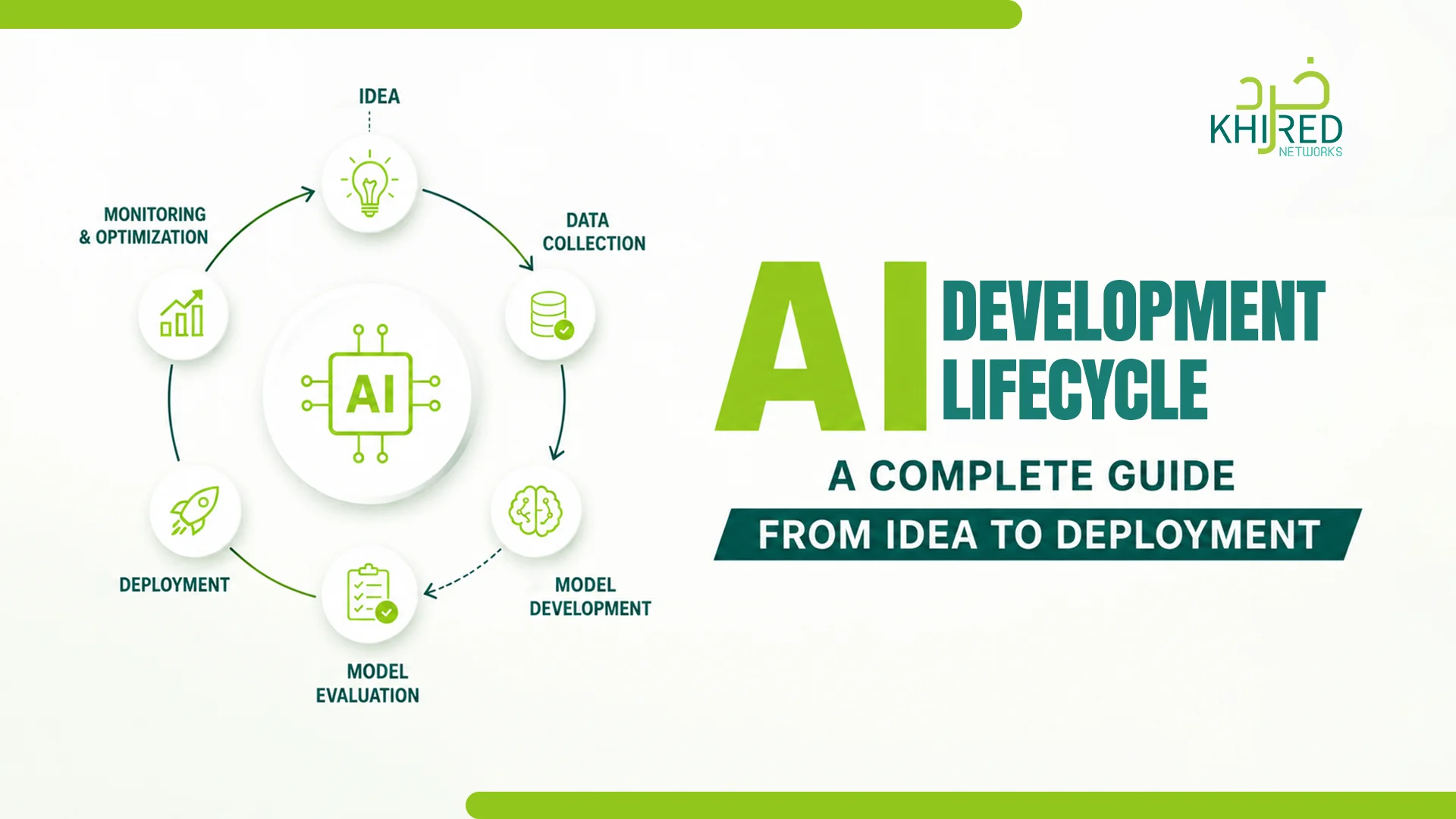
Here is the step-by-step breakdown of the AI development lifecycle:
Stage 1: Ideation & Problem Definition
Every successful AI project starts with a clear answer to one question: What business problem are we solving?
Key Activities
- Identify a specific, measurable business problem that AI can address
- Assess whether AI is the right solution (rule-based systems may be simpler, cheaper, and more predictable)
- Define success metrics: accuracy, precision, recall, business impact (cost saved, revenue generated)
- Estimate ROI: development cost vs expected benefit
Common Pitfalls
Starting with technology (“let’s use AI”) instead of a problem (“customers wait too long for responses”). Building solutions in search of problems. Failing to define measurable success criteria.
Sample Problem Statement
“Reduce customer support response time for order status inquiries from 4 hours to under 2 minutes by automating 70% of WISMO queries.”
Stage 2: Data Collection & Preparation
AI models learn from data. If the data is wrong, incomplete, or biased, the model will be too. This stage is often the most time-consuming and the most critical.
Key Activities
- Data sourcing: Identify internal databases, external APIs, user-generated data, or third-party datasets
- Data collection: Extract, aggregate, and store raw data
- Data cleaning: Handle missing values, remove duplicates, correct inconsistencies
- Data labelling: For supervised learning, annotate data with correct outputs (e.g., “spam” or “not spam”)
- Data splitting: Divide into training (60-80%), validation (10-20%), and test (10-20%) sets
- Data versioning: Track which data version produced which model — essential for reproducibility and auditability
Common Pitfalls
Training on historical data that no longer reflects current conditions. Leaking future information into training data. Ignoring class imbalance (e.g., 99% non-fraud, 1% fraud — a model that always predicts “non-fraud” is 99% accurate but useless).
Stage 3: Model Development & Training
This is what most people think of as “AI development” but it is only one stage in the lifecycle.
Key Activities
- Feature engineering: Transform raw data into inputs the model can use effectively
- Algorithm selection: Choose model types based on problem: classification, regression, clustering, recommendation, etc.
- Hyperparameter tuning: Optimise model settings (learning rate, tree depth, number of layers)
- Training: Feed training data to the model, allowing it to learn patterns
- Validation: Evaluate performance on validation data, tune hyperparameters, prevent overfitting
- Experiment tracking: Record every run’s parameters, metrics, and model artifacts for reproducibility
Common Pitfalls
Overfitting to training data (model memorises instead of generalises). Underfitting (model too simple for problem complexity). Not comparing against simple baselines (a linear model might perform just as well as a neural network at lower cost).
Sample Evaluation Metrics
|
Problem Type |
Common Metrics |
|
Classification |
Accuracy, precision, recall, F1, AUC-ROC |
|
Regression |
MAE, RMSE, R-squared |
|
Recommendation |
Precision@k, Recall@k, NDCG |
|
Ranking |
Mean Average Precision (MAP) |
Stage 4: Testing & Validation
Before deployment, the model must be tested not just for accuracy but for robustness, fairness, and safety.
Key Activities
- Holdout testing: Evaluate final model on test data never seen during training
- Cross-validation: Assess performance stability across different data subsets
- Bias testing: Check for disparate impact across demographic groups
- Robustness testing: Evaluate performance on edge cases, adversarial inputs, and out-of-distribution data
- Explainability: Use SHAP, LIME, or attention visualisation to understand why the model makes specific predictions
Common Pitfalls
Testing only on clean, well-formatted data. Ignoring real-world noise, missing values, and unexpected inputs. No bias testing for regulated applications (hiring, lending, healthcare).
Stage 5: AI Model Deployment (From Notebook to Production)
Deployment is where many AI projects die. The gap between notebook and production is wide — and crossing it requires infrastructure, not just code.
Key Activities
- Model packaging: Serialise model (ONNX, TensorFlow SavedModel, pickle) with dependencies
- Inference environment setup: Deploy as a REST API, batch job, or edge deployment
- CI/CD for models: Automated pipeline for testing and deploying new model versions
- Canary deployment: Roll out to a small percentage of traffic before full release
- Shadow deployment: Run new model alongside production model to compare performance without impacting users
Deployment Patterns
|
Pattern |
Description |
Best For |
|
REST API |
Model served as a microservice |
Real-time predictions |
|
Batch inference |
Model processes data in scheduled jobs |
Recommendations, reports |
|
Edge deployment |
Model runs on device (phone, sensor) |
Low latency, offline needs |
|
Streaming |
Model processes real-time event streams |
Fraud detection, monitoring |
Stage 6: Monitoring & Maintenance
Deployment is not the end, it is the beginning of ongoing operations.
Key Activities
- Performance monitoring: Track prediction accuracy, latency, throughput
- Data drift detection: Monitor input data distributions for statistically significant changes
- Concept drift detection: Detect when the relationship between inputs and outputs changes
- Alerting: Trigger notifications when metrics fall below thresholds
- Automated retraining: Trigger new training pipeline when drift is detected or on schedule
What to Monitor
|
Metric Type |
What It Measures |
|
System metrics |
Latency, throughput, uptime, error rate |
|
Model metrics |
Accuracy, precision, recall, F1 (where ground truth available) |
|
Data metrics |
Input distribution, feature statistics, missing value rate |
|
Business metrics |
Conversion, cost saved, user satisfaction |
Common Pitfalls
No monitoring at all, the model could fail silently for months without anyone noticing. Monitoring accuracy without monitoring drift. Accuracy may stay high while the model makes systematically wrong predictions for specific subgroups.
Stage 7: Retraining & Iteration
Models decay. Data changes. Business requirements evolve. The AI build and deployment lifecycle is cyclical, not linear.
Key Activities
- Scheduled retraining: Retrain weekly, monthly, or quarterly on fresh data
- Trigger-based retraining: Retrain when drift exceeds the threshold or when new labelled data accumulates
- A/B testing: Compare new model versions against the current production version
- Model versioning: Maintain a registry of all models with performance metrics, training data versions, and deployment dates
- Deprecation: Retire old model versions systematically
Team Roles Throughout the Lifecycle
Different stages require different expertise.
|
Stage |
Key Roles |
|
Ideation |
Product manager, business stakeholder, data scientist |
|
Data preparation |
Data engineer, data analyst, domain expert |
|
Model development |
Data scientist, ML engineer |
|
Testing |
ML engineer, QA engineer, domain expert |
|
Deployment |
ML engineer, DevOps engineer, platform engineer |
|
Monitoring |
ML engineer, data scientist, SRE |
|
Retraining |
ML engineer, data engineer |
Common Failure Modes by Stage
|
Stage |
Most Common Failure |
|
Ideation |
No clear business problem — building AI for AI’s sake |
|
Data prep |
Training on data that doesn’t reflect production conditions |
|
Model training |
Overfitting, no baseline comparison |
|
Testing |
No bias or robustness testing |
|
Deployment |
Handoff gap — data scientists “throw models over the wall” |
|
Monitoring |
No monitoring — model decays silently |
|
Retraining |
Manual retraining — slow, inconsistent, forgotten |
MLOps: The Discipline That Connects It All
The AI system development process cannot succeed without MLOps. The practices that bridge model development and production operations.
What MLOps adds:
- Versioned data and models (not just code)
- Automated retraining pipelines
- Drift detection and alerting
- Model registry with audit trails
- Reproducible experiment tracking
Without MLOps, each stage operates in isolation. With MLOps, the lifecycle becomes a continuous, automated, auditable loop.
Conclusion
The end-to-end AI development journey does not end with an accurate model. It ends with a reliable, monitored, continuously improving system that delivers business value.
The seven-stage framework provides a roadmap:
- Ideation — solve a real problem
- Data preparation — quality in, quality out
- Model training — learn from data
- Testing — validate for accuracy, bias, robustness
- Deployment — get to production reliably
- Monitoring — detect drift and decay
- Retraining — maintain performance over time
Skipping stages or treating them as optional is why most AI projects fail to reach production. Following them systematically is how successful AI systems are built.
Ready to Build Production-Ready AI?
Khired Networks specialises in end-to-end MLOps pipeline management. From ideation to deployment, monitoring to retraining. We build AI systems that work reliably in production.
Contact Khired Networks today for a free consultation. Let us discuss your AI project and build a system that delivers lasting business value.
Frequently Asked Questions
What is MLOps?
MLOps (Machine Learning Operations) is the discipline that bridges model development and production operations. It includes data versioning, experiment tracking, model registries, automated retraining pipelines, drift detection, and monitoring.
What are the stages of the AI development lifecycle?
The seven stages are: ideation & problem definition, data collection & preparation, model development & training, testing & validation, deployment, monitoring & maintenance, and retraining & iteration.
How does AI development differ from software development?
Traditional software produces deterministic outputs from code. AI produces probabilistic outputs from data + code + models. AI requires data versioning, experiment tracking, drift monitoring, and continuous retraining; none of which exist in traditional software.
Does the EU AI Act apply to UK companies?
Yes, if you deploy AI in the EU market or your system affects EU citizens. The UK is no longer an EU member, but the Act has extraterritorial reach. Many UK companies serving EU customers or with EU operations must comply. UK-specific AI regulation is also developing.
What is ISO 42001, and do we need it?
ISO 42001 is the international standard for AI management systems, covering risk management, transparency, data governance, and continuous improvement. You need it if customers or regulators require certification. It is not yet mandatory, but it is becoming a procurement standard.
How long does it take to develop an AI system?
It may take 2-4 months. An enterprise-scale AI system with custom infrastructure, compliance, and MLOps typically takes 6-12 months for initial deployment. Complexity, data availability, and compliance requirements drive timelines.
What is responsible AI development?
Responsible AI means building systems that are fair (no disparate impact), transparent (explainable decisions), accountable (auditable), private (data protected), and safe (robust to edge cases).
How to build an AI governance framework in the UK?
Start with a cross-functional committee (legal, data science, product, compliance). Document risk assessments for each AI system. Establish data governance, model testing standards, and human oversight protocols. Align with ICO guidance on GDPR and monitor evolving UK AI regulation.


0 Comments
Trackbacks/Pingbacks