
SUMMARY
- Define specific, measurable outcomes before selecting any AI tool.
- Clean, governed data and reliable deployment matter more than model choice.
- Data prep consumes 30-50% of budgets. Ongoing monitoring and retraining add 15-30% annually.
- Fairness, privacy, and accountability must be designed in — not bolted on later.
- The best AI system is useless if nobody trusts or uses it. Engage people early.
Artificial intelligence promises transformation. It also promises failure. According to market intelligence firm IDC, only 13% of AI implementation projects were successful in 2024. Among 100 organisations that undertake AI-driven digital transformations, about 20 reach a satisfactory level of success. The gap between ambition and execution is wide and growing wider as AI adoption accelerates.
The problem is rarely the technology itself. It is the artificial intelligence strategy, or lack thereof. Organisations jump into AI without clear objectives, struggle with poor data quality, underestimate integration complexity, and fail to build the governance structures needed for sustainable success.
This guide provides a comprehensive AI implementation framework, a step-by-step roadmap to move from aspiration to execution. Whether you are a business leader, transformation lead, or technology executive, you will understand what successful AI implementation requires.
Why Most AI Implementation Strategies Fail
92% of middle market executives experienced challenges with AI implementation in 2025. 62% said generative AI was harder to implement than expected.
The Five Internal Hurdles to AI Implementation
According to research examining GenAI adoption in business, most organisations face five interconnected barriers that derail AI initiatives. Each must be addressed systematically.
1. Management hurdles
Leaders struggle to justify AI investments when returns are uncertain and timelines are vague. Without a clear business case, budgets are cut, projects are deprioritised, and AI initiatives die before they start.
The absence of a structured strategy means teams build solutions in search of problems — investing in technology without understanding what they are trying to achieve.
2. Data challenges
AI models are only as good as the data they are trained on. Yet most organisations operate with fragmented data across disconnected systems, inconsistent formats, and poor traceability. AI models trained on poor-quality data hallucinate, erode trust, and deliver misleading outputs.
The cost of fixing data issues (cleaning, labelling, structuring) typically consumes 30-50% of the total project budget. Yet it is often underestimated or ignored.
3. IT systems barriers
AI cannot be bolted onto outdated systems. Legacy infrastructure, decades-old databases, monolithic architectures, and custom-built applications, was never designed for AI workloads.
Integration becomes a costly, time-consuming exercise. Without modern architecture and phased migration plans, AI projects stall, overrun budgets, and fail to deliver on their promise.
4. Workforce gaps
Demand for AI talent outpaces supply, leaving organisations unable to hire the data scientists, ML engineers, and MLOps specialists they need. Even when hiring is possible, organisational resistance slows progress.
Employees fear displacement, distrust AI outputs, and resist changes to established workflows. Training and upskilling internal teams is an essential but often overlooked investment.
5. Governance and compliance blind spots
Many organisations treat AI governance as an afterthought — something to address “later.” But regulators, customers, and procurement teams are increasingly demanding proof of responsible AI.
Without clear accountability structures, bias detection protocols, and compliance frameworks (GDPR, EU AI Act, ISO 42001), AI projects become liabilities. A single compliance failure can destroy trust, invite fines, and undo years of progress.
Technological, Organisational, and Ethical Barriers
The challenges of AI adoption fall into three categories:
| Category | Key Barriers |
| Technological | Strong computational infrastructure required; data accessibility and quality issues; integration complexity with existing systems |
| Organisational | Labor skill gaps; resistance to change; misalignment between AI aspirations and business objectives |
| Ethical | Biases in AI algorithms; data privacy concerns; wider social effects of AI deployment |
The World Economic Forum identifies six common reasons why AI initiatives fail to deliver business value:
- capability gaps,
- unavailable or poor-quality data,
- technology foundations not in place,
- poor governance structure,
- lack of understanding about project finance,
- lack of understanding about project management in AI.
Successful AI implementation requires addressing all five hurdles simultaneously. Technology alone is never enough.
The AI Implementation Roadmap: Seven Stages to Success
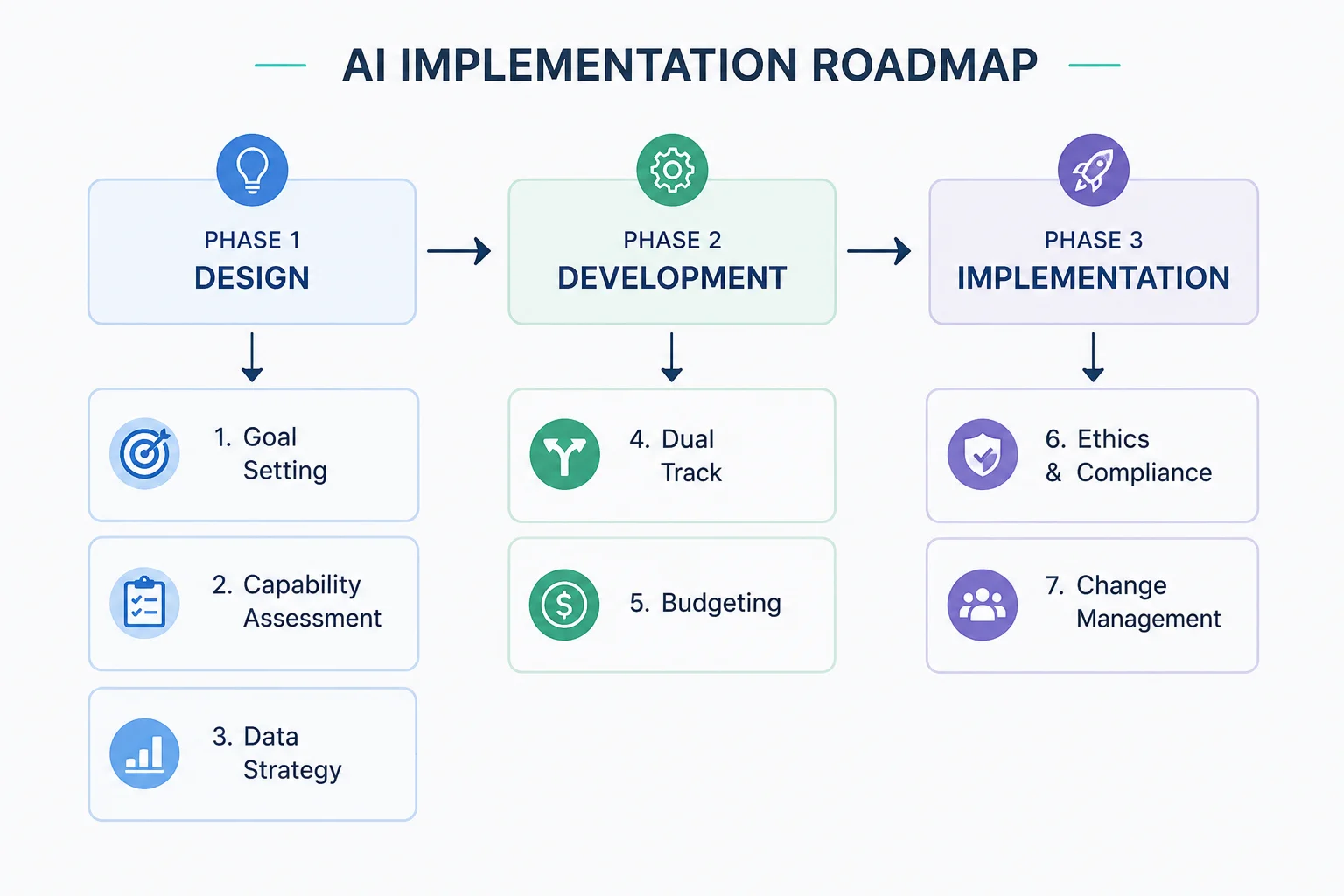
Based on research from LSE Business Review, the AI implementation journey follows seven stages, grouped into three macro-phases: design, development, and implementation.
Phase 1: Design Your AI Strategy
Stage 1: Goal Setting — Start with Business Problems, Not Technology
An AI strategy defines how data and intelligent systems will align with the organisation’s broader strategy. Strategic alignment is the cornerstone of success.
The biggest mistake: Starting with “let’s use AI” instead of “what problem are we solving?”
How to set effective AI goals:
- Define the business problem clearly: What inefficiency, opportunity, or customer pain point are you addressing?
- Translate into AI objectives: Intelligent technologies excel at predicting and optimising tasks your organisation performs frequently and for which abundant data are available.
- Identify automation potential: Look for repetitive tasks, data-heavy operations, or areas with high error rates.
- Set measurable success metrics: Generalised “efficiency” and “better decisions” are insufficient. Use quantifiable indicators: 30% reduction in processing time, 15% increase in conversion, 50% decrease in manual errors.
- Gather customer feedback: Uncover use cases that would have an impact on customer satisfaction when automated with AI.
- Explore industry use cases: Research how similar organisations or industries solve problems with AI.
Example Goal Setting:
- Vague: “We want AI to improve customer service.”
- Specific: “Reduce customer support response time for order status inquiries from 4 hours to under 2 minutes by automating 70% of WISMO queries using an AI chatbot.”
A critical aspect of integration is discerning which tasks are best suited for automation versus which require human judgment. Identifying the right balance between AI and human input is crucial for maximising efficiency and effectiveness.
Stage 2: Capability Assessment — Audit Your Readiness
To obtain and maintain a competitive edge, organisations need unique resources: tangible (hardware), intangible (data), and organisational (employee skills).
What to assess:
| Capability Area | What to Evaluate |
| Technology infrastructure | Existing IT systems, cloud readiness, legacy constraints |
| Data maturity | Availability, quality, accessibility, governance maturity |
| Talent & skills | Data scientists, ML engineers, AI literacy across teams |
| Data management | AI project management capability, MLOps readiness |
| Organisational readiness | Leadership commitment, culture of innovation, change appetite |
How to assess:
- Create an IT and skills inventory: Document existing systems, data sources, and technical capabilities.
- Conduct an AI maturity assessment: Gauge overall organisational readiness and plan accordingly.
- Identify non-AI key resources: Your brand, network, and domain expertise are valuable assets. Identify which ones could be replaced by AI and how to combine AI with non-AI resources to create an even bigger advantage.
- Audit existing AI features: Many organisations overlook that AI applications are already embedded in their technology platforms — ERP, CRM, HR systems, and productivity tools. Exploring these options first represents the quickest, lowest-friction wins.
Stage 3: Data Strategy — Build the Foundation
“The effectiveness of AI depends on the quality and volume of accessible data.” A robust data strategy is necessary to outline how the organisation collects, manages, and uses data, keeping it accurate, accessible, and safe throughout its life cycle.
Key elements of a data strategy:
Data Governance: Restrict internet-facing workloads to public data only. Allow internal workloads to use business data with defined data access boundaries. Use data governance tools to govern and classify data.
Data Scalability: Anticipate the volume, velocity, and variety of data required. Choose flexible architectures capable of scaling according to demand.
Data Lifecycle Planning
| Stage | Key Considerations |
| Collection | Identify data sources (databases, APIs, IoT devices, third-party). Maintain data lineage. |
| Storage | Align storage solutions with data type (structured, unstructured, real-time). |
| Processing | Use ETL/ELT pipelines to ensure data quality and readiness. |
| Auditing | Implement regular audits to identify and mitigate bias within AI datasets. |
Critical warning: Recent findings suggest that using AI-generated content in model training can lead to significant biases in the models, emphasising the importance of data quality. The ability to ensure that humans perform critical tasks unaffected by AI biases is emerging as a competitive differentiator.
Phase 2: Develop and Validate
Stage 4: Dual-Track Implementation — Pilot and Build Foundations Simultaneously
While this stage sits squarely in the middle of the roadmap, this position may be somewhat inaccurate. Running pilots is often one of the earliest steps organisations undertake and rightly so.
There are many lessons to be learnt from running pilots, which come in very handy at later stages, and they help build momentum for more substantial AI projects.
Why dual-track matters:
- Pilots prove value quickly: Small-scale projects build confidence, demonstrate ROI, and create internal advocates.
- Foundations enable scale: While pilots run, build the infrastructure, governance, and processes needed for enterprise-wide deployment.
- Learning informs strategy: Pilots reveal what works (and what doesn’t) before committing to large-scale investment.
AI pilot best practices:
- Start with a clearly defined use case with measurable success metrics
- Keep the scope narrow and timeframe short (8-12 weeks)
- Engage end-users early for feedback
- Document lessons learned rigorously
- Treat pilot success as validation and pilot failure as valuable learning
The World Economic Forum recommends a “dual effort” approach, creating the foundations for substantial AI projects while simultaneously running pilots to build momentum.
Stage 5: Budgeting — Plan for Reality, Not Perfection
“AI is evolving at such a rapid pace that budgeting even a year ahead is very challenging. Cost curves can suddenly drop.”
What to include in your AI budget:
| Cost Category | What It Covers |
| Technology | Compute, storage, platforms, tools, licences |
| Data | Collection, cleaning, labelling, storage, governance |
| Talent | Hiring, training, consulting, upskilling |
| Integration | Connecting AI to existing systems, APIs, middleware |
| Governance | Compliance, ethics reviews, auditing, monitoring |
| Change management | Training, communications, support |
| Ongoing operations | Maintenance, updates, monitoring, retraining |
Why traditional budgeting fails:
- Hidden costs: Costs with user feedback loops, subsequent reworks, or funds for cleaning, normalising, and cataloguing data are typically not even included in ROI calculations.
- Rapid evolution: New applications may become available that create unprecedented savings or revenues.
- Infrastructure demands: AI requires modern architecture; legacy systems cannot be retrofitted.
Recommended approach: A more incremental and flexible approach to budgeting minimises the risk of major budget overruns and lets you collect valuable data to develop stronger business cases for more substantial investments.
Phase 3: Implement and Sustain
Stage 6: Ethics and Compliance — Build Responsibility In
“Technologies are not intrinsically good or bad. It’s how we use them that defines their value and impact. But AI is different. It stands apart due to its profound capabilities and potential risks.”
Five Pillars of Responsible AI (ESCP framework):
- Fairness: Prevent bias and disparate impact
- Safety: Protect users and systems from harm
- Privacy: Protect data throughout the lifecycle
- Transparency: Explain how decisions are made
- Accountability: Assign ownership and responsibility
Compliance considerations:
- UK GDPR: AI processing personal data requires DPIA, legitimate interest assessment, and transparency obligations
- EU AI Act: Applies to UK companies serving EU markets or affecting EU citizens
- Sector regulations: Healthcare (MHRA, DCB0129), finance (FCA), etc.
- ISO 42001: International AI management systems standard — increasingly required in procurement
Every AI project needs to carefully consider and assess the impact of its implementation at the individual, organisational, and societal levels. A high-value AI strategy brings a positive impact on societal values.
Careful monitoring of biases and ethics-related aspects in the design and development phases is crucial to avoid risks in the implementation phase.
Stage 7: Change Management — Technology Alone Is Not Enough
“Some people seem to think that as soon as they have access to the latest technology, they have a digital organisation. Technology is only part of the story.”
The human side of AI implementation:
- Align with stakeholders
Engage internal and external stakeholders early. Build a shared vision for AI integration. Address concerns transparently.
- Nurture a digital culture
Foster an organisational culture that understands and trusts AI. Open dialogues about the technology’s capabilities, limitations, and optimal use cases are essential.
- Upgrade digital capabilities
Continuously upskill employees. AI literacy should be organisation-wide — not limited to technical teams. The synergy between technical and human assets is key to realising the full potential of AI.
- Address resistance proactively
Success in this domain depends not only on redefining processes but also on fostering an organisational culture that understands and trusts AI. Open dialogues about the technology’s capabilities, limitations, and optimal use cases are essential to develop a shared vision for AI integration.
Training employees and engaging them in AI strategy development is critical. AI without human intervention can lead to a “lack of nuance”.
The Buy-Configure-Build Decision Framework
A critical part of your AI implementation strategy is deciding what to buy, configure, or build.
| Approach | Description | Best For |
| Buy (Embedded AI) | Using AI features already in your existing platforms (ERP, CRM, productivity tools) | Quick wins, no new data pipelines, low change management |
| Configure (Tailored Intelligence) | Extending vendor copilots with your proprietary enterprise data | Making AI more relevant to your specific language, processes, and metrics |
| Build (Custom AI) | Developing bespoke AI solutions unique to your business model |
Competitive differentiation, compliance, unique workflows
|
How to decide:
- Does this tool solve a real business problem?
- Does it align with my data and processes?
- Does it create an advantage or just keep me on par with competitors?
The benefit of today’s purpose-built solutions is new industry-specific accelerators that help accelerate time to value and bring stability to deployments in ways that were previously cost- or time-prohibitive.
The Business Case for AI Implementation
Costs to consider:
| Cost Category | Typical Range (UK, 2026) |
| AI platform/subscription | £500-£5,000/month |
| Custom AI development | £15,000-£500,000+ |
| Data preparation | 30-50% of total project cost |
| Integration | 10-25% of total project cost |
| Change management & training | 10-20% of total project cost |
| Ongoing operations | 15-30% of initial project cost annually |
Benefits to measure:
- Direct cost savings from automation
- Revenue increases from improved customer experience
- Productivity gains from employee augmentation
- Risk reduction from better decision-making
- Competitive advantage from faster innovation
Common pitfall: Ignoring costs for user feedback loops, reworks, data cleaning, and cataloguing. These are typically not even included in ROI calculations.
Conclusion
Successful AI adoption follows a clear AI implementation framework: design your strategy around business problems, develop with data excellence and validated pilots, implement with ethics, compliance, and change management.
The organisations that succeed are not those with the most advanced technology. They are those who:
- Start with clear business problems, not technology
- Invest in data quality and governance from day one
- Balance quick wins with long-term foundation-building
- Build responsible AI into every stage, not as an afterthought
- Treat change management as essential, not optional
The journey is complex. But the roadmap is clear.
Ready to Implement Your AI Strategy?
From AI readiness assessment and use case identification to custom solution development and MLOps infrastructure, we guide you from aspiration to production.
Contact Khired Networks today for a free AI strategy consultation. Let us assess your readiness, identify your quick wins, and build a roadmap that works for your business.
Frequently Asked Questions
What is an AI implementation strategy?
An AI implementation strategy is a structured plan that defines how an organisation will design, develop, and deploy artificial intelligence solutions to achieve specific business objectives.
Why do most AI projects fail?
IDC research found only 13% of AI implementation projects were successful in 2024. Common failure factors include poor strategic alignment, capability gaps, unavailable or poor-quality data, inadequate technology foundations, poor governance structure, and lack of understanding about project finance and management.
What are the stages of AI implementation?
The roadmap includes seven stages: goal setting, capability assessment, data strategy, dual-track implementation, budgeting, ethics and compliance, and change management.
Should we buy, configure, or build AI solutions?
Start by auditing existing AI features in your current technology platforms (quickest wins). Then consider extending vendor tools with your proprietary data. Only build custom AI where it creates competitive advantage, compliance, or unique business value.
What data do I need for successful AI implementation?
AI requires properly governed data. This includes data collection, storage, processing, and auditing. Recent findings suggest that using AI-generated content in model training can lead to significant biases, making data quality a critical competitive differentiator.
How much does AI implementation cost?
Costs vary widely based on complexity, scale, and approach. AI platform subscriptions range from £500-£5,000 monthly. Custom AI development can cost £15,000 to £500,000+. Data preparation typically accounts for 30-50% of total project cost. Ongoing operations run 15-30% of initial project cost annually.
What is responsible AI?
Responsible AI ensures AI systems are fair, safe, private, transparent, and accountable. It requires continuous monitoring of biases, compliance with regulations, and alignment with societal values.
How can I implement AI into my business?
Start with a specific business problem, assess your data quality and infrastructure, choose between buying, configuring, or building AI solutions, run a small pilot, and plan for ongoing monitoring and retraining. Success depends on data readiness and change management, not just technology.
How to implement AI in SAP?
Explore SAP Business AI features already in your S/4HANA, SuccessFactors, or Ariba. Extend with your proprietary data using SAP’s generative AI hub. Work with a certified partner for complex integrations. Start with high-impact use cases like invoice processing, predictive analytics, or intelligent sourcing.
How do I measure the success of AI implementation?
Measure success against the specific business metrics you defined before starting, not general AI metrics like accuracy. Track cost savings, revenue increases, productivity gains, customer satisfaction improvements, or error reduction.


0 Comments