
SUMMARY
- IVR uses fixed keypad menus, while IVA uses conversational AI to understand natural speech.
- Traditional IVR contains only 5 to 10 percent of calls without an agent (Teneo, 2026).
- Enterprise IVA systems can reach 60 to 90 percent containment on the same call types (Teneo, 2026).
- IVR is cheaper to set up, but costs more per unresolved call that reaches a human.
- IVA needs conversation design, integrations, and ongoing review, not just a menu script.
- The line is blurring, since conversational IVR now sits between the two older categories.
Press 1 for sales. Press 2 for support. Most callers have met this menu, and most have hated it. According to containment benchmarks published by Teneo (2026), a traditional menu-based IVR resolves only 5 to 10 percent of calls without a human. An intelligent virtual agent can reach 60 percent or more.
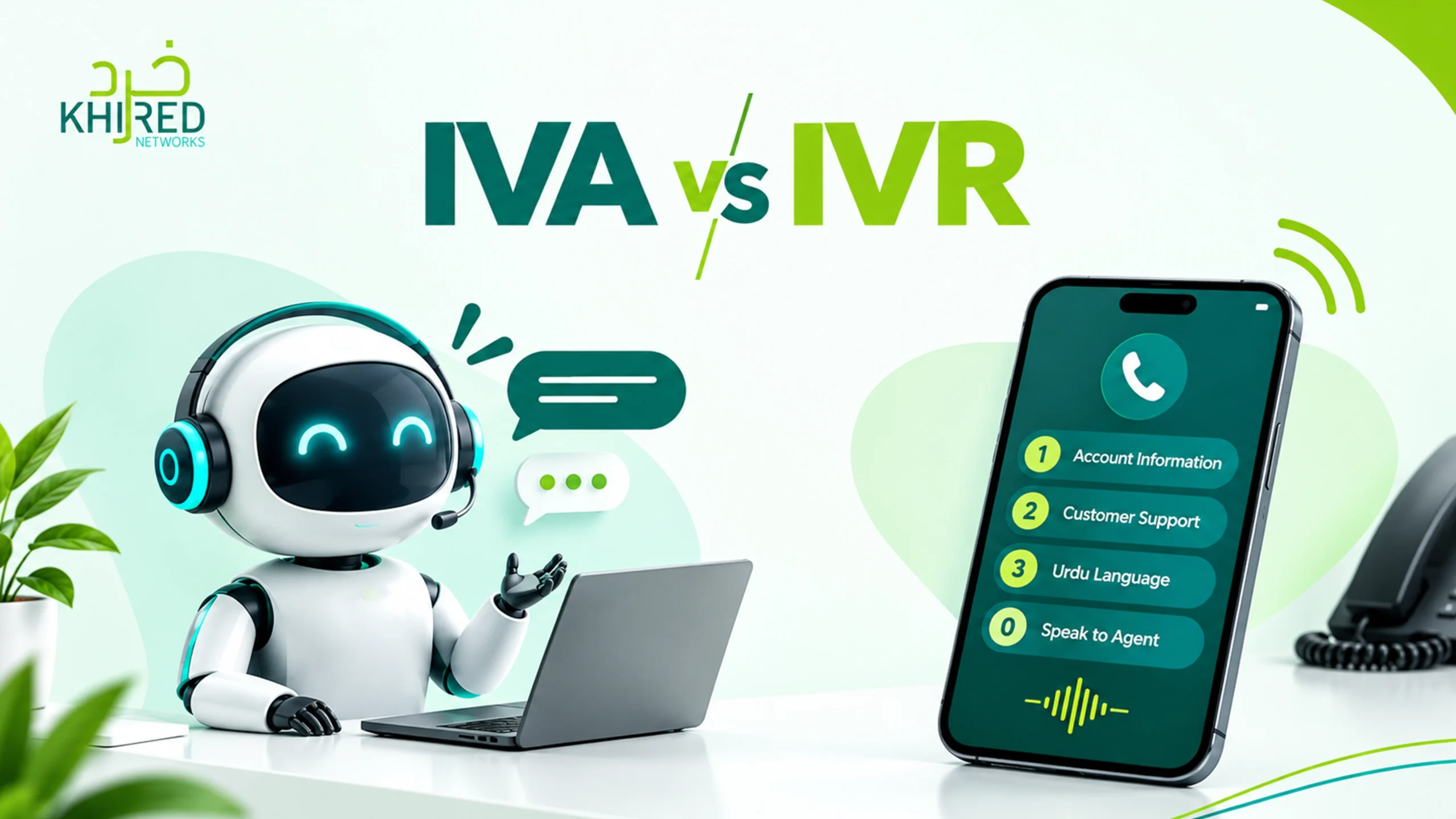
That gap is the whole story. An IVR routes calls through fixed menus. An IVA understands what the caller actually wants and resolves it.
Most businesses still run an IVR built a decade ago. They lose callers, agents, and money to a menu tree. This guide compares IVA vs IVR on technology, cost, and containment, then shows which one fits your business, drawing on the same conversational AI and voice agents work we build for clients.
What Is an IVR?
An IVR, or interactive voice response, is an automated phone system driven by fixed menus. It recognizes keypad presses or a small set of voice commands. It routes the caller down a preset path.
The technology behind it is DTMF. That stands for dual-tone multi-frequency, the keypad tones your phone sends. The system maps each tone to a branch in a decision tree.
IVR has real strengths. It is cheap, predictable, and reliable for simple routing. For a caller who just wants the billing department, a menu works fine.
The weakness is rigidity. An IVR cannot handle a request it was not scripted for. A caller who says something outside the menu hits a dead end or waits for an agent.
What Is an IVA?
An IVA, or intelligent virtual agent, is an AI system that holds a real conversation. It uses conversational AI to understand intent, not just keywords. It can complete tasks, not just route calls.
The caller speaks naturally. The IVA interprets the request using natural language processing and natural language understanding. It then answers or acts.
Unlike an IVR, an IVA connects to your business systems. It can check an order, reset a password, or book an appointment by reading your CRM or helpdesk in real time, the same kind of integration behind our AI answering service for real estate agents. Some add voice biometrics for identity checks.
The result is resolution, not just routing. An IVA aims to finish the call itself. It hands off to a human only when the task truly needs one.
How Do IVA and IVR Differ?
IVA and IVR differ in how they understand input and what they can finish. IVR matches fixed menu choices and routes. IVA interprets natural language and resolves. The table below shows the core contrasts.
| Dimension | IVR | IVA |
|---|---|---|
| Core technology | DTMF keypad, fixed menus | Conversational AI, NLP, NLU |
| Caller input | Press a number or set command | Speak or type in own words |
| Understanding | Keyword and menu match | Intent and context |
| System integration | Limited or none | Full CRM and helpdesk access |
| Main outcome | Routing to a department | Resolving the request |
| Typical containment | 5 to 10 percent | 60 to 90 percent at enterprise grade |
The containment figures are the sharpest divide. According to Teneo (2026), traditional IVR contains 5 to 10 percent of calls. Enterprise agentic IVA systems reach 60 to 90 percent on comparable workloads.
Practitioner Insight: The number that decides an IVA project is not accuracy, it is containment on your top five call reasons. We always pull a call-reason breakdown first. If 70 percent of calls are three repetitive tasks, an IVA pays for itself fast. If calls are long-tail and complex, containment stays low and the business case weakens. Audit the call mix before you buy anything.
How Does an IVA Actually Work?
An IVA works by converting speech to intent, then acting on that intent through connected systems. The pipeline runs in real time on every call. The steps below show the flow from caller to resolution.
| Step | What Happens | Outcome |
|---|---|---|
| 1 | Caller speaks naturally, speech is converted to text | Raw input captured |
| 2 | NLU layer interprets the intent behind the words | Goal identified |
| 3 | IVA checks whether it can resolve the request | Decision point |
| 4 | If yes, it queries the CRM or backend system | Task completed and confirmed by voice |
| 5 | If no, it performs a warm transfer with full context | Agent receives the call already briefed |
The first step is speech recognition. The system turns the caller’s words into text. A traditional IVR never does this, since it only reads keypad tones.
Next comes understanding. The NLU layer identifies the caller’s goal, even with unexpected phrasing. This is the step that separates an IVA from a menu.
Then the IVA acts. It reads your backend, completes the task, and confirms by voice. If it cannot finish, it transfers the caller with full context attached.
What Are the Benefits of Each?
Each system wins on different ground. The right choice depends on your call mix and budget. Here is where each one delivers value.
IVR benefits come from simplicity. It is cheap to set up, predictable in behavior, and reliable for basic routing. For pure department transfers at high volume, it still does the job.
IVA benefits come from resolution and experience. It cuts wait times, handles natural speech, and resolves the majority of routine calls. It also frees agents for complex work that needs a human, a shift we also cover in B2B live chat agents for text-based channels.
Practitioner Insight: The hidden cost of IVR is not the license, it is the abandoned call. Callers who hit a menu they cannot escape hang up and call back, or churn. We measure this as repeat contact within seven days. On one deployment, replacing a rigid IVR with an IVA cut repeat contacts sharply, because callers got an answer the first time instead of a transfer.
How Much Does Each Cost?
Cost splits into setup and cost per outcome. IVR wins on setup. IVA often wins on cost per resolved call. The table below frames the trade-off.
| Factor | IVR | IVA |
|---|---|---|
| Setup cost | Low, often in your phone plan | Higher, platform plus design |
| What you build | Menus, prompts, routing | Knowledge, conversation design, integrations |
| Ongoing work | Update menus and recordings | Review conversations, update knowledge |
| Cost driver | Fixed, per seat or plan | Usage, per minute or interaction |
| Cost per unresolved call | High, every miss hits an agent | Low, most calls self-resolve |
A basic IVR is cheaper to stand up. That is not the full picture. Every call an IVR fails to contain lands on a paid agent, and that labor cost compounds at volume.
An IVA costs more to build and tune. It earns that back by containing the calls an IVR would have passed to a human. The math favors IVA when call volume and repetition are high.
Which Is Better for Your Business?
Neither is universally better, so match the tool to your call mix. Use the questions below to decide. The split is usually clear once you look at your real calls.
Check your call reasons. If most calls are a few repetitive tasks, an IVA will contain them. If calls are rare and complex, an IVR plus agents may be enough.
Check your volume. High call volume magnifies the cost of every failed IVR transfer. Volume is the strongest signal for moving to an IVA.
Check your systems. An IVA needs clean access to your CRM and helpdesk. Without integration, it cannot resolve, only answer.
Check your budget shape. If you have no setup budget but high agent cost, the IVA business case is strongest over 12 months.
Named Examples
Teneo reports enterprise agentic IVA deployments reaching 60 to 90 percent containment, against 5 to 10 percent for traditional IVR (Teneo, 2026). The gap reflects resolution capability, not just better menus.
Nextiva documents conversational IVR as a middle category that blends menu fallback with natural language (Nextiva, 2026). This shows the line between IVR and IVA is now a spectrum, not a hard split, a theme we explore further in conversational AI IVR.
What Are the Risks and Common Mistakes?
Both systems fail in predictable ways. Knowing the traps protects your budget and your callers. These are the issues we see most in real deployments.
The first mistake is buying an IVA for simple routing. If all you need is a department transfer, a menu is cheaper. The language model adds cost with no containment gain.
The second mistake is deploying an IVA without integrations. An IVA that cannot read your systems can talk but not resolve. Containment stays near IVR levels, and the investment underperforms.
The third risk is poor fallback design. A caller stuck with an IVA that cannot help, and cannot transfer, is worse off than with a menu. Every IVA needs a clean human handoff path.
Practitioner Insight: The deployment that fails is the one with no transfer strategy. Teams obsess over containment and forget the 20 percent of calls the IVA should escalate. When those callers get trapped in a loop, CSAT collapses and leadership blames the AI. We design the escalation path first, with full context passed to the agent, then optimize containment second.
What Changed in 2026?
The gap between IVR and IVA widened sharply this year. Conversational AI made IVAs far better at understanding messy, real speech. Containment rates that were a vendor dream are now achievable.
The categories also blurred. Conversational IVR emerged as a middle option that upgrades a menu with natural language. According to Teneo (2026), it contains 10 to 15 percent of calls, above a classic IVR but below a full IVA.
Buyer expectations shifted too. Callers now expect to speak naturally to any phone system. A rigid press-one menu increasingly reads as a sign of a business that has not modernized, the same shift covered from the text-channel side in AI chatbot vs conversational AI.
Build a Smarter Voice System With Khired Networks
An IVA is only as good as the engineering behind it. Khired Networks builds conversational AI and intelligent virtual agents that resolve calls, not just route them. We handle speech, intent, system integration, and the escalation paths that keep callers out of loops.
Every system we build runs on your own infrastructure, with full source code and ownership handed to you. You can change the underlying model or move providers without a rebuild.
Talk to Khired Networks about replacing a rigid IVR with a voice agent that actually resolves your customers’ calls.
Frequently Asked Questions
What is the difference between IVA and IVR?
IVR uses fixed keypad menus to route calls, while IVA uses conversational AI to understand natural speech and resolve requests. IVR matches menu choices. IVA interprets intent and completes tasks through connected systems.
Is an IVA better than an IVR?
An IVA is better for varied, high-volume calls that need resolution, not just routing. IVR is better for simple, cheap department transfers. According to Teneo (2026), IVA containment far exceeds IVR on comparable call types.
What does IVA stand for in call centers?
IVA stands for intelligent virtual agent. It is an AI-powered phone system that holds natural conversations with callers. It understands intent through conversational AI and resolves requests by connecting to CRM and helpdesk systems.
How much more does an IVA cost than an IVR?
An IVA costs more to set up and tune than an IVR, because it needs conversation design and integrations. However, it often costs less per resolved call, since it contains calls an IVR would pass to a paid agent.
What is call containment rate?
Call containment rate is the share of calls a system resolves without a live agent. Traditional IVR contains 5 to 10 percent of calls. Enterprise IVA systems can reach 60 to 90 percent (Teneo, 2026).
Can IVR and IVA work together?
Yes. Many businesses run an IVA for natural-language resolution and keep an IVR menu as a fallback. Conversational IVR is a hybrid that blends both. A clean transfer path between them is essential.


0 Comments