
SUMMARY
- Touch-tone IVR drives 67 percent of callers to abandon within 90 seconds, and 34 percent of those never call back
- Conversational AI IVR contains 60 to 80 percent of calls on defined call types, versus 14 to 40 percent for traditional menus
- Voice AI costs around 0.40 US dollars per call versus 7 to 12 US dollars for a human agent, a 90 to 95 percent unit cost reduction
- The technology stack is a real-time pipeline: speech-to-text, natural language understanding, LLM reasoning, and text-to-speech
- Latency is the make-or-break factor; anything over 1.5 seconds between caller input and response feels broken
- 80 percent of businesses plan to integrate voice AI into customer service by the end of 2026
- The biggest deployment failure is poor human handoff; if the caller must repeat everything to an agent, the project has failed
Nobody likes pressing 1 for billing. That is not an opinion. It is data.
Research shows 83 percent of callers say IVR is the worst part of calling a business. Touch-tone menus drive 67 percent of callers to abandon within 90 seconds. Of those who hang up, 34 percent never call back. Every abandoned call is a lost customer or a lost sale.
The old phone menu was built for one thing. It managed call volume. It was never built to understand what the caller actually wanted. That gap is now being closed by conversational AI.
Conversational AI IVR replaces the rigid menu tree with natural speech. The caller states their need once, in their own words. The system understands the intent and resolves the request. No pressing numbers. No navigating four levels of options. No starting over when the menu does not fit.
This shift is happening fast. By 2030, traditional IVR systems are projected to be functionally extinct in developed markets. This guide explains how conversational AI IVR works, why it wins, what it costs, and how to deploy it.
What Is Conversational AI IVR?
IVR stands for Interactive Voice Response. It is an automated system that answers a business phone line. Traditional IVR uses touch-tone menus. Press 1 for sales. Press 2 for support.
Conversational AI IVR is different. It understands natural human speech. The caller simply says what they need. The system figures out the rest.
The difference is fundamental. Traditional IVR forces callers into a fixed decision tree. Conversational systems let callers express their need naturally. The platform then adapts to the caller, not the other way around.
Conversational AI IVR goes by several names. You may see it called AI IVR, conversational IVR, or an Intelligent Virtual Assistant. They all describe the same thing. A phone system that understands intent instead of just collecting button presses.
The success metric also changes. Traditional IVR measures containment, meaning calls kept away from agents. Conversational AI measures completion, meaning the caller’s goal was actually achieved. That is a meaningful shift. A menu can contain a call while still failing the customer.
Traditional IVR vs Conversational AI IVR
The two systems look similar from the outside. Both answer the phone. The experience they deliver is completely different.
| Feature | Traditional IVR | Conversational AI IVR |
|---|---|---|
| Input method | Touch-tone key presses | Natural spoken language |
| Navigation | Fixed menu tree | Caller states intent directly |
| Understanding | Matches button to option | Understands meaning and context |
| Handles unexpected requests | No, caller must fit the menu | Yes, adapts to the request |
| Multi-turn conversation | No | Yes, remembers context |
| Containment rate | 14 to 40 percent | 60 to 80 percent |
| Caller abandonment | High, 67 percent within 90 seconds | Much lower |
| Setup for new options | Re-record and rebuild menu | Add intent, no re-recording |
| Cost per call | Higher due to escalations | Around 0.40 US dollars |
The gap in containment is the headline. Traditional menus resolve 14 to 40 percent of calls without a human. Well-configured conversational systems resolve 60 to 80 percent on defined call types. That difference flows straight to the bottom line.
Traditional IVR abandonment is structural, not accidental. Systems with more than ten menu levels see abandonment between 30 and 50 percent. The reasons are consistent. The caller’s need does not fit any option. Each menu level adds seconds. A rigid menu signals the company did not invest in the caller’s experience.
How Conversational AI IVR Works
Conversational AI IVR is not one technology. It is a stack of capabilities working together in real time. Here is what happens during a single call.
Step 1: Speech to text. The caller speaks. Automatic speech recognition converts the spoken words into text. Model quality matters here. A premium recognition model can produce far fewer errors than a base model.
Step 2: Natural language understanding. The system analyzes the text to find intent. It also extracts key details like dates, amounts, and account numbers. This is how it understands meaning even when phrasing varies.
Step 3: Dialogue management and reasoning. The system decides what to do next. It can answer, ask a clarifying question, confirm a detail, or hand off to a human. This is where context across turns lives. Modern systems use LLM reasoning and retrieval to pull accurate answers.
Step 4: Text-to-speech. The system converts its response into natural-sounding speech. Generative TTS makes the reply sound fluid, not robotic or pre-recorded.
Step 5: Telephony delivery. The voice travels back to the caller over the phone network. This layer adds its own latency, which must be managed carefully.
All five steps happen in real time, within a second or two. The entire loop repeats for every turn of the conversation.
Why Latency Is the Make-or-Break Factor
In voice conversations, silence feels broken. Anything over 1.5 seconds between the caller speaking and the system responding creates an awkward pause.
The best platforms target sub-second response times. Some now reach 600 to 800 milliseconds. That is where a conversation starts to feel natural. Latency, not raw intelligence, is often what separates a good deployment from a frustrating one.
Practitioner Insight: Teams often obsess over which LLM to use and ignore latency budgeting. This is backwards. A slightly less capable model that responds in 700 milliseconds beats a smarter model that takes 2 seconds. The caller cannot see the model. They only feel the pause. Budget the latency across every layer first. Allow roughly 150 milliseconds for speech-to-text, keep LLM inference tight, and reserve headroom for the telephony network. The model choice matters far less than the total turn time the caller actually experiences.
The Business Case: Why Companies Are Switching
The move from touch-tone menus to conversational AI is driven by hard numbers. Here is what the data shows.
| Metric | Documented Result |
|---|---|
| Containment on defined call types | 60 to 80 percent |
| Cost per call | ~0.40 US dollars vs 7 to 12 US dollars for a human |
| Unit cost reduction per interaction | 90 to 95 percent |
| Faster call resolution vs menus | Up to 40 percent faster |
| First-call resolution improvement | 12 to 20 percentage points |
| Cost per call cut with AI agents | Up to 50 percent |
Consider what these numbers mean in practice. A human agent call costs 7 to 12 US dollars. A voice AI call costs around 0.40 US dollars. For a business handling thousands of calls a month, that gap is enormous.
The savings scale further at volume. One telecom analyzes over 600,000 calls per month at under 0.01 US dollars per call. Gartner projects conversational AI will cut contact center labor costs by 80 billion US dollars in 2026.
But cost is only half the story. Conversational AI also recovers lost revenue. Contractors and home service businesses miss 60 to 80 percent of incoming calls. Each missed call represents 200 to 2,000 US dollars in potential revenue. An AI system that answers every call, every hour, captures business that was previously lost.
Where Conversational AI IVR Delivers the Most Value
Not every call is a good fit for automation. The technology delivers the most value on specific call types.
High-value use cases:
- Order and delivery status. The most common query in retail. “Where is my order?” is perfectly suited to automation.
- Balance and account inquiries. Financial services lead voice AI adoption, with identity-verified balance and status checks a core use case.
- Appointment booking and reminders. Scheduling, confirming, and rescheduling are structured tasks the AI handles well.
- After-hours call handling. This is the most common entry point. The AI answers calls when the office is closed.
- Claims status and routine requests. Insurance and utility queries with a clear resolution path.
- Call routing and triage. Even when a human is needed, the AI gathers context first and routes correctly.
Where humans still win:
- Complex complaints requiring judgment and empathy
- Emotionally sensitive situations
- Highly unusual requests outside any defined process
- High-stakes decisions where trust matters most
The right model is not full automation. It is division of labor. Currently 76 percent of CX leaders use AI IVR to handle routing and availability, while humans manage the complex interactions that require judgment.
Industry Adoption in 2026
Voice AI adoption is now mainstream, but it varies by sector. Here is where the technology has the deepest penetration.
| Industry | Adoption Signal | Primary Use Case |
|---|---|---|
| Financial services and insurance | Leads all verticals at 32.9 percent market share | Balance inquiries, claims status |
| Retail and e-commerce | Leads conversational AI overall at 21.2 percent | Order status and returns |
| Telecom | Major call volume reduction reported | High-volume routine service |
| Healthcare | Emerging major adopter | Appointment booking and reminders |
| Home and field services | Fastest-growing among small businesses | Missed-call recovery, booking |
The overall trend is unambiguous. 67 percent of Fortune 500 companies are running production voice AI systems. Production voice agent implementations grew 340 percent year over year across more than 500 organizations. 80 percent of businesses plan to integrate voice AI into customer service by the end of 2026.
Consumer comfort is rising alongside adoption. 62 percent of consumers are now comfortable interacting with an AI voice agent for routine tasks, up from 41 percent in 2024.
Architecture Diagram: Conversational AI IVR Pipeline
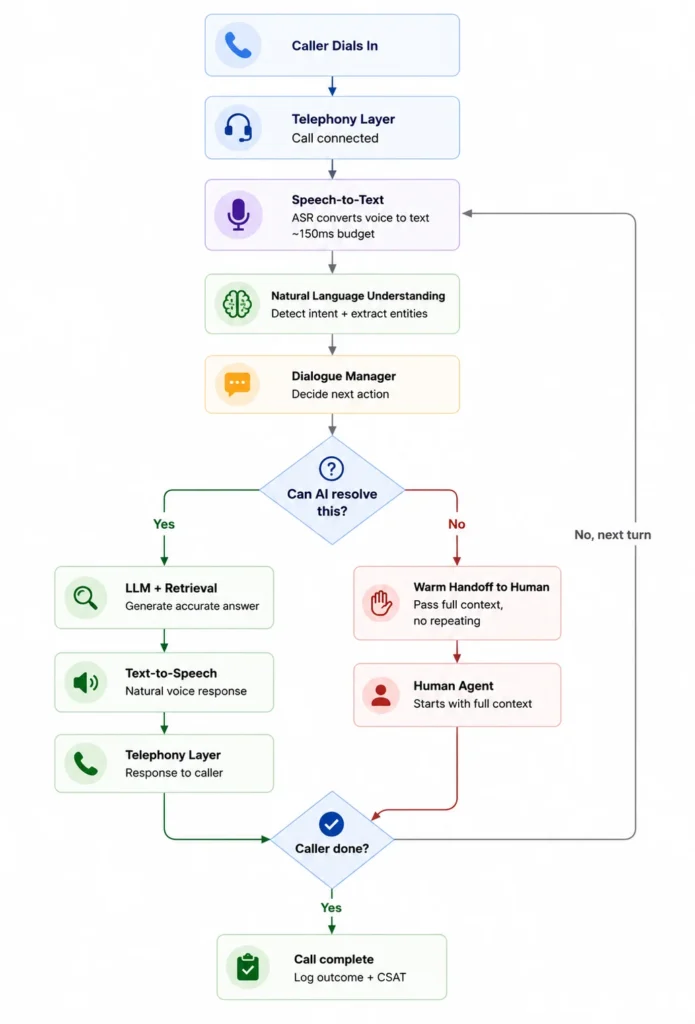
Figure 1: The conversational AI IVR pipeline. Every caller turn flows through speech-to-text, understanding, reasoning, and text-to-speech in real time. When the AI cannot resolve a request, a warm handoff passes full context to a human so the caller never repeats themselves.
The Metrics That Actually Matter
Measuring a conversational AI IVR system correctly is critical. Some metrics mislead if read alone.
| Metric | What It Measures | Why It Matters |
|---|---|---|
| Containment rate | Calls resolved without a human | Core efficiency metric, but never read alone |
| Completion rate | Caller goals actually achieved | The true success measure |
| Turn latency (p50 and p90) | Response speed per turn | Below 1.5 seconds keeps conversation natural |
| Intent recognition accuracy | How often intent is understood | Drives containment and correct routing |
| First-call resolution | Issues solved on the first call | Directly tied to customer satisfaction |
| Escalation quality | Whether handoff preserves context | Poor handoff is the top failure cause |
Common Deployment Mistakes to Avoid
Conversational AI IVR delivers strong results when built well. Most failures trace back to a handful of avoidable mistakes.
Mistake 1: Poor human handoff. This is the most common failure. If the caller must repeat everything to a human after talking to the AI, the project has failed the customer. The handoff must pass full context to the agent.
Mistake 2: Trying to automate everything at once. Start with one high-volume, high-friction call type that has a clear resolution path. Prove it works. Then expand.
Mistake 3: Ignoring latency. A smart system that responds slowly feels broken. Budget latency across every layer before choosing a model.
Mistake 4: Reading containment alone. A high containment rate can hide a terrible caller experience. Measure completion and satisfaction too.
Mistake 5: Evaluating on generic demos. Do not judge a platform on a polished demo. Test it against your actual call types and real caller phrasing.
Mistake 6: No parallel testing. Run the AI path alongside the existing IVR before full migration. Measure abandonment, containment, and escalation quality before you switch fully.
How to Deploy Conversational AI IVR
A structured rollout reduces risk and proves value early. Here is the path most successful deployments follow.
Step 1: Pick one call type. Choose a single IVR branch with high volume, high friction, and a clear resolution path. Order status or balance inquiry are common starting points.
Step 2: Map the real interaction. Document how callers actually phrase this request. Use real call recordings, not assumptions. This defines the intents the system must handle.
Step 3: Build and tune the pipeline. Configure speech-to-text, intent recognition, reasoning, and text-to-speech. Tune latency across every layer. Design the fallback and handoff flow carefully.
Step 4: Run in parallel. Run the AI path alongside the existing IVR. Route a portion of calls to it. Measure containment, completion, abandonment, and escalation quality against the old system.
Step 5: Expand gradually. Once the first call type performs well, add the next. Expand intent by intent. Each new call type builds on the proven foundation.
Step 6: Monitor and improve. Voice AI is not set and forget. Review failed calls. Refine intents. Update answers as products and policies change.
How Khired Networks Builds Conversational AI Voice Systems
A conversational AI IVR that works needs more than a model. It needs a tuned real-time pipeline, latency budgeted across every layer, accurate intent recognition on your actual call types, and a warm handoff that never makes callers repeat themselves.
Khired Networks builds conversational AI voice systems for businesses and enterprises. This includes AI voice agents, conversational IVR, and full customer service automation. Every system is engineered for low latency, high completion rates, and clean human handoff, with monitoring built in from day one.
Frequently Asked Questions
What is conversational AI IVR?
Conversational AI IVR is a phone system that understands natural speech instead of touch-tone menus. Callers say what they need in their own words. The AI understands the intent and resolves the request without forcing menu navigation.
How is conversational AI IVR different from traditional IVR?
Traditional IVR forces callers through fixed touch-tone menus. Conversational AI IVR understands natural language and adapts to the caller. It handles 60 to 80 percent of calls versus 14 to 40 percent for traditional menus, with far lower abandonment.
How much does conversational AI IVR cost per call?
Voice AI costs around 0.40 US dollars per call, compared to 7 to 12 US dollars for a human agent. That is a 90 to 95 percent reduction in unit cost per interaction, which scales significantly for high call volumes.
What is a good containment rate for AI IVR?
Well-configured deployments reach 60 to 80 percent containment on defined call types. However, containment should never be judged alone. Always read it with completion rate and customer satisfaction, since a system that blocks humans scores high but serves callers poorly.
Will conversational AI IVR replace human agents?
No. The best model is division of labor. AI handles routine, high-volume calls like order status and booking. Humans handle complex, emotional, or high-stakes interactions requiring judgment. Around 76 percent of CX leaders use this hybrid approach today.
How long does it take to deploy conversational AI IVR?
Deployment starts with one high-volume call type and expands from there. A focused first use case can go live in a few weeks. Full migration across all call types is gradual and proven branch by branch through parallel testing.


0 Comments