
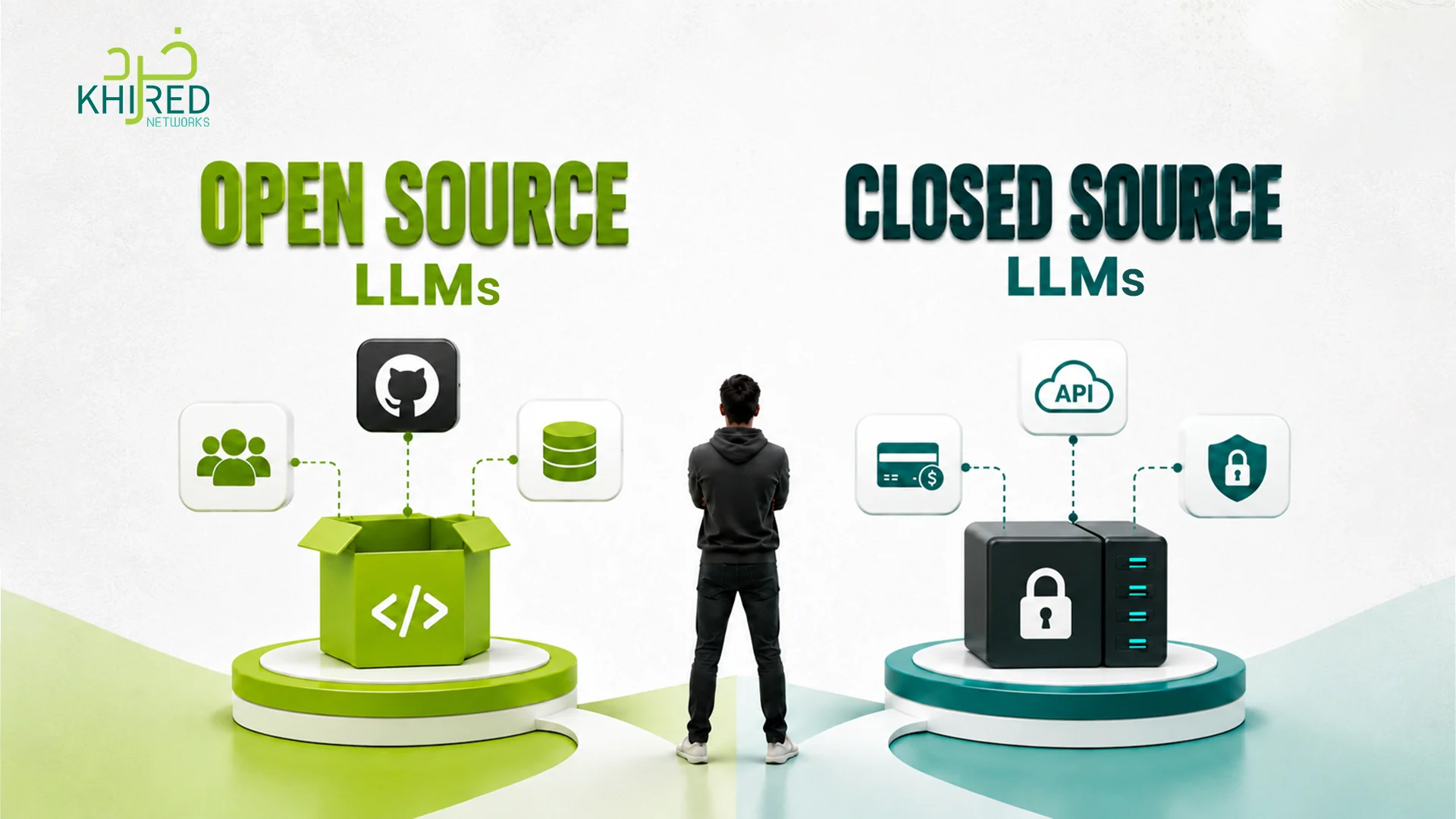
SUMMARY
- Open-source LLMs now represent 62.8% of the market by model count. Whereas closed-source models still dominate enterprise production workloads by usage share
- Open source has continued to trail frontier closed-source models in performance by nine to twelve months. This gap is real, but shrinking faster than most organisations realise
- Open-source LLMs have achieved “good enough” quality for approximately 80% of real-world use cases while costing 86% less than proprietary alternatives
- Self-hosting open-source models can reduce total cost of ownership by up to 60% compared to proprietary API fees over a three-year period
- 41% of companies will switch from closed to open source if the open-source model matches the closed model’s performance. A threshold increasingly within reach in 2025
- The right answer for most organisations in 2026 is not open or closed. It is a hybrid architecture that routes tasks to whichever model type fits the requirements
The debate between open-source vs closed-source LLMs has moved on. It is no longer a question of ideology. Open enthusiasts versus proprietary sceptics, and it has not been for some time. It is now a question of enterprise economics, data governance, deployment architecture, and the specific requirements of each workload.
According to Menlo, in 2024–2025, the market was dominated by closed-source usage at approximately 80–90% share. Entering 2026, that dominance is eroding as generative AI workloads scale beyond pilots into persistent, high-volume systems.
But closed-source models have not stood still. Frontier performance, the kind required for complex multi-step reasoning, ambiguous planning tasks, and mission-critical code generation, still sits predominantly with proprietary providers. Enterprise dollars are now consolidating around a few high-performing, closed-source models.
This guide cuts through both sets of claims. You will find what differentiates open-source LLMs from closed-source alternatives, where each genuinely excels, which specific models lead their respective categories, and how to build an architecture that uses both intelligently.
What Are Open-Source LLMs?
Open-source LLMs are large language models whose weights, the billions of numerical parameters that encode the model’s learned knowledge and behaviour, are made publicly available. This means anyone can download, run, fine-tune, modify, and in most cases deploy these models commercially, subject to the specific licence terms of each release.
The term “open source” is often used loosely in AI. A more precise distinction separates:
- Open weights — the trained model parameters are released, but training data and full training code may not be. Most popular models fall here, including Llama, Qwen, DeepSeek, Mistral, and Gemma.
- Fully open source — weights, training data, architecture, and training code are all published. Genuinely rare at frontier scale.
For practical purposes, what matters is whether you can download the weights and self-host the model without ongoing dependency on an external API. When practitioners talk about open-source LLMs in enterprise contexts, that is the definition being used.
Key open-source model families as of mid-2026: Meta’s Llama series, Alibaba’s Qwen series, DeepSeek’s V3/V4 and R1 series, Mistral’s model family, Google’s Gemma series, Zhipu AI’s GLM series, and Moonshot AI’s Kimi series.
What Are Closed Source LLMs?
Closed-source LLMs, also called proprietary or closed-weight models, are large language models where the weights, architecture details, and training specifics are not publicly released. Access is provided exclusively through APIs or managed services, controlled entirely by the provider.
You can use these models; you cannot inspect, modify, or self-host them. Every query you make goes to the provider’s infrastructure, which has implications for data privacy, latency, cost predictability, and long-term vendor dependency.
Closed-source models are typically developed by well-resourced organisations with the compute budget to train at frontier scale: OpenAI, Anthropic, Google DeepMind, and xAI currently lead this category. The business model is API usage fees, enterprise licensing, or subscription access, revenue structures that fund continued frontier research.
Key closed-source models as of mid-2026: OpenAI’s GPT-5 family, Anthropic’s Claude Opus and Sonnet series, Google’s Gemini 3 Pro, and xAI’s Grok 4.
Open-Source vs Closed-Source LLMs: Side-by-Side Comparison
| Dimension | Open-Source LLMs | Closed-Source LLMs |
| Access | Download weights, self-host | API access only |
| Cost at scale | Infrastructure cost only — no per-token fees | Per-token or per-call pricing |
| Data privacy | Full control — data never leaves your infrastructure | Data sent to provider’s servers |
| Customisation | Full fine-tuning, modification, and retraining | Limited fine-tuning via managed APIs |
| Performance at frontier | Strong; trailing top closed models by ~9–12 months | Leads on aggregate benchmarks and complex reasoning |
| Deployment flexibility | On-premises, private cloud, air-gapped | Cloud API only (with some private deployment options at enterprise tier) |
| Vendor dependency | None | High — provider controls pricing, availability, and deprecation |
| Transparency | Weights inspectable; training data often undisclosed | Minimal — architecture and training are proprietary |
| Support | Community-driven; enterprise support from specialist providers | Vendor-provided with SLAs |
| Regulatory alignment | Strong for GDPR, EU AI Act; data sovereignty fully achievable | Requires data processing agreements; residency controls vary by provider |
| Time to deploy | Longer — infrastructure setup required | Immediate — API key and call |
| Ongoing maintenance | Internal responsibility | Managed by provider |
Pros and Cons of Open-Source LLMs
Pros
Full data sovereignty
When you self-host an open-source model, no query, document, or user input leaves your infrastructure. For organisations handling legally privileged data, clinical records, financial data, or anything subject to GDPR or sector-specific regulation, this is not a preference, it is a compliance requirement. The European market prioritises on-premises deployment to comply with GDPR, leading to a 15% higher adoption of self-hosted solutions compared to other regions.
Dramatic cost advantage at scale
At an experimental scale, the cost difference between open and closed-source is marginal. At enterprise scale, it becomes existential. Self-hosting open-source models can reduce total cost of ownership by up to 60% compared to proprietary API fees over a three-year period. For high-volume applications (internal search, document processing, support automation) this difference is the line between a viable and non-viable business model.
Deep customisation through fine-tuning
Open weights can be fine-tuned on your specific domain data using techniques like LoRA and QLoRA, producing models that dramatically outperform general-purpose alternatives on your specific tasks. Fine-tuning a 7B–14B open-source model on domain-specific data frequently outperforms a frontier closed-source model on domain-specific benchmarks, at a fraction of the inference cost.
No vendor lock-in
Closed-source API providers change pricing, deprecate models, and impose usage restrictions on schedules that may not align with your product roadmap. Open-source models, once downloaded and deployed, do not change without your explicit decision to update them. That stability has real commercial value in production systems.
Regulatory transparency
The EU AI Act explicitly recognises open-source foundation models as an economic public good. For organisations in regulated industries or operating under AI governance frameworks, the inspectability of open weights, combined with on-premises deployment, provides an audit trail that closed-source API usage cannot match.
Cons
Performance gap at the frontier
Open-source has continued to trail frontier closed-source models in performance by nine to twelve months. For tasks requiring the highest level of general reasoning, creative problem-solving, or multi-step ambiguous planning, this gap remains real. It is closing, but it has not closed.
Infrastructure complexity
Running open-source LLMs in production requires GPU hardware or cloud GPU instances, serving infrastructure (vLLM, TensorRT-LLM, or similar), monitoring, and a team capable of managing model updates, performance degradation, and deployment pipelines. This overhead is non-trivial and is often underestimated in initial planning.
Licensing complexity
“Open source” does not mean licence-free for commercial use. Llama 4 restricts usage based on monthly active user counts. Some models prohibit using their outputs to train other models. Others have geographic restrictions. Every model requires licence review before commercial deployment.
Slower time to initial deployment
Getting a closed-source model working requires an API key. Getting an open-source model into production requires infrastructure setup, serving optimisation, load testing, and operational procedures. For organisations that need to move quickly, that setup cost is real.
Pros and Cons of Closed-Source LLMs
Pros
Frontier performance
On the most demanding benchmarks, graduate-level reasoning (GPQA Diamond), competitive coding, complex multi-step planning, closed-source models currently lead. GLM-5.2 currently leads among open weights models with an Intelligence Index score of 51, compared to top closed models scoring above 60. For genuinely hard tasks, the performance gap still matters.
Immediate deployment
No infrastructure, no serving stack, no GPU procurement. An API key and a few lines of code, and you have access to frontier-level model capability. For prototyping, early product development, and low-volume applications, this speed-to-capability advantage is significant.
Managed reliability and SLAs
Enterprise tiers from OpenAI, Anthropic, and Google come with uptime guarantees, dedicated throughput, priority access, and support SLAs. For production systems where downtime has direct business impact, the managed reliability of a closed-source API is a genuine advantage over self-managed infrastructure.
Continuous model improvement
Closed-source providers update and improve their models on a schedule that benefits all API users without requiring any action on their part. New capabilities, safety improvements, and performance gains arrive automatically through the same API endpoint.
Multimodal and extended capability
Leading closed-source models offer multimodal capabilities; vision, audio, code execution, web browsing, and tool use in polished, production-ready form. While open-source models are catching up, the breadth and reliability of closed-source multimodal capabilities currently exceed what is available in self-hostable form.
Cons
Cost at scale
Per-token pricing that is manageable at pilot scale becomes significant at enterprise volume. Comparable open-source LLMs operate at ~$0.60–$0.70 per million tokens, representing a ~10× cost differential for near-frontier performance. Organisations running millions of queries per day will find this arithmetic challenging to justify indefinitely.
Data privacy limitations
Every query sent to a closed-source API is processed on the provider’s infrastructure. Data processing agreements, regional data residency settings, and zero-retention policies are available at enterprise tier. But none of these provide the same guarantee as data that never leaves your own servers.
Vendor dependency
Model deprecation, pricing changes, API modifications, and usage policy updates are all unilateral provider decisions. Building a production system on a closed-source model that may be deprecated or repriced is a strategic risk that increases over time as dependency deepens.
Limited customisation
Managed fine-tuning is available from some providers, but it operates within the constraints the provider defines. You cannot modify the model architecture, retrain from scratch on proprietary data, or implement customisation approaches that require direct weight access.
Open-Source LLMs vs Closed for Coding
Coding is the workload where the open-source vs closed debate is most practically significant and where the gap has narrowed most dramatically.
Programming has become the most consistently expanding category across all LLM models, and the share of programming-related requests has grown steadily through 2026, paralleling the rise of LLM-assisted development environments.
For open-source LLMs vs closed-source for coding, the picture depends on the type of coding task:
Autocomplete and Routine Code Generation
Open-source models, particularly Qwen Coder variants and smaller DeepSeek models, are fully competitive with closed-source alternatives and can be self-hosted for air-gapped environments where code cannot be sent to external APIs.
Repository-level Agentic Coding
This is where the distinction matters most. A year ago, the conventional wisdom was simple: if you wanted a model capable of serious agentic coding work, multi-step planning, reliable tool use, long-context reasoning, you used Claude or GPT.
In 2026, open-weight LLMs for agentic coding are being deployed inside real engineering pipelines at real companies. The models leading this shift are DeepSeek V4, Kimi K2.6, Qwen 3.6 Plus, and GLM 5.1.
Mission-critical Production Code
Closed-source models retain a narrow but real advantage for the most complex cases. For highly open-ended, long-horizon planning tasks, closed-source models still tend to edge ahead but the difference is smaller than it was a year ago, and for many production workflows it does not matter.
Security-sensitive Codebases
For organisations that cannot send proprietary code to external APIs, financial services, defence, healthcare systems, regulated infrastructure, open-source models self-hosted on private infrastructure are not just preferable; they are the only viable option.
The practical recommendation: for the best coding quality, test Kimi K2.6 and GLM-5.1 first. For local coding without sending code to an API, start with Gemma 4 26B A4B or a smaller Qwen Coder variant.
When to Choose Open vs Closed Source
The decision framework is not about which category is “better.” It is about which fits your specific requirements across five dimensions:
Choose open-source LLMs when:
- Your data cannot leave your infrastructure (regulatory, legal, or competitive reasons)
- You are running high query volumes where API pricing is economically unsustainable
- You need deep customisation through fine-tuning on proprietary domain data
- Your workload falls within the 80% of use cases where open-source quality is sufficient
- You are operating in the EU under GDPR and need full data residency control
- You are building for air-gapped environments
Choose closed-source LLMs when:
- You need frontier performance on genuinely hard, open-ended reasoning tasks
- Speed to deployment matters more than long-term cost optimisation
- You need enterprise SLAs, managed uptime guarantees, and vendor support
- Your query volume is low enough that API pricing is manageable
- You require multimodal capabilities that open-source alternatives do not yet match reliably
- Your team lacks the infrastructure expertise to manage self-hosted GPU inference
Key questions to determine your decision:
| Question | Implication |
| Does your data leave your infrastructure? | If no → open source required |
| What is your monthly token volume? | >10M tokens/month → open-source economics become compelling |
| Do you need 95%+ task accuracy on complex reasoning? | Yes → closed-source currently leads |
| Do you need fine-tuning on proprietary data? | Yes → open source required |
| How quickly do you need to deploy? | Immediate → closed-source; weeks acceptable → open viable |
| What is your GPU infrastructure capacity? | None → closed-source; available → open-source viable |
The Hybrid Approach: Using Both
The same report expects businesses will use both open and closed-source models, aiming for a 50-50 split. This is where most mature AI architectures are heading. Not a binary choice, but a routing architecture that directs each task to the model best suited for it.
Open-source LLMs and closed-source LLMs represent different strategic levers, not competing endgames. Open models offer cost efficiency, sovereignty, and transparency. Closed models offer polish, centralised safety, and predictable support. Enterprises increasingly require both, coordinated through architecture rather than ideology.
A practical hybrid architecture looks like this:
Tier 1: Routine, high-volume tasks (classification, extraction, summarisation, simple Q&A): Run on a fine-tuned open-source model (7B–14B) self-hosted on your infrastructure. Cost per query is minimal. Data never leaves your systems.
Tier 2: Standard production tasks (RAG-powered responses, customer support, code review, document analysis): Run on a mid-tier open-source model (30B–70B) or a cost-efficient closed-source option like Claude Haiku or GPT-4o-mini, depending on data sensitivity requirements.
Tier 3: Complex, high-stakes tasks (frontier reasoning, ambiguous multi-step planning, expert-level analysis, complex code generation): Route to the best available closed-source frontier model; Claude Opus, GPT-5, or Gemini 3.1 Pro where the performance premium justifies the cost and data sensitivity allows.
This architecture can reduce overall LLM spend by 40–70% compared to routing everything to a frontier closed-source model, while maintaining frontier-level output quality for the tasks that actually need it.
Conclusion
The open-source vs closed-source LLMs debate has moved from philosophy to engineering. The question is no longer which approach is ideologically correct. It is which model, deployed which way, best fits each specific workload.
Proprietary models retain a narrow lead for elite tasks (that top 20%) but the window is closing rapidly. For the 80% of tasks where open-source quality is sufficient, the cost, privacy, and customisation advantages of self-hosted models are decisive.
If you are building an AI system, the architecture that will serve you best routes different task types to the model best suited for each. Using open source for cost efficiency and data sovereignty at scale, and closed-source for the frontier reasoning cases where the performance premium genuinely justifies it.
Building AI systems for your business?
Khired Networks designs and deploys production-grade AI architectures globally, selecting the right model for each use case, whether open or closed-source, and building the full stack around it.
Explore our AI/ML development services or book a free discovery call.
Frequently Asked Questions
What is the main difference between open source and closed-source LLMs?
Open-source LLMs provide downloadable weights for self-hosting. Closed-source models are accessible only via API. You cannot inspect, modify, or self-host them. The practical differences are cost, data privacy, customisation flexibility, and performance.
Are open-source LLMs as good as closed-source?
Open-source models are “good enough” for approximately 80% of real-world use cases, but closed-source maintains a lead on frontier tasks. The gap is narrowing consistently in coding, reasoning, and agentic workflows, but has not fully closed as of mid-2026.
Which open-source LLM is best for coding in 2026?
Qwen3-Coder-480B (69.6% on SWE-bench) and DeepSeek-V3.2 (roughly 70%) lead. For agentic coding, Qwen 3.6 Plus and Kimi K2.6 excel. For local deployment, Qwen 3.6 27B and Gemma 4 26B A4B are recommended.
Is it cheaper to use open-source LLMs?
At small scale, self-hosting costs can exceed API pricing. At enterprise scale (millions of queries monthly), self-hosting open source can reduce total cost of ownership by up to 60% over three years.
Can I use open-source LLMs commercially?
Yes, but licence terms vary. Qwen and Gemma use permissive Apache 2.0. DeepSeek uses MIT. Llama 4 imposes restrictions based on monthly active user counts. Always review the specific licence before deployment.
What is the best closed-source LLMs in 2026?
Claude Fable 5, Claude Opus 4.8, GPT-5.5, and Gemini 3.1 Pro lead on frontier benchmarks. For cost-efficient access, Claude Haiku, GPT-4o-mini, and Qwen3.7 Max are strongest options.
Which should I choose for enterprise AI deployment?
A hybrid architecture is the correct answer — fine-tuned open source for high-volume routine tasks, closed-source frontier models for complex reasoning tasks. Open source offers customisation, cost savings, and private deployment; closed-source leads on performance for demanding tasks.
Are open-source LLMs safe for sensitive data?
Self-hosted open-source models are the highest-privacy option — queries never leave your infrastructure. Closed-source APIs require data to be sent to provider servers. For regulated industries (GDPR, healthcare, legal), self-hosting is often the only compliant option.


0 Comments