
SUMMARY
- Over $9.7 billion has been poured into agentic AI startups since 2023, with the majority going to vertical, domain-specific solutions rather than horizontal platforms
- Agentic AI has shown the ability to reduce human task time by up to 86% in multi-step workflows, the performance gap that creates startup opportunity
- Only 2% of organisations had deployed agentic AI at scale by 2025, while 61% were still in exploration phases; the gap between interest and implementation is where startups live
- By 2028, agentic AI is projected to manage 68% of all customer service and support interactions with technology vendors
- The vertical AI agents segment is expected to register the highest CAGR of 62.7% during the forecast period 2025–2030; specialisation is the growth vector
- The most fundable AI agent startups in 2025 are not building models; they are building workflows, integrations, and agent architectures on top of existing foundation models
- Domain expertise is the moat, not the technology: the founders with the deepest understanding of a specific workflow will win
The best AI agent startup ideas right now are not the obvious ones. Everyone is building generic chatbots. The founders who will build the next generation of AI companies are the ones solving specific, painful, high-frequency problems inside industries that are still largely manual. Thus, replacing them with autonomous agents that think, decide, and act without waiting to be told.
The numbers back this up. According to MarketsandMarkets, the global AI agents market was estimated at USD 7.63 billion in 2025 and is projected to reach USD 182.97 billion by 2033, growing at a CAGR of 49.6%. That is not incremental growth. That is a market in the process of being built from scratch. AI agent startups raised $3.8 billion in 2024, nearly tripling investments from the previous year.
The window is open. But it will not stay open equally wide for long. Vertical AI agent companies, those that go deep into a single industry or workflow, are where the most durable startup value will be created.
This guide gives you ten of the best opportunities, with the strategic context to pursue them intelligently.
Why 2026 Is the Year to Launch an AI Agent Startup
Three things converged in 2025 and 2026 that were not simultaneously true before: foundation models became capable enough to complete complex multi-step tasks reliably, orchestration frameworks like LangChain, LangGraph, and CrewAI matured enough to build production-grade agent systems, and enterprise buyers started allocating real budget to AI automation rather than just running pilots.
According to Medium, between 2023 and 2026, usage of AutoGPT and agentic frameworks surged by 920% across developer repositories, signalling how fast the technical infrastructure has matured on the supply side. On the demand side, around 45% of Fortune 500 companies are actively piloting agentic systems in 2025. The gap between piloting and deploying at scale is exactly where a focused startup can step in and do the integration, customisation, and productization that enterprise teams struggle to do internally.
OpenAI’s revenue path from USD 12.7 billion in 2025 toward USD 125 billion by 2029 signals where enterprise AI spending is heading. The question for founders is: which workflow, in which industry, should you own?
Understanding the AI Agent Opportunity
Before covering specific AI agent startup ideas, it is worth understanding what distinguishes an AI agent from a simpler AI application. The distinction determines which startup models are defensible and which are not.
An AI agent is a system that perceives context, reasons about it, takes multi-step actions using tools or APIs, and pursues a goal autonomously. Unlike a standard chatbot that responds to a single input and waits, an agent plans, executes, monitors the result, adapts if something fails, and continues until the task is done.
This means the startup opportunity is not in building agents that answer questions. It is in building agents that complete jobs. The practical distinction looks like this:
| Standard AI Application | AI Agent Startup Opportunity |
| Answers a customer query | Resolves the customer issue end to end |
| Summarises a legal document | Reviews a contract, flags risks, and drafts suggested revisions |
| Generates a sales email | Identifies the prospect, researches them, personalises the email, sends it, and logs the result in the CRM |
| Extracts data from a PDF | Extracts, validates, classifies, and routes data into the correct downstream system |
The startup value is in the second column. The first column is what foundation model APIs already do out of the box. The second column requires domain knowledge, workflow design, system integration, and agent orchestration — all things that create moats.
Best AI Agent Startup Ideas by Vertical
The most profitable AI agent startups focus on vertical integration. Instead of building generic chatbots, successful founders create purpose-built agents that solve specific, expensive pain points for buyers who already pay humans to do the work.
Here is a breakdown of high-impact AI agent startup ideas categorized by industry vertical:
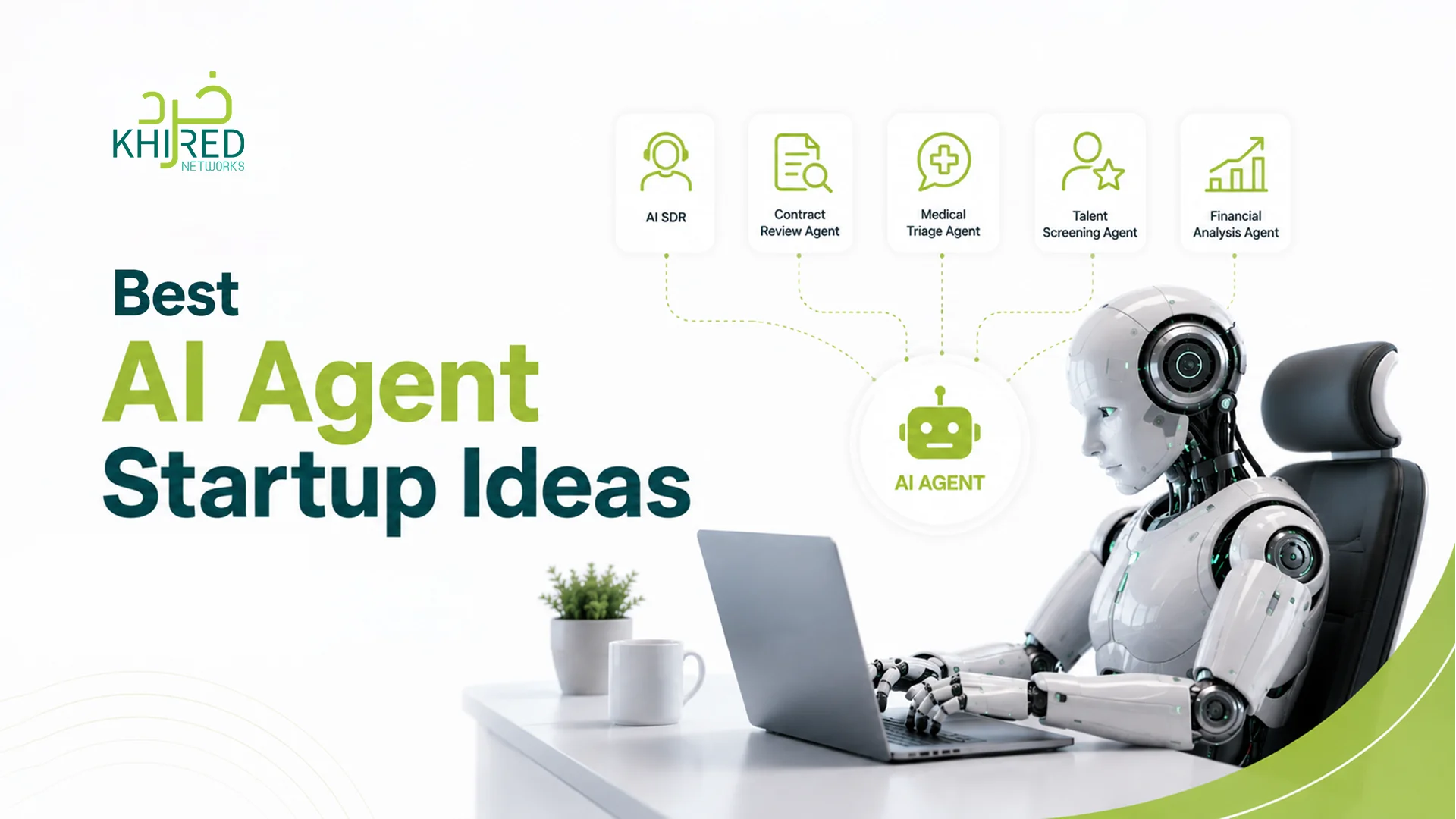
1. AI Sales Development Representative (SDR) Agent
The problem: Sales development is one of the most repetitive, time-intensive functions in B2B companies. SDRs spend most of their time on research, personalisation, sequencing, and CRM hygiene. Work that is highly structured, data-driven, and largely rule-following. It is a near-perfect candidate for autonomous agent replacement.
The startup opportunity: Build an AI SDR agent that identifies target accounts from defined ICP criteria, researches each prospect using real-time web data, crafts personalised outreach sequences, sends them across email and LinkedIn, handles initial replies, books qualified meetings directly into the sales team’s calendar, and logs everything to the CRM automatically. The agent handles the full top-of-funnel workflow. The human sales rep picks up at the discovery call.
Why it works at startup scale: According to Deloitte, 80% of marketers reported in 2025 that AI tools exceeded their return on investment expectations. Sales teams with measurable pipeline metrics can calculate ROI within weeks of deployment, making this a high-conviction purchase for buyers and a relatively short sales cycle for the startup.
Defensible moat: Outreach quality at scale. The differentiation is not in sending volume. It is in personalisation accuracy, reply handling quality, and meeting show rates. These improve with proprietary training data from each customer’s closed-won patterns.
Revenue model: Seat replacement subscription. Priced against the cost of a human SDR ($50,000–$80,000 per year in the UK and US), a well-positioned AI SDR agent can command £2,000–£5,000 per month per seat equivalent.
2. AI Legal Research & Contract Review Agent
The problem: Legal work at junior associate level is among the highest-volume, most repetitive, and most expensive professional work that exists. Contract review, due diligence research, regulatory lookup, and precedent search are all structurally suited to agentic automation.
The startup opportunity: Build an AI legal agent for mid-market law firms and in-house legal teams that performs contract review against a defined playbook (flagging non-standard clauses, missing provisions, and risk areas), drafts suggested redlines, retrieves relevant regulatory precedents from a connected knowledge base, and produces a structured risk summary for a senior lawyer to review. The lawyer approves, not the agent but the agent does 80% of the billable-hour work in minutes.
Why it works: Legal teams face enormous volume pressure with high liability for errors. A system that is auditable, cites its sources, and produces structured output (rather than a hallucinated narrative) addresses the core objection to AI in regulated professional services.
Defensible moat: Jurisdiction-specific fine-tuning and playbook customisation. The startup that trains on a firm’s own contract history and builds their specific review playbook into the agent becomes very difficult to replace.
Revenue model: Per-matter pricing or monthly subscription. Legal work is already billed per matter. AI pricing can mirror that model while delivering dramatically better economics for the buyer.
3. AI Medical Triage & Documentation Agent
The problem: Healthcare administrators and clinical staff spend an estimated 30–40% of their time on documentation, scheduling, and administrative coordination. Time taken directly away from patient care. AI agents are automating 89% of clinical documentation tasks in early deployments, significantly enhancing healthcare provider efficiency.
The startup opportunity: Build an AI agent for GP practices, outpatient clinics, or hospital departments that handles inbound patient contact. One that helps capturing symptoms through a structured voice or text conversation, routing to the right appointment type, flagging urgent cases for immediate escalation, and generating a structured pre-consultation summary for the clinician. Post-appointment, the agent generates clinical notes from a structured transcript, sends follow-up instructions, and manages repeat prescription requests within protocol.
Why it works: 90% of hospitals worldwide are expected to adopt AI agents by 2025 for predictive analytics and improved patient outcomes. Healthcare is one of the fastest-adopting verticals. The pain is acute enough that procurement cycles are shorter than in other regulated industries.
Defensible moat: Clinical safety architecture. Building the right escalation logic, liability framework, and compliance controls (GDPR, NHS data standards, IG Toolkit in the UK) is genuinely difficult. Startups that get clinical governance right early will be very hard to displace.
Revenue model: Per-practice or per-bed monthly subscription. NHS integrated care systems and private clinic groups are both viable buyers.
4. AI Recruiting & Talent Screening Agent
The problem: High-volume recruiting is a data-heavy, decision-intensive process that most talent teams run inefficiently. CV screening, initial outreach, scheduling, and candidate communication consume enormous recruiter time on work that is structurally automatable.
The startup opportunity: Build an AI recruiting agent that ingests job requirements and ideal candidate profiles, screens CVs at scale against defined criteria (without demographic bias), sends personalised outreach to shortlisted candidates, conducts asynchronous first-stage screening conversations, scores and ranks candidates by fit, schedules interviews into the hiring manager’s calendar, and maintains candidate communication throughout the pipeline.
Why it works: Recruiting is a volume game with a measurable output — qualified candidates per week. An agent that consistently improves that metric at lower cost than a human recruiter will sell itself. The UK recruitment technology market is particularly receptive to AI tools following post-pandemic hiring volume surges.
Defensible moat: Bias reduction architecture and audit trails. UK and EU employment law increasingly requires explainability in hiring decisions. A recruiting agent built with explainability and fairness controls from the start addresses both the commercial need and the regulatory risk.
5. AI Financial Analysis & Reporting Agent
The problem: Financial analysts at banks, asset managers, and corporate finance teams spend disproportionate time on data gathering, model population, and report generation. All this is structurally automatable and take relatively little time on the interpretation and decision-making that requires their expertise.
The startup opportunity: Build an AI financial agent that retrieves data from specified sources (Bloomberg terminals, Companies House filings, internal ERP systems, market data APIs), populates defined financial models, identifies material variances against benchmarks, and generates a structured written analysis with the key findings a senior analyst needs to review. The agent handles data gathering and first-pass commentary. The analyst handles interpretation and client communication.
Why it works: Financial institutions report a 38% increase in profitability by 2035 attributed to the integration of AI agents. Finance is a data-dense, time-pressured environment where speed to insight is a direct competitive advantage.
Revenue model: Enterprise SaaS with a per-seat or per-model-run pricing structure. Investment banks and asset managers are high-willingness-to-pay buyers when ROI is demonstrable.
6. AI Customer Support Automation Agent
The problem: Customer support is the single largest volume of repetitive, structured, human-handled communication in most businesses. Tier 1 and Tier 2 support queries follow predictable patterns, require access to the same data systems, and apply the same resolution logic repeatedly.
The startup opportunity: Build a vertical-specific AI customer support agent, not a generic platform, but one built specifically for a single industry (e-commerce, SaaS, fintech, property management). The agent handles the full resolution workflow: retrieves customer account data, applies product-specific resolution logic, takes actions in the backend (processes refunds, updates records, sends instructions), escalates genuinely complex cases with full context, and closes the ticket. By 2028, agentic AI is projected to manage 68% of all customer service and support interactions with technology vendors.
Defensible moat: Vertical depth. A generic support bot that works for any industry competes with every platform vendor in the market. A support agent purpose-built for property management companies — with specific knowledge of tenancy law, lease processes, and maintenance workflows — is something property companies will pay a significant premium for.
Revenue model: Per-resolution pricing or ticket-volume subscription. Priced against the all-in cost of a human support agent (£25,000–£35,000 per year in the UK), a well-scoped support agent can deliver a 60–70% cost reduction for buyers.
7. AI Supply Chain & Procurement Agent
The problem: Supply chain management involves enormous volumes of structured decisions: supplier selection, purchase order generation, delivery tracking, exception management, and vendor communication. Most of these follow defined rules and require data access rather than genuine human judgement.
The startup opportunity: Build an AI procurement agent that monitors inventory levels against defined thresholds, identifies reorder requirements, queries approved supplier catalogues, generates and submits purchase orders to the appropriate approvers, tracks delivery status, flags exceptions, and updates ERP records throughout. For more sophisticated deployments, the agent monitors supplier performance metrics and surfaces re-sourcing recommendations before supply disruptions occur.
Why it works: Agentic AI systems can complete up to 12 times more complex tasks compared to traditional LLMs, thanks to dynamic feedback loops and autonomous decision-making. Supply chain management involves exactly the type of multi-step, data-intensive decision sequences where that capability advantage is most pronounced.
Revenue model: Per-ERP-integration subscription. SAP, Oracle, and Microsoft Dynamics integrations are the primary connector layer. The switching cost once integrated is very high.
8. AI Real Estate Research & Lead Agent
The problem: Real estate professionals; agents, surveyors, developers, and investors, spend significant time on market research, property data compilation, comparables analysis, and lead qualification. These are all data-heavy, structured tasks with clear decision outputs.
The startup opportunity: Build an AI real estate agent for property professionals that monitors defined market segments for new listings matching specified criteria, retrieves and summarises comparable sales data, generates investment analysis summaries for shortlisted properties, manages inbound buyer and tenant enquiries, qualifies lead intent through a structured conversation, and books viewings directly into the agent’s diary. For commercial property, the agent monitors planning permission filings and flags development opportunities in target areas.
Why it works: Real estate is a high-value transaction business where the cost of a missed lead or a slow research process is directly measurable in lost commission or deal value. ROI conversations are straightforward.
Defensible moat: Market data integration and local knowledge training. A UK commercial property AI agent trained on Rightmove, CoStar, Zoopla, and Land Registry data, with fine-tuned understanding of regional market dynamics, is genuinely differentiated from a generic research assistant.
9. AI Compliance & Risk Monitoring Agent
The problem: Compliance functions in regulated industries; financial services, healthcare, legal, and manufacturing, involve continuous monitoring of policy adherence, regulatory change, and risk exposure across large volumes of data and transactions. Manual monitoring is inherently incomplete. Automated rules-based monitoring misses the contextual judgement that real compliance requires.
The startup opportunity: Build a compliance monitoring agent that continuously scans transactions, communications, or operational data against a defined policy and regulatory framework, identifies potential violations, classifies them by severity, drafts a structured alert for the compliance officer, retrieves the relevant regulatory text to support the finding, and logs the finding with full audit trail. Regulatory change monitoring is a parallel function. The agent monitors official publications for changes affecting the client’s sector and surfaces relevant updates with impact summaries.
Why it works: Regulatory fines for compliance failures in financial services (FCA), healthcare (ICO), and data protection (GDPR) are large enough that a compliance monitoring tool priced at a fraction of the fine prevention value is an easy purchase decision.
Revenue model: Annual SaaS contract with per-user or per-data-volume tiers. Compliance tooling is one of the stickiest SaaS categories. Once integrated into audit workflows, churn is extremely low.
10. AI Internal Knowledge & Operations Agent
The problem: Knowledge management is one of the most universally poor functions in mid-to-large organisations. Institutional knowledge lives in documents, Slack threads, email chains, and the heads of employees who may or may not still work there. Finding the right information takes time that compounds across thousands of employees every day.
The startup opportunity: Build an AI internal knowledge agent for specific business functions. An HR knowledge agent for people queries, an engineering knowledge agent for technical documentation, or a sales enablement agent for product and pricing information. The agent connects to the organisation’s existing document sources (Confluence, SharePoint, Google Drive, Notion). Also, it ingests and indexes them, and provides accurate, sourced answers to employee queries in natural language, with every response traceable to the underlying document.
Why it works: The productivity case is immediate and measurable. If 500 employees each save 20 minutes per day on information retrieval, the annual productivity gain is calculable in the first meeting. Unlike most enterprise software, the value is visible within days of deployment.
Defensible moat: This is where AI Chatbot Development meets knowledge architecture. The defensible position is not in the retrieval technology. It is in the data connectors, the fine-tuning on organisational taxonomy, and the quality of the answer evaluation framework. Organisations with complex knowledge graphs or highly regulated documentation are particularly high-value customers.
Quick Reference Table
| Vertical | Agent Type | Key Differentiator | Primary Buyer |
| Sales | AI SDR | Personalisation quality | B2B sales teams |
| Legal | Contract Review | Jurisdiction-specific fine-tuning | Mid-market law firms |
| Healthcare | Medical Triage | Clinical safety architecture | GP practices, clinics |
| Recruiting | Talent Screening | Bias audit trails | Talent teams |
| Finance | Financial Analysis | Data integration depth | Banks, asset managers |
| Support | Customer Support | Vertical depth | E-commerce, SaaS, fintech |
| Supply Chain | Procurement | ERP switching costs | Manufacturing, retail |
| Real Estate | Research & Lead | Local market data | Agencies, developers |
| Compliance | Risk Monitoring | Regulatory fine prevention | Financial services, healthcare |
| Knowledge | Internal Ops | Knowledge architecture | Mid-to-large enterprises |
Cross-Vertical AI Automation Ideas Worth Exploring
Beyond the ten verticals above, several agentic AI startup ideas cut across industries and represent large horizontal opportunities:
Meeting intelligence agents
Attend, transcribe, summarise, extract actions, and update relevant systems after every meeting. The differentiation is in the CRM, project management, and ticketing system integrations.
Invoice and accounts payable agents
Receive invoices, extract key data, match to purchase orders, route for approval, schedule payment, and update accounting systems. High volume, high frequency, low tolerance for error. A strong AI automation idea for finance automation startups.
Candidate outreach and employer branding agents
Manage the candidate experience at scale: personalised communication, employer brand content, and candidate nurture between application and start date.
Regulatory filing agents
Compile, format, and submit regulatory filings for SMEs in sectors with high compliance burden (financial services, healthcare, food safety, construction). Startups that own the filing workflow own the relationship.
Contract lifecycle management agents
Automate the entire contract process from creation to renewal. They generate initial drafts from templates, negotiate standard clauses, flag deviations, route for internal approvals, track obligations, and send renewal reminders before expiry. Legal, procurement, and sales teams all benefit, making this a horizontal opportunity across any organisation that handles agreements at scale.
What Makes an AI Agent Startup Actually Work
Not all agentic AI startup ideas are equal in commercial viability. The ones that succeed tend to share five characteristics:
1. A well-defined, high-frequency task
The more often the workflow runs, the faster ROI accumulates. Daily or weekly tasks outperform monthly or annual ones.
2. Measurable output
If the buyer cannot quantify what the agent saved or produced, they cannot justify the spend internally. Leads booked, documents reviewed, tickets resolved, time saved, all measurable. “Better insights”, not measurable enough.
3. Existing data to work with
Agents that improve over time because they have access to historical data (past emails, tickets, contracts, calls) outperform agents that start from scratch. Access to the buyer’s existing data is both a competitive requirement and a moat.
4. A clear human in the loop
The most commercially successful AI agent startups in 2025 are not replacing human judgement entirely. They are replacing the 80% of a job that is mechanical and presenting the output to a human who handles the remaining 20%. This is easier to sell, easier to approve, and safer to operate.
5. Integration depth
Agents that connect to the systems buyers already use (Salesforce, HubSpot, SAP, Jira, Slack) are dramatically easier to sell than those requiring data migration or parallel systems.
How to Start Building AI Agents for Your Startup
Building AI agents for a startup context is a different problem from building a proof of concept. The gap between a compelling demo and a production-grade system is where most early AI startups stall. Here is the architecture that works:
Step 1 — Define the workflow precisely
Map every step the human currently takes, every system they touch, and every decision point. The agent architecture follows the workflow, not the other way around.
Step 2 — Select your LLM and orchestration framework
For most vertical startup use cases, GPT-4o or Anthropic Claude 3.5 Sonnet provides the reasoning capability needed. LangGraph and CrewAI are the most production-mature orchestration frameworks for multi-step agents in 2025.
Step 3 — Build the tool layer first
The tool and API integration layer, the connections between the agent and the real business systems it needs to act on, is the most important and most underestimated part of the build. Get this right before building the agent reasoning layer.
Step 4 — Implement observability from day one
Every agent action and decision should be logged, queryable, and auditable. LangSmith is the current standard for LLM observability. Without this, debugging production failures is extremely difficult and customer trust evaporates quickly.
Step 5 — Define human approval checkpoints
For high-impact agent actions (sending emails, updating customer records, processing financial transactions), build explicit human approval steps. These are not weaknesses. They are trust-building mechanisms that accelerate sales cycles with enterprise buyers.
Step 6 — Evaluate before you deploy
Build domain-specific evaluation sets; real examples of the task, run by the agent, scored against expected outputs. This is the difference between a system you can confidently sell and one that surprises you in production.
Common Mistakes AI Agent Startups Make
Targeting too broad a problem
“AI for sales” is not a startup, it is a category. “AI SDR agent for UK-based B2B SaaS companies with a 50–500 employee target market” is a startup. Specificity is the foundation of a defensible position.
Underestimating integration complexity
The agent logic is the easy part. Integrating reliably with five different CRM systems, handling auth flows, managing API rate limits, and ensuring data consistency across systems. This takes longer than expected and is where most early builds break in production.
Building on top of a single LLM provider without fallback
Any production agent system must have fallback logic for model failures, API outages, and degraded performance. Single-provider dependency is a runtime risk that enterprise buyers will specifically ask about.
Optimising for demo quality instead of production reliability
The most common failure mode in early AI agent startups. A system that impressively completes a task 90% of the time in a demo will lose enterprise clients who encounter the 10% failure in production. Reliability engineering comes before feature expansion.
Skipping the data layer
Building AI agents for business problems without access to the buyer’s real historical data produces agents that are generically capable but not specifically accurate. The data layer- ingestion, cleaning, indexing, and ongoing updates- is as important as the agent architecture itself.
Conclusion
The AI agent startup ideas with the highest commercial potential in 2026 are not the broadest ones; they are the most specific. The founders who go deepest into a single workflow, a single industry, and a single pain point will build the most defensible companies. The market is large enough that you do not need to own everything to build a significant business. You need to own one workflow, solve it completely, and deliver results that are measurable from week one.
The vertical AI agents segment is projected to grow at a CAGR of 62.7% through 2030, the fastest growth rate in the entire AI agents market. That growth goes to the startups that commit to a vertical, go deep on domain expertise, and build agent systems that work reliably in production rather than impressively in demos.
If you are evaluating AI agent startup ideas, start with the workflow you know best. The technical infrastructure to build on has never been more accessible. The buyer appetite has never been higher. The funding environment has never been more favourable. The only thing left is the decision to build.
Ready to build your AI agent product?
Khired Networks specialises in building production-grade AI agent systems for startups and enterprises across the UK and Pakistan.
Explore our AI agent development services or book a free discovery call to discuss your idea.
Frequently Asked Questions
What is the most profitable AI agent startup idea right now?
The highest-margin AI agent opportunities in 2025 are in verticals where the workflow is high-frequency, well-defined, and currently staffed by expensive humans. Legal, financial services, and healthcare lead on deal size. Sales and customer support lead on volume.
How much does it cost to build an AI agent startup MVP?
A focused, production-ready single-workflow AI agent MVP — with one CRM integration, observability, and a defined human approval loop — typically costs £25,000–£60,000 to build properly. Cutting this budget typically means cutting integration quality, which causes production failures that are more expensive to fix later.
Do I need to train my own AI model to build an AI agent startup?
No. The most successful AI agent startups in 2025 are building on top of foundation models from OpenAI, Anthropic, and Google — not training their own. The competitive moat comes from workflow design, integration depth, domain-specific fine-tuning, and evaluation quality, not from the underlying model.
What is the difference between building AI agents and building a standard SaaS product?
A standard SaaS product provides tools and interfaces for humans to work with. An AI agent produces work outputs directly — completing tasks rather than supporting them. This means evaluation, observability, and fallback handling are far more critical in agent systems than in conventional software.
Which industries are most ready for AI agent adoption in 2025?
Financial services, healthcare, legal, recruiting, and customer support are the earliest and most active adopters. Manufacturing is accelerating fastest from a lower base. Professional services firms are particularly high-value targets because their labour costs are high and their workflows are structured.
How long does it take to go from idea to paying customers for an AI agent startup?
With the right workflow focus and an existing distribution channel or warm industry network, six to twelve months is a realistic path to three to five paying enterprise customers for a focused vertical AI agent startup. The sales cycle for enterprise AI tools is typically eight to sixteen weeks from first meeting to contract.
What funding is available for AI agent startups?
AI agent startups raised $3.8 billion in 2024, nearly tripling investments from the previous year. Seed rounds for focused vertical AI agent companies with a working MVP and early customer traction are regularly closing at £500,000–£2 million in the UK. Series A rounds for those with demonstrable revenue retention are in the £5–15 million range.


0 Comments